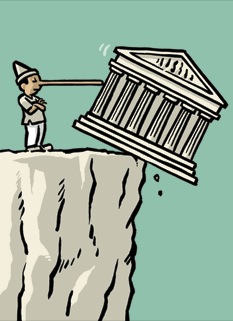
του Ιάσονα Μανωλόπουλου
Καθημερινή
26 Αυγούστου 2012
Χώρες με βαθιά προβλήματα, όπως η Ελλάδα, που διακρίνονται για τους λαϊκιστές πολιτικούς τους ποτέ δεν ξεμένουν από «πολέμους»... Η πολιτικολογία επικεντρώνεται κυρίως στις συγκρούσεις ανάμεσα στην Ελλάδα και την τρόικα, τον ιδιωτικό και τον δημόσιο τομέα, την Αθήνα και την επαρχία, τους ντόπιους και τους μετανάστες.
Υπάρχει μια τεράστια σύγκρουση που υποβόσκει χωρίς να πολυσυζητιέται: η σύγκρουση ανάμεσα στις γενεές. Ωφελημένοι από την πιστωτική έκρηξη, την άνοδο στις τιμές των ακινήτων και τα κλειστά επαγγέλματα, ήταν οι μεγαλύτεροι σε ηλικία. Τις δυσμενείς επιπτώσεις του χρέους, της εκτύπωσης χρήματος και των μέτρων λιτότητας τις βιώνουν δυσανάλογα οι νέοι.
Αυτό το μοτίβο το βλέπουμε σε ολόκληρη τη Δύση. Οπως παρατήρησε το 1790 ο θεωρητικός της πολιτικής επιστήμης, Εντμουντ Μπερκ: «Η κοινωνία είναι όντως ένα συμβόλαιο. Το κράτος είναι ένας συνεταιρισμός, όχι μόνο ανάμεσα στους ζωντανούς, αλλά ανάμεσα στους ζωντανούς, τους νεκρούς και σε όσους πρόκειται να γεννηθούν».
Στον δυτικό κόσμο αρχίζουν συζητήσεις για το αν έχει αθετηθεί το κοινωνικό συμβόλαιο μεταξύ των γενεών. Μήπως η γενιά του «baby boom» (της μεταπολεμικής έκρηξης των γεννήσεων) -η «γενιά του ’60», όπως ονομάζεται στην Ελλάδα- έχει φερθεί με εξαιρετικά εγωιστικό τρόπο; Υποστηρίζεται ότι, αφού ωφελήθηκε από τη δωρεάν παιδεία, τις καλές υπηρεσίες υγείας και τις διαρκώς αυξανόμενες συντάξεις, τώρα, που αποτελεί την ομάδα ψηφοφόρων που επηρεάζει περισσότερο από κάθε άλλη την κυβέρνηση, στερεί τα οφέλη αυτά από τη νεότερη γενιά. Η τάση αυτή μπορεί να παγιωθεί, αφού στις περισσότερες χώρες είναι πιθανότερο να ψηφίζουν οι μεγαλύτεροι. Μήπως οδεύουμε, λοιπόν, προς μια γεροντοκρατία - μια κοινωνία όπου κυβερνούν οι ηλικιωμένοι και για τους ηλικιωμένους; Υπάρχουν ενδείξεις ότι μια ολόκληρη γενιά έδρασε σαν τεράστια συνδικαλιστική οργάνωση, εξασφαλίζοντας για λογαριασμό της δυσανάλογα γενναιόδωρα οφέλη σε βάρος άλλων. Ωστόσο, σχεδόν σε κάθε συζήτηση περί ανισότητας ανάμεσα στις γενεές ελλοχεύει ο κίνδυνος της υπεραπλούστευσης, δεδομένου ότι στο εσωτερικό κάθε γενεάς παρατηρούνται τεράστιες παραλλαγές.
Περισσότερα
Sunday, August 26, 2012
Για την αυτογνωσία μας
του Θάνου Βερέμη
Καθημερινή
26 Αυγούστου 2012
Oυδέν κακόν αμιγές καλού. H δημοσιονομική και κοινωνική κρίση που ζούμε προκάλεσε την πιο γόνιμη συζήτηση για το ελληνικό οικονομικό και κοινωνικό φαινόμενο από την εποχή της πρώτης μεταπολεμικής διετίας. H δυσπραγία μας, απαλλαγμένη από τη διάσπαση που προκαλούσαν στην προσοχή των ειδικών οι συγκυρίες της ανασυγκρότησης, του ανένδοτου αγώνα, της δικτατορίας και της μεταπολιτευτικής ευζωίας, μας ανάγκασε επιτέλους να εγκύψουμε στις δομικές μας αδυναμίες. O συλλογικός τόμος Aπρονοησία και νέμεση. Eλληνική κρίση 2001-2011 (The Athens Review of Books, 2012) με επιμέλεια Mανώλη Bασιλάκη, αποτελεί κιβωτό αυτογνωσίας. Oι μελέτες που περιέχονται στον τόμο αυτό έχουν ξεπεράσει δεξιές και αριστερές αγκυλώσεις για να πουν τα πράγματα με το όνομά τους. Mερικοί από τους συνεργάτες βρέθηκαν σε δημόσιες θέσεις, ένας μάλιστα από αυτούς είναι ο σημερινός υπουργός Oικονομικών, όμως οι περισσότεροι διέφυγαν την προσοχή των πολιτικών μας ηγετών. Oλοι τους προσφέρουν τον λίθο τους για να οικοδομηθεί συστηματικά η ερμηνεία τού τι πήγε στραβά σε τούτο τον τόπο.
Πολλοί επισημαίνουν την εξάρτηση μεγάλου τμήματος της κοινωνίας από το κράτος, ώστε να σοβεί μια επικίνδυνη αντιπαράθεση των ομάδων που επωφελούνται από το status quo με εκείνους που καταβάλλουν ακέραιο το κόστος αυτής της ανωμαλίας.
Kαι ενώ σαν τους Mοιραίους του Bάρναλη περιμένουμε τον παράκλητο ηγέτη που θα μας σώσει από το σημερινό αδιέξοδο, πλησιάζουμε επικίνδυνα το ενδεχόμενο «μιας βίαιης εξαθλίωσης» (Mιχ. Mητσόπουλος, σ. 297).
Περισσότερα
Καθημερινή
26 Αυγούστου 2012
Oυδέν κακόν αμιγές καλού. H δημοσιονομική και κοινωνική κρίση που ζούμε προκάλεσε την πιο γόνιμη συζήτηση για το ελληνικό οικονομικό και κοινωνικό φαινόμενο από την εποχή της πρώτης μεταπολεμικής διετίας. H δυσπραγία μας, απαλλαγμένη από τη διάσπαση που προκαλούσαν στην προσοχή των ειδικών οι συγκυρίες της ανασυγκρότησης, του ανένδοτου αγώνα, της δικτατορίας και της μεταπολιτευτικής ευζωίας, μας ανάγκασε επιτέλους να εγκύψουμε στις δομικές μας αδυναμίες. O συλλογικός τόμος Aπρονοησία και νέμεση. Eλληνική κρίση 2001-2011 (The Athens Review of Books, 2012) με επιμέλεια Mανώλη Bασιλάκη, αποτελεί κιβωτό αυτογνωσίας. Oι μελέτες που περιέχονται στον τόμο αυτό έχουν ξεπεράσει δεξιές και αριστερές αγκυλώσεις για να πουν τα πράγματα με το όνομά τους. Mερικοί από τους συνεργάτες βρέθηκαν σε δημόσιες θέσεις, ένας μάλιστα από αυτούς είναι ο σημερινός υπουργός Oικονομικών, όμως οι περισσότεροι διέφυγαν την προσοχή των πολιτικών μας ηγετών. Oλοι τους προσφέρουν τον λίθο τους για να οικοδομηθεί συστηματικά η ερμηνεία τού τι πήγε στραβά σε τούτο τον τόπο.
Πολλοί επισημαίνουν την εξάρτηση μεγάλου τμήματος της κοινωνίας από το κράτος, ώστε να σοβεί μια επικίνδυνη αντιπαράθεση των ομάδων που επωφελούνται από το status quo με εκείνους που καταβάλλουν ακέραιο το κόστος αυτής της ανωμαλίας.
Kαι ενώ σαν τους Mοιραίους του Bάρναλη περιμένουμε τον παράκλητο ηγέτη που θα μας σώσει από το σημερινό αδιέξοδο, πλησιάζουμε επικίνδυνα το ενδεχόμενο «μιας βίαιης εξαθλίωσης» (Mιχ. Mητσόπουλος, σ. 297).
Περισσότερα
Saturday, August 25, 2012
Spetses, the tycoons' playground where gulf between rich and poor grows wider
by Vanessa Thorpe
Guardian
August 25, 2012
On a jetty alongside the town beach a loud phone call disturbs the peace of a handful of Spetses residents lying in the sun before taking their daily swim – one free pleasure that is still available to all. A rich weekender from Athens booms ostentatiously into his mobile, directing a man behind the wheel of a sizeable speedboat. "Just ignore the line of buoys," he says, "and steer straight over to me so we can talk." The instruction provokes a furious reaction from locals, who yell out angrily that boats are never allowed to come so close to the swimmers. A nasty row flares up – a sign of growing social tensions on an island where poor locals live cheek-by-jowl with the holidaymaking rich.
Antonis Samaras, the Greek prime minister, spent last week pleading with European leaders for more time to implement the severe austerity programme that is, ultimately, the condition for Greece remaining in the euro. Back home, and on islands such as Spetses, those well-off Greeks who remain financially cushioned from the effects of the deepening crisis, and from the fresh austerity measures due to be imposed next month, are the targets of growing fury.
The Saronic isle, with its pretty horse buggies and flowery villas, has been chosen as the location for a new Greek tourism advert, designed to reassure international visitors that the beaches and the bobbing fishing boats are still waiting for them, despite the economic meltdown. Yet the place is also a microcosm of the country's troubles: 30 square miles that encompass unimaginably big gaps in income.
While Athenians can enjoy browsing in the expensive deli that has replaced the souvlaki outlet in the square, the majority of Spetsiots can no longer afford to eat in local restaurants. The price of food in supermarkets and shops has soared.
More
Guardian
August 25, 2012
On a jetty alongside the town beach a loud phone call disturbs the peace of a handful of Spetses residents lying in the sun before taking their daily swim – one free pleasure that is still available to all. A rich weekender from Athens booms ostentatiously into his mobile, directing a man behind the wheel of a sizeable speedboat. "Just ignore the line of buoys," he says, "and steer straight over to me so we can talk." The instruction provokes a furious reaction from locals, who yell out angrily that boats are never allowed to come so close to the swimmers. A nasty row flares up – a sign of growing social tensions on an island where poor locals live cheek-by-jowl with the holidaymaking rich.
Antonis Samaras, the Greek prime minister, spent last week pleading with European leaders for more time to implement the severe austerity programme that is, ultimately, the condition for Greece remaining in the euro. Back home, and on islands such as Spetses, those well-off Greeks who remain financially cushioned from the effects of the deepening crisis, and from the fresh austerity measures due to be imposed next month, are the targets of growing fury.
The Saronic isle, with its pretty horse buggies and flowery villas, has been chosen as the location for a new Greek tourism advert, designed to reassure international visitors that the beaches and the bobbing fishing boats are still waiting for them, despite the economic meltdown. Yet the place is also a microcosm of the country's troubles: 30 square miles that encompass unimaginably big gaps in income.
While Athenians can enjoy browsing in the expensive deli that has replaced the souvlaki outlet in the square, the majority of Spetsiots can no longer afford to eat in local restaurants. The price of food in supermarkets and shops has soared.
More
Δεν χρειαζόμαστε επιπλέον χρήματα;
του Τάσου Τέλλογλου
Protagon.gr
25 Αυγούστου 2012
Ως τον Νοέμβριο του 2012 το Βερολίνο ξέρει ότι δεν μπορεί – θέλει δεν θέλει (και δεν το θέλει) να προκαλέσει την εξοδο της Ελλάδας από το Ευρώ. Στις χθεσινές ελληνογερμανικές συζητήσεις ο υπουργός Οικονομικών Βόλφγκανγκ Σόιμπλε ρώτησε την ελληνική αντιπροσωπεία αν η Ελλάδα θα είναι σε θέση να τηρήσει την υποχρέωσή της για χρέος στο 120% του ΑΕΠ το 2020. Θυμίζουμε ότι ο στόχος αυτός είναι απόλυτα συνδεδεμένος με το αν το ΔΝΤ θα συνεχίσει να χρηματοδοτεί το ελληνικό πρόγραμμα. Αν το ΔΝΤ δεν είναι βεβαιο για την τήρηση αυτού του στόχου τότε είτε θα ζητήσει από την ΕΚΤ και τις άλλες κεντρικές τράπεζες να «κουρέψουν» τα δικά τους ελληνικά ομόλογα (υψους 60 δις) είτε θα ζητήσει από την κ Μέρκελ και τους αλλους επιπλέον χρήματα.
Η κυρία Μέρκελ δεν πρόκειται να ζητήσει από τη Βουλή της μία νέα ψηφοφορία για επιπλέον χρήματα προς την Ελλάδα. Αν όμως για παράδειγμα το ποσό για την ανακεφαλαιοποίηση των Τραπεζών «εξομοιωθεί» με την αντίστοιχη βοήθεια στην Ισπανία, τότε το αποτέλεσμα θα είναι ίδιο σε ογκο και ίσως μεγαλύτερο από το κούρεμα των ελληνικών ομολόγων στο σύστημα της ΕΚΤ. Σε αυτή την περίπτωση θα χρειασθεί βεβαίως ψηφοφορία στο γερμανικό κοινοβούλιο αλλά και υπαγωγή των ελληνικών ανακεφαλαιοποιημένων τραπεζών στο σύστημα της ευρωπαικής τραπεζικής εποπτείας -κάτι που δεν είναι βεβαιο ότι οι ελληνικές τράπεζες και οι ευρωπαικοί θεσμοί, για διαφορετικούς λόγους, θέλουν. Στο Βερολίνο πιστεύουν ότι τα «νούμερα δεν βγαίνουν» και αυτό εκφράσθηκε ξεκάθαρα στην ελληνική αντιπροσωπεία, που δεν αρνείται το συμπέρασμα αλλά αποδίδει το πρόβλημα σε όσα προηγήθηκαν. Ενα από αυτά ηταν ότι οι κκ Σαμαράς και Βενιζέλος είχαν συμφωνήσει την περασμένη ανοιξη με τον τότε πρωθυπουργό Παπαδήμο σε αυτά τα «νούμερα». Ενα δεύτερο ήταν ότι από τον Μάρτιο μέχρι σήμερα εγιναν πολλές ασκήσεις επί χάρτου και λίγα πρακτικά βήματα.
Περισσότερα
Protagon.gr
25 Αυγούστου 2012
Ως τον Νοέμβριο του 2012 το Βερολίνο ξέρει ότι δεν μπορεί – θέλει δεν θέλει (και δεν το θέλει) να προκαλέσει την εξοδο της Ελλάδας από το Ευρώ. Στις χθεσινές ελληνογερμανικές συζητήσεις ο υπουργός Οικονομικών Βόλφγκανγκ Σόιμπλε ρώτησε την ελληνική αντιπροσωπεία αν η Ελλάδα θα είναι σε θέση να τηρήσει την υποχρέωσή της για χρέος στο 120% του ΑΕΠ το 2020. Θυμίζουμε ότι ο στόχος αυτός είναι απόλυτα συνδεδεμένος με το αν το ΔΝΤ θα συνεχίσει να χρηματοδοτεί το ελληνικό πρόγραμμα. Αν το ΔΝΤ δεν είναι βεβαιο για την τήρηση αυτού του στόχου τότε είτε θα ζητήσει από την ΕΚΤ και τις άλλες κεντρικές τράπεζες να «κουρέψουν» τα δικά τους ελληνικά ομόλογα (υψους 60 δις) είτε θα ζητήσει από την κ Μέρκελ και τους αλλους επιπλέον χρήματα.
Η κυρία Μέρκελ δεν πρόκειται να ζητήσει από τη Βουλή της μία νέα ψηφοφορία για επιπλέον χρήματα προς την Ελλάδα. Αν όμως για παράδειγμα το ποσό για την ανακεφαλαιοποίηση των Τραπεζών «εξομοιωθεί» με την αντίστοιχη βοήθεια στην Ισπανία, τότε το αποτέλεσμα θα είναι ίδιο σε ογκο και ίσως μεγαλύτερο από το κούρεμα των ελληνικών ομολόγων στο σύστημα της ΕΚΤ. Σε αυτή την περίπτωση θα χρειασθεί βεβαίως ψηφοφορία στο γερμανικό κοινοβούλιο αλλά και υπαγωγή των ελληνικών ανακεφαλαιοποιημένων τραπεζών στο σύστημα της ευρωπαικής τραπεζικής εποπτείας -κάτι που δεν είναι βεβαιο ότι οι ελληνικές τράπεζες και οι ευρωπαικοί θεσμοί, για διαφορετικούς λόγους, θέλουν. Στο Βερολίνο πιστεύουν ότι τα «νούμερα δεν βγαίνουν» και αυτό εκφράσθηκε ξεκάθαρα στην ελληνική αντιπροσωπεία, που δεν αρνείται το συμπέρασμα αλλά αποδίδει το πρόβλημα σε όσα προηγήθηκαν. Ενα από αυτά ηταν ότι οι κκ Σαμαράς και Βενιζέλος είχαν συμφωνήσει την περασμένη ανοιξη με τον τότε πρωθυπουργό Παπαδήμο σε αυτά τα «νούμερα». Ενα δεύτερο ήταν ότι από τον Μάρτιο μέχρι σήμερα εγιναν πολλές ασκήσεις επί χάρτου και λίγα πρακτικά βήματα.
Περισσότερα
Life Is Expensive in Euro Zone's Weakest Nations
Wall Street Journal
August 24, 2012
The crisis afflicting the euro zone's weakest economies can be described simply: Everything became too expensive.
Labor costs rose too high, which is why wages needed to fall. But so did the cost of groceries, transportation, housing and dozens of other goods and services. Fast-rising prices in the crisis-hit countries sapped their economic competitiveness during the first decade of the euro, eventually causing growth to suffer and unemployment to rise.
Has the problem been fixed? Not really. Going into the third year of the region's debt crisis, prices in the euro-zone "periphery"—southern Europe, Ireland and the Baltic countries, which peg their currencies to the euro—are still too high. That is a big problem for policy makers hoping economic growth can return to the periphery in a year or two.
Why the focus on prices? The euro zone's first decade saw inflation in the periphery run consistently higher than in Germany—transforming Germany into the bloc's low-cost production center. To regain competitiveness after the crisis, prices in the periphery needed to fall relative to Germany and the other strong euro-zone countries, such as the Netherlands and Austria.
For some countries, such as Greece, that probably meant outright deflation. For others, such as Spain, it probably meant just a significantly lower inflation rate than Germany.
More
August 24, 2012
The crisis afflicting the euro zone's weakest economies can be described simply: Everything became too expensive.
Labor costs rose too high, which is why wages needed to fall. But so did the cost of groceries, transportation, housing and dozens of other goods and services. Fast-rising prices in the crisis-hit countries sapped their economic competitiveness during the first decade of the euro, eventually causing growth to suffer and unemployment to rise.
Has the problem been fixed? Not really. Going into the third year of the region's debt crisis, prices in the euro-zone "periphery"—southern Europe, Ireland and the Baltic countries, which peg their currencies to the euro—are still too high. That is a big problem for policy makers hoping economic growth can return to the periphery in a year or two.
Why the focus on prices? The euro zone's first decade saw inflation in the periphery run consistently higher than in Germany—transforming Germany into the bloc's low-cost production center. To regain competitiveness after the crisis, prices in the periphery needed to fall relative to Germany and the other strong euro-zone countries, such as the Netherlands and Austria.
For some countries, such as Greece, that probably meant outright deflation. For others, such as Spain, it probably meant just a significantly lower inflation rate than Germany.
More
Germany Tells Athens to Stick to Plan
Wall Street Journal
August 24, 2012
German Chancellor Angela Merkel said she wants to keep Greece in the euro zone through a regime of painful austerity, after Greek Prime Minister Antonis Samaras made an impassioned appeal that after six years of recession his beleaguered country needs breathing room.
The two leaders were speaking at a news conference Friday after talks in the Berlin chancellery, capping a week in which Berlin and Athens exchanged verbal blows in the media over whether Greece should be allowed to slow down its efforts to overhaul its economy and cut its deficit. Mr. Samaras has argued in a series of high-profile interviews that Greece needs time to get its economy growing again. Ms. Merkel insists Greece stick to its commitments.
"I want Greece to remain a part of the euro zone and that's what I am working on," Ms. Merkel said. "We expect from Greece that the promises that were made are implemented, that actions follow words."
The chancellor didn't comment directly on the time extension, but said Germany doesn't pass "premature judgments" and would wait for a report from creditor inspectors.
More
August 24, 2012
German Chancellor Angela Merkel said she wants to keep Greece in the euro zone through a regime of painful austerity, after Greek Prime Minister Antonis Samaras made an impassioned appeal that after six years of recession his beleaguered country needs breathing room.
The two leaders were speaking at a news conference Friday after talks in the Berlin chancellery, capping a week in which Berlin and Athens exchanged verbal blows in the media over whether Greece should be allowed to slow down its efforts to overhaul its economy and cut its deficit. Mr. Samaras has argued in a series of high-profile interviews that Greece needs time to get its economy growing again. Ms. Merkel insists Greece stick to its commitments.
"I want Greece to remain a part of the euro zone and that's what I am working on," Ms. Merkel said. "We expect from Greece that the promises that were made are implemented, that actions follow words."
The chancellor didn't comment directly on the time extension, but said Germany doesn't pass "premature judgments" and would wait for a report from creditor inspectors.
More
Friday, August 24, 2012
In Euro Crisis, Fingers Can Point in All Directions
New York Times
August 24, 2012
The debate about how to distribute the cost of preserving the euro often centers on a fundamental question that is unspoken but implicit: Who caused this crisis anyway?
A hint: It wasn’t just the Greeks.
In Germany, however, the prevailing stereotype is that the dissolute Greeks squandered the privileges of euro zone membership. There is a palpable resentment among German taxpayers who feel they are being asked to pay for the sins of the Greeks as well as the Spaniards and Italians.
It is, of course, not that simple. While it is true that a series of Greek governments bears a large share of the guilt for the euro crisis, for mismanaging their economy and finances, there are plenty of other culprits. They include the German and French banks that lent Greece money and fueled the Spanish housing bubble, and the European political leaders who, more than a decade ago, introduced the euro even though they knew it had basic flaws.
The circle of perpetrators could also include the fickle bond investors who underpriced the risk of Greek debt before 2010 and whose volatile reaction to even minor events has lately been wreaking havoc with Spanish and Italian borrowing costs and, by extension, those countries’ economies. It could include the bank regulators and national governments that created incentives for European banks to load up on European government bonds.
More
August 24, 2012
The debate about how to distribute the cost of preserving the euro often centers on a fundamental question that is unspoken but implicit: Who caused this crisis anyway?
A hint: It wasn’t just the Greeks.
In Germany, however, the prevailing stereotype is that the dissolute Greeks squandered the privileges of euro zone membership. There is a palpable resentment among German taxpayers who feel they are being asked to pay for the sins of the Greeks as well as the Spaniards and Italians.
It is, of course, not that simple. While it is true that a series of Greek governments bears a large share of the guilt for the euro crisis, for mismanaging their economy and finances, there are plenty of other culprits. They include the German and French banks that lent Greece money and fueled the Spanish housing bubble, and the European political leaders who, more than a decade ago, introduced the euro even though they knew it had basic flaws.
The circle of perpetrators could also include the fickle bond investors who underpriced the risk of Greek debt before 2010 and whose volatile reaction to even minor events has lately been wreaking havoc with Spanish and Italian borrowing costs and, by extension, those countries’ economies. It could include the bank regulators and national governments that created incentives for European banks to load up on European government bonds.
More
Greece and Germany, and Not Much Has Changed
by Paul Vigna
Wall Street Journal
August 24, 2012
The euro crisis seemed to take the summer off, but it’s coming back. Greece Prime minister Antonis Samaras has been out trying to get some eased terms for his nation, but a visit to Germany and Chancellor Angela Merkel didn’t bear much fruit.
Dow Jones’ Katie Martin reports on this morning’s Markets Hub.
More
Wall Street Journal
August 24, 2012
The euro crisis seemed to take the summer off, but it’s coming back. Greece Prime minister Antonis Samaras has been out trying to get some eased terms for his nation, but a visit to Germany and Chancellor Angela Merkel didn’t bear much fruit.
Dow Jones’ Katie Martin reports on this morning’s Markets Hub.
More
Greece and the Euro: Out of time?
Economist
August 24, 2012
Megan Greene, director of economic research at Roubini Global Economics, discusses whether Greece will be granted more time to carry out austerity reforms.
More
August 24, 2012
Megan Greene, director of economic research at Roubini Global Economics, discusses whether Greece will be granted more time to carry out austerity reforms.
More
Greek Request for 'More Time Equals More Money'
Spiegel
August 24, 2012
Greek Prime Minister Antonis Samaras, who met with German Chancellor Angela Merkel on Friday, says his country needs more time to meet its obligations. German editorialists argue that asking for more time amounts to asking for more money and insist that Greece should stick to the schedule.
Greek Prime Minister Antonis Samaras had been expected to make his case for more time to meet austerity targets in his meeting with German Chancellor Angela Merkel in Berlin on Friday. Samaras has said he wants an additional two years, until 2016, to trim €11.5 billion ($14.3 billion) from the Greek budget.
But if Samaras had been hoping for quick concessions from Berlin, he didn't get them. Although Merkel reassured Samaras that she wanted Greece "to stay in the euro zone," she gave no sign of wanting to grant Athens more time to meet the terms of the bailout.
Merkel did, however, say that Germany would not "make premature judgments" about Greece's reform efforts, but would await "reliable evidence," a reference to the report by the so-called troika -- made up of officials from the the European Commission, the European Central Bank and the International Monetary Fund -- which is expected in September or October. "We know that great sacrifices are being demanded from Greece's citizens," Merkel said, adding that Berlin supported the efforts of the new Greek government under Samaras.
More
August 24, 2012
Greek Prime Minister Antonis Samaras, who met with German Chancellor Angela Merkel on Friday, says his country needs more time to meet its obligations. German editorialists argue that asking for more time amounts to asking for more money and insist that Greece should stick to the schedule.
Greek Prime Minister Antonis Samaras had been expected to make his case for more time to meet austerity targets in his meeting with German Chancellor Angela Merkel in Berlin on Friday. Samaras has said he wants an additional two years, until 2016, to trim €11.5 billion ($14.3 billion) from the Greek budget.
But if Samaras had been hoping for quick concessions from Berlin, he didn't get them. Although Merkel reassured Samaras that she wanted Greece "to stay in the euro zone," she gave no sign of wanting to grant Athens more time to meet the terms of the bailout.
Merkel did, however, say that Germany would not "make premature judgments" about Greece's reform efforts, but would await "reliable evidence," a reference to the report by the so-called troika -- made up of officials from the the European Commission, the European Central Bank and the International Monetary Fund -- which is expected in September or October. "We know that great sacrifices are being demanded from Greece's citizens," Merkel said, adding that Berlin supported the efforts of the new Greek government under Samaras.
More
Europeans to Debate Further Aid for Greece
New York Times
August 23, 2012
Vacation is over early this year in the euro zone, with Greece and its shaky future back on the table and Spain waiting in the wings to ask for help from European bailout funds.
The political debate in Germany over the euro has resumed at a heated level, Italy is preparing for a spring election and the new Socialist government of France must come to grips with how it will meet its own deficit targets for next year when growth is close to zero.
“September promises to be pretty dramatic in the euro zone,” said Megan Greene, director of European research at Roubini Global Economics.
The first problem for euro zone leaders is Greece. After two rounds of legislative elections, the Greeks finally gave the center-right leader Antonis Samaras enough votes to form a coalition without the leftist party Syriza, and he has spent the summer trying to find another $14.5 billion in spending cuts and new revenue over 2013 and 2014 to qualify for the next round of bailout money it needs to stay solvent.
More
August 23, 2012
Vacation is over early this year in the euro zone, with Greece and its shaky future back on the table and Spain waiting in the wings to ask for help from European bailout funds.
The political debate in Germany over the euro has resumed at a heated level, Italy is preparing for a spring election and the new Socialist government of France must come to grips with how it will meet its own deficit targets for next year when growth is close to zero.
“September promises to be pretty dramatic in the euro zone,” said Megan Greene, director of European research at Roubini Global Economics.
The first problem for euro zone leaders is Greece. After two rounds of legislative elections, the Greeks finally gave the center-right leader Antonis Samaras enough votes to form a coalition without the leftist party Syriza, and he has spent the summer trying to find another $14.5 billion in spending cuts and new revenue over 2013 and 2014 to qualify for the next round of bailout money it needs to stay solvent.
More
Thursday, August 23, 2012
A Message to our Readers spending their summer vacations in Greece: PLEASE ALWAYS ASK FOR A SALES RECEIPT AFTER EVERY TRANSACTION!
![]() |
| From The New Yorker |
We hope you enjoy your time in Greece. We really appreciate your decision to spend your vacations and money in our beautiful country, especially because your support at this time is more than welcome.
However, if you really want to support the Greek economy and the Greek people you should always ask for a sales receipt after any transaction. When you rent a room, enjoy Greek food in a tavern, have a cocktail at a bar, ride a taxi or buy gifts from a souvenir shop, do not forget to ask for a sales receipt. Even if you buy a small bottle of water, a diet Coke or a newspaper ask for a sales receipt (Απόδειξη / Apodeixi in Greek).
If the store owner refuses to give you a receipt, if he/she offers instead a lame excuse for “not being able to give you a receipt at this time” and especially if he/she asks you to “pay more” if you need a receipt, you should immediately contact a police officer and report exactly what happened.
You will notice that many store owners and entrepreneurs in Greece are more than happy to give you a sales receipt – they do this automatically after the transaction – you don’t even have to ask. These people are not fools. They are responsible Greek citizens.
On the other hand you should help us punish and marginalize the shameless tax evaders. Their selfish opportunistic behavior is one of the causes of Greece’s ordeal. Do not let them get away by stealing taxes from the Greek people but also from you. Their behavior is criminal but also antisocial and they should be punished for that.
This is an initiative by the contributors of GreekCrisis.net aimed at the readers of this blog. We will greatly appreciate it if you could share this text in any way you can (Facebook, Twitter, etc.)
We understand that we are at the end of this summer. However, your help will be instrumental every time you visit Greece. Please help us restore fairness and the Rule of Law in the Greek marketplace.
We wish you a great rest of the summer!
Aristides Hatzis & Yulie Foka-Kavalieraki
The Crisis of Europe: How the Union Came Together and Why It’s Falling Apart
by Timothy Garton Ash
Foreign Affairs
September/October 2012
May 10, 1943: German forces are destroying the Warsaw ghetto. Facing armed resistance from Polish Jewish fighters, they set fire to it house by house, burning some inhabitants alive and driving others out from the cellars. "Today, in sum 1,183 Jews were apprehended alive," notes the official report by the SS commander Jürgen Stroop. "187 Jews and bandits were shot. An indeterminable number of Jews and bandits were destroyed in blown-up bunkers. The total number of Jews processed so far has risen to 52,683." An appendix to this document contains the now-famous photograph of a terrified small boy in an outsize cloth cap, his hands held high in surrender. Marek Edelman, one of very few leaders of the Warsaw ghetto uprising to survive, concluded a memoir published immediately after the war with these words: "Those who were killed in action had done their duty to the end, to the last drop of blood that soaked into the pavements. . . . We, who did not perish, leave it up to you to keep the memory of them alive -- forever."
Fast-forward exactly 60 years, to May 10, 2003, a month before Poland holds a referendum on whether to join the European Union. At a "yes" campaign rally in Warsaw, a banner in Poland's national colors, red and white, proclaims, "We go to Europe under the Polish flag." Outside the rebuilt Royal Castle, a choir of young girls in yellow and blue T-shirts -- echoing the European flag's yellow stars on a blue background -- breaks into song. To the music of the EU's official anthem, which is drawn from the final movement of Beethoven's Ninth Symphony, they sing, in Polish, the words of the German poet Friedrich Schiller's "Ode to Joy." Soon these young Poles will be able to move at will across most of a continent almost whole and free, to study, work, settle down, marry, and enjoy all the benefits of a generous European welfare state, in Dublin, Madrid, London, or Rome. "Be embraced, ye millions! This kiss to the entire world! Brothers, a loving father must live above that canopy of stars!"
To understand how a predicted crisis of European monetary union became an existential crisis of the whole post-1945 project of European unification, you have to see Europe's unique trajectory from one May 10 to the other. Both the memories of World War II and the exigencies of the Cold War drove three generations of Europeans to heights of peaceful unification that were unprecedented in European history and unmatched on any other continent. Yet that project began to go wrong soon after the fall of the Berlin Wall, as western European leaders hastily set course for a structurally flawed monetary union.
More
Foreign Affairs
September/October 2012
May 10, 1943: German forces are destroying the Warsaw ghetto. Facing armed resistance from Polish Jewish fighters, they set fire to it house by house, burning some inhabitants alive and driving others out from the cellars. "Today, in sum 1,183 Jews were apprehended alive," notes the official report by the SS commander Jürgen Stroop. "187 Jews and bandits were shot. An indeterminable number of Jews and bandits were destroyed in blown-up bunkers. The total number of Jews processed so far has risen to 52,683." An appendix to this document contains the now-famous photograph of a terrified small boy in an outsize cloth cap, his hands held high in surrender. Marek Edelman, one of very few leaders of the Warsaw ghetto uprising to survive, concluded a memoir published immediately after the war with these words: "Those who were killed in action had done their duty to the end, to the last drop of blood that soaked into the pavements. . . . We, who did not perish, leave it up to you to keep the memory of them alive -- forever."
Fast-forward exactly 60 years, to May 10, 2003, a month before Poland holds a referendum on whether to join the European Union. At a "yes" campaign rally in Warsaw, a banner in Poland's national colors, red and white, proclaims, "We go to Europe under the Polish flag." Outside the rebuilt Royal Castle, a choir of young girls in yellow and blue T-shirts -- echoing the European flag's yellow stars on a blue background -- breaks into song. To the music of the EU's official anthem, which is drawn from the final movement of Beethoven's Ninth Symphony, they sing, in Polish, the words of the German poet Friedrich Schiller's "Ode to Joy." Soon these young Poles will be able to move at will across most of a continent almost whole and free, to study, work, settle down, marry, and enjoy all the benefits of a generous European welfare state, in Dublin, Madrid, London, or Rome. "Be embraced, ye millions! This kiss to the entire world! Brothers, a loving father must live above that canopy of stars!"
To understand how a predicted crisis of European monetary union became an existential crisis of the whole post-1945 project of European unification, you have to see Europe's unique trajectory from one May 10 to the other. Both the memories of World War II and the exigencies of the Cold War drove three generations of Europeans to heights of peaceful unification that were unprecedented in European history and unmatched on any other continent. Yet that project began to go wrong soon after the fall of the Berlin Wall, as western European leaders hastily set course for a structurally flawed monetary union.
More
Will Actions Follow Words in Europe?
by Mohamed A. El-Erian
Huffington Post
August 23, 2012
Thank you Germany, Italy, Spain and, especially, the European Central Bank. They all said enough to provide markets and investors with a tranquil August so far. The question now is whether they will be able and willing to pivot -- from reassuring words to the series of actions required to enable this tranquility to grow deep roots.
Let us start with some key facts. By the close on July 25th, Europe finances were at a critical level -- again. The yield on 10-year Spanish bonds had surged to 7.3%, rendering the country's debt dynamics highly unstable; and it was probably only a matter of days before it would have lost market access.
With Spain tottering, there were concerns that Italy could not be that far behind. Accordingly, the 10-year yield there had risen to 6.4 percent, fueling concerns that it too would eventually need a bailout.
Such recourse to European funding packages by two of the eurozone's largest economies would have probably overwhelmed creditors' willingness to lend. It would have also undermined the economic and financial fabric of Europe's historic economic integration initiative.
More
Huffington Post
August 23, 2012
Thank you Germany, Italy, Spain and, especially, the European Central Bank. They all said enough to provide markets and investors with a tranquil August so far. The question now is whether they will be able and willing to pivot -- from reassuring words to the series of actions required to enable this tranquility to grow deep roots.
Let us start with some key facts. By the close on July 25th, Europe finances were at a critical level -- again. The yield on 10-year Spanish bonds had surged to 7.3%, rendering the country's debt dynamics highly unstable; and it was probably only a matter of days before it would have lost market access.
With Spain tottering, there were concerns that Italy could not be that far behind. Accordingly, the 10-year yield there had risen to 6.4 percent, fueling concerns that it too would eventually need a bailout.
Such recourse to European funding packages by two of the eurozone's largest economies would have probably overwhelmed creditors' willingness to lend. It would have also undermined the economic and financial fabric of Europe's historic economic integration initiative.
More
Europe's tough message for Greece
Reuters
August 23, 2012
The leaders of France and Germany, Francois Hollande and Angela Merkel, are expected to present a united front towards Greece and tell Athens it can't expect any leeway unless it sticks to the terms of its bailout agreement. Joanna Partridge reports.
More
August 23, 2012
The leaders of France and Germany, Francois Hollande and Angela Merkel, are expected to present a united front towards Greece and tell Athens it can't expect any leeway unless it sticks to the terms of its bailout agreement. Joanna Partridge reports.
More
Ιδιωτικοποιήσεις με δημόσιο χρήμα;
του Τάσου Τέλλογλου
Protagon.gr
23 Αυγούστου 2012
Τόσο ο πρόεδρος του Eurogroup, χθες το βράδυ, όσο και ο κ. Αντώνης Σαμαράς στη συνέντευξη που δημοσιεύεται σήμερα το πρωί στην Sueddeutsche Zeitung του Μονάχου, μίλησαν για την ανάγκη να προχωρήσουν με πιο γρήγορους ρυθμούς οι ιδιωτικοποιήσεις. Και οι δύο αναφέρθηκαν στη ζημιά που κάνουν Γερμανοί πολιτικοί και άλλοι εκπρόσωποι του προτεσταντικού βορρά όταν θέτουν το ζήτημα της παραμονής ή όχι της Ελλάδας στο ευρώ: Κανείς δεν επενδύει σε μία χώρα που δεν γνωρίζει το νόμισμά της. Αυτές είναι οι ευθύνες των άλλων.
Υπάρχουν όμως ορισμένα ερωτήματα για τη διαδικασία των ιδιωτικοποιήσεων που αφορούν εμάς ή μάλλον κάποιους από εμάς. Αναρωτήθηκε ο κ. Σαμαράς στη συνέντευξή του στη γερμανική εφημερίδα γιατί πρέπει το κράτος να είναι επιχειρηματίας σιδηροδρομικών μεταφορών ή να διαθέτει γραφεία στοιχημάτων; Θα έρθουν λοιπόν κάποιοι ιδιώτες να δραστηριοποιηθούν σε αυτούς του κλάδους. Γιατί πρέπει αυτοί οι ιδιώτες να έχουν εγχώριους εταίρους για να μπουν στην ελληνική αγορά, γιατί δεν μπορούσε π.χ. η ιταλική εταιρεία στοιχηματισμού να μπει στην ελληνική αγορά χωρίς Έλληνα συνέταιρο, που δεν διαθέτει απ' όσο γνωρίζουμε παρόμοια τεχνογνωσία;
Περισσότερα
Protagon.gr
23 Αυγούστου 2012
Τόσο ο πρόεδρος του Eurogroup, χθες το βράδυ, όσο και ο κ. Αντώνης Σαμαράς στη συνέντευξη που δημοσιεύεται σήμερα το πρωί στην Sueddeutsche Zeitung του Μονάχου, μίλησαν για την ανάγκη να προχωρήσουν με πιο γρήγορους ρυθμούς οι ιδιωτικοποιήσεις. Και οι δύο αναφέρθηκαν στη ζημιά που κάνουν Γερμανοί πολιτικοί και άλλοι εκπρόσωποι του προτεσταντικού βορρά όταν θέτουν το ζήτημα της παραμονής ή όχι της Ελλάδας στο ευρώ: Κανείς δεν επενδύει σε μία χώρα που δεν γνωρίζει το νόμισμά της. Αυτές είναι οι ευθύνες των άλλων.
Υπάρχουν όμως ορισμένα ερωτήματα για τη διαδικασία των ιδιωτικοποιήσεων που αφορούν εμάς ή μάλλον κάποιους από εμάς. Αναρωτήθηκε ο κ. Σαμαράς στη συνέντευξή του στη γερμανική εφημερίδα γιατί πρέπει το κράτος να είναι επιχειρηματίας σιδηροδρομικών μεταφορών ή να διαθέτει γραφεία στοιχημάτων; Θα έρθουν λοιπόν κάποιοι ιδιώτες να δραστηριοποιηθούν σε αυτούς του κλάδους. Γιατί πρέπει αυτοί οι ιδιώτες να έχουν εγχώριους εταίρους για να μπουν στην ελληνική αγορά, γιατί δεν μπορούσε π.χ. η ιταλική εταιρεία στοιχηματισμού να μπει στην ελληνική αγορά χωρίς Έλληνα συνέταιρο, που δεν διαθέτει απ' όσο γνωρίζουμε παρόμοια τεχνογνωσία;
Περισσότερα
Greece Faces New Pressure on Cuts
Wall Street Journal
August 22, 2012
A top European official on Wednesday warned that Greece faced a "last chance" in proving its credibility to international creditors, and said a decision on Athens's proposal to extend deadlines on overhauls wouldn't come until after inspectors visit next month.
Speaking after a meeting with Greek Prime Minister Antonis Samaras, Eurogroup chief Jean-Claude Juncker said Greece must step up its efforts to cut its budget deficit and enact economic overhauls.
"As far as the immediate future is concerned, the ball is in the Greek court," he said. "In fact this is the last chance and Greek citizens have to know this."
But he reiterated his hopes that Greece would remain in the euro.
"I am totally opposed to the exit of Greece from the euro area," he said, adding that Greece's departure would pose a "major risk" for the currency bloc.
More
August 22, 2012
A top European official on Wednesday warned that Greece faced a "last chance" in proving its credibility to international creditors, and said a decision on Athens's proposal to extend deadlines on overhauls wouldn't come until after inspectors visit next month.
Speaking after a meeting with Greek Prime Minister Antonis Samaras, Eurogroup chief Jean-Claude Juncker said Greece must step up its efforts to cut its budget deficit and enact economic overhauls.
"As far as the immediate future is concerned, the ball is in the Greek court," he said. "In fact this is the last chance and Greek citizens have to know this."
But he reiterated his hopes that Greece would remain in the euro.
"I am totally opposed to the exit of Greece from the euro area," he said, adding that Greece's departure would pose a "major risk" for the currency bloc.
More
Time for Germany’s Bundesbank to Put Up or Shut Up
Bloomberg
Editorial
August 23, 2012
The future of the euro and maybe of the European Union itself will turn in the next few weeks on a disagreement between Mario Draghi, president of the European Central Bank, and Jens Weidmann, head of the Bundesbank. Draghi wants the ECB to do “whatever it takes” to preserve the single currency. Weidmann doesn’t.
A question arises: How did the Bundesbank, representing just one nation among the 17 members of the euro area, ever acquire the veto over ECB policy it is apparently allowed to wield?
There are two main answers. First, when the Bundesbank ruled the roost as Germany’s central bank, its reputation was peerless. In some ways the ECB was modeled on it, and the habit of deference persists. But while the Bundesbank still calls itself a central bank, its role now is to serve as a regional office of the ECB.
Second, Germany is the biggest economy in the euro area. But so what? Votes on the ECB’s governing council are distributed not by shares of euro-area gross domestic product or ECB capital. The ECB was purposely designed so that every country in the system sends a member to the council; each of those members has one vote.
Germany doesn’t actually have a veto; it just talks as though it does, and the rest of the council usually goes along. Don’t be fooled; Germany understands the limit of its power. Some of its politicians have started complaining about it, saying it’s wrong that Malta has as much voting power as Germany and the rules should be changed. They are worried that Germany’s minority view on the council might soon be voted down.
More
Editorial
August 23, 2012
The future of the euro and maybe of the European Union itself will turn in the next few weeks on a disagreement between Mario Draghi, president of the European Central Bank, and Jens Weidmann, head of the Bundesbank. Draghi wants the ECB to do “whatever it takes” to preserve the single currency. Weidmann doesn’t.
A question arises: How did the Bundesbank, representing just one nation among the 17 members of the euro area, ever acquire the veto over ECB policy it is apparently allowed to wield?
There are two main answers. First, when the Bundesbank ruled the roost as Germany’s central bank, its reputation was peerless. In some ways the ECB was modeled on it, and the habit of deference persists. But while the Bundesbank still calls itself a central bank, its role now is to serve as a regional office of the ECB.
Second, Germany is the biggest economy in the euro area. But so what? Votes on the ECB’s governing council are distributed not by shares of euro-area gross domestic product or ECB capital. The ECB was purposely designed so that every country in the system sends a member to the council; each of those members has one vote.
Germany doesn’t actually have a veto; it just talks as though it does, and the rest of the council usually goes along. Don’t be fooled; Germany understands the limit of its power. Some of its politicians have started complaining about it, saying it’s wrong that Malta has as much voting power as Germany and the rules should be changed. They are worried that Germany’s minority view on the council might soon be voted down.
More
Wednesday, August 22, 2012
Athens Shows Its Commitment to Austerity
Spiegel
August 22, 2012
Many German politicians accuse Greece of not doing enough to cut spending. But studies show that, measured in relative terms, Athens has carried out the most brutal austerity program in the EU's history. Prime Minister Antonis Samaras is making it clear that he wants to change his country's culture of cronyism.
When Antonis Samaras travels to Berlin on Friday, his role will be clear: Greece's conservative prime minister is coming as a supplicant who is being forced to ask for more financial assistance in Germany for his hard-hit nation.
Still, calls for more time to implement austerity measures in Greece have already met with resistance in a broad section of the German government. "Europe and the euro cannot be allowed to fail because people refuse to implement reforms," Economics Minister Philipp Rösler told SPIEGEL ONLINE on Sunday. And the accusation being heard in the run-up to Samaras' important meeting with German Chancellor Angela Merkel is that the Greeks are exactly these kinds of reform refuseniks.
However, the reality is much different. Measured according to GDP, the Greeks are clearly making much deeper cuts than all other crisis-hit countries in the euro zone. This was recently confirmed by a study from the central bank of Ireland, which itself has a reputation as a model cost-cutter. The report finds that, since 2010, Greece has responded to pressure from the European Union and the International Monetary Fund by slashing expenditures and raising taxes worth the equivalent of 20 percent of GDP -- which represents the most brutal belt-tightening program in the history of the EU. This achievement is particularly noteworthy given the fact that it has taken place in the midst of a severe recession.
Given these circumstances, why do there continue to be doubts about the seriousness of the Greeks' efforts? On the one hand, this results from the fact that, despite all the cuts, Greece's debt burden will continue to grow if its economy doesn't grow as well. On the other hand, media reports about phantom retirees or bureaucratic chaos continue to create the impression that ongoing waste in other areas will negate all of the successful belt-tightening efforts.
More
August 22, 2012
Many German politicians accuse Greece of not doing enough to cut spending. But studies show that, measured in relative terms, Athens has carried out the most brutal austerity program in the EU's history. Prime Minister Antonis Samaras is making it clear that he wants to change his country's culture of cronyism.
When Antonis Samaras travels to Berlin on Friday, his role will be clear: Greece's conservative prime minister is coming as a supplicant who is being forced to ask for more financial assistance in Germany for his hard-hit nation.
Still, calls for more time to implement austerity measures in Greece have already met with resistance in a broad section of the German government. "Europe and the euro cannot be allowed to fail because people refuse to implement reforms," Economics Minister Philipp Rösler told SPIEGEL ONLINE on Sunday. And the accusation being heard in the run-up to Samaras' important meeting with German Chancellor Angela Merkel is that the Greeks are exactly these kinds of reform refuseniks.
However, the reality is much different. Measured according to GDP, the Greeks are clearly making much deeper cuts than all other crisis-hit countries in the euro zone. This was recently confirmed by a study from the central bank of Ireland, which itself has a reputation as a model cost-cutter. The report finds that, since 2010, Greece has responded to pressure from the European Union and the International Monetary Fund by slashing expenditures and raising taxes worth the equivalent of 20 percent of GDP -- which represents the most brutal belt-tightening program in the history of the EU. This achievement is particularly noteworthy given the fact that it has taken place in the midst of a severe recession.
Given these circumstances, why do there continue to be doubts about the seriousness of the Greeks' efforts? On the one hand, this results from the fact that, despite all the cuts, Greece's debt burden will continue to grow if its economy doesn't grow as well. On the other hand, media reports about phantom retirees or bureaucratic chaos continue to create the impression that ongoing waste in other areas will negate all of the successful belt-tightening efforts.
More
Greece Back in Focus; Investors Not Pleased
by Cynthia Lin and Stephen L. Bernard
Wall Street Journal
August 22, 2012
Greece is once again stirring up worries for investors.
The nation’s prime minister is set to meet with euro-zone leaders to assess the progress of reforms required to receive financial bailouts. Greek Prime Minister Antonis Samaras has said his country needs more time to implement spending cuts and other reforms.
Dow Jones Newswires is reporting Greece’s new government has a proposal that would give it two more years to meet its deficit targets. But the proposal may provoke intense disagreements among the country’s creditors on how to cut its debt mountain down.
More
Wall Street Journal
August 22, 2012
Greece is once again stirring up worries for investors.
The nation’s prime minister is set to meet with euro-zone leaders to assess the progress of reforms required to receive financial bailouts. Greek Prime Minister Antonis Samaras has said his country needs more time to implement spending cuts and other reforms.
Dow Jones Newswires is reporting Greece’s new government has a proposal that would give it two more years to meet its deficit targets. But the proposal may provoke intense disagreements among the country’s creditors on how to cut its debt mountain down.
More
Subscribe to:
Posts (Atom)