Economist
April 19, 2014
Greece’s chances of recovery after six years of misery are improving. Its first bond offering in four years, seen as a test of confidence, did much better than expected. Tourists are flocking in for Easter; hoteliers predict a record 19m visitors will come this year. One long-blocked resort project on Crete seems poised to go ahead, raising hopes that foreign investment may flow into other industries such as electricity and ports. Angela Merkel, the German chancellor and often one of Greece’s harshest critics, spoke encouragingly to young Greek entrepreneurs during a quick visit to Athens on April 11th.
Yet the new optimism does not seem to be trickling down to most voters. Unemployment fell slightly in January, but still stood at 26.7%. The social safety-net is stretched so thin that only one in ten of the unemployed gets any benefits. Private-sector workers complain of being paid months in arrears. An estimated 35% of Greeks now live in poverty, according to social workers and charities.
No wonder Greece’s clientelist political system is in tatters. It was once a politician’s responsibility to find jobs in the public sector for his (rarely her) constituents. Ambitious MPs extended their patronage to the private sector. “My application for an assistant supermarket manager’s job was picked on merit, but it wasn’t approved by the local MP—he wanted someone else,” says Simos, a 28-year-old economics graduate now working in Germany.
Angry voters used to shout “Thieves, traitors” outside parliament as lawmakers waved through a string of unpopular reforms demanded by Greece’s creditors. The centre-right New Democracy (ND) and the PanHellenic Socialist Movement (Pasok), partners in a fractious coalition with only a two-seat majority in parliament, are now widely blamed for the collapse of the patronage system that they built during 30 years of alternating in power.
More
Saturday, April 19, 2014
Greek politics: Remaking the political landscape
Thursday, April 17, 2014
Θεωρίες και Άκρα
του Αριστείδη Χατζή
Τα Νέα
17 Απριλίου 2014
Κατά τη διάρκεια της κρίσης χύθηκε πολύ μελάνι για ανοησίες. Από τους ψεκασμούς και τις διάφορες θεωρίες συνωμοσίας μέχρι την ακατάσχετη πολυλογία και εσχατολογία που δημιουργούσε περισσότερο θόρυβο παρά διάλογο.
Μία από τις ανόητες θεωρίες, που ευτυχώς μας άφησε χρόνους αυτές τις ημέρες, είναι και η θεωρία των δύο άκρων. Η θεωρία αυτή ήταν βλακώδης, όχι βέβαια γιατί δεν υπάρχουν τα δύο άκρα. Όσο θα υπάρχει ένα ισχυρό ναζιστικό κόμμα στην Ελλάδα και όσο θα δραστηριοποιούνται αριστερές τρομοκρατικές οργανώσεις μικρού και μεγάλου βεληνεκούς μπορεί κανείς κάλλιστα να μιλά για δύο άκρα. Είναι τα άκρα της βίας.
Όμως η «θεωρία των δύο άκρων» είναι κάτι άλλο. Σύμφωνα μ’ αυτήν το ένα άκρο βέβαια είναι η Χρυσή Αυγή. Το άλλο όμως είναι ο ΣΥΡΙΖΑ. Σε κάποιες εκδοχές ακόμα και το ΚΚΕ. Δεν χρειάζεται βέβαια να εξηγήσω γιατί είναι θηριώδης ανοησία να συγκρίνεται το ΚΚΕ με τη Χρυσή Αυγή χρησιμοποιώντας το επιχείρημα του σταλινισμού. Όσοι κάνουν αυτό το λάθος έχουν μείνει ακόμα στο 1949 ή πάντως δεν φαίνεται να έχουν ξεπεράσει το 1974. Ανεξάρτητα των επίσημων πολιτικών θέσεων του ΚΚΕ, δεν μπορεί κανείς να μη διακρίνει τη σιωπηρή μεν αλλά ηχηρή από πολλές απόψεις αποδοχή της κοινοβουλευτικής δημοκρατίας. Η απόσταση της ρητορικής από τη συμπεριφορά του κόμματος είναι τόση που μόνο ένας κακόπιστος (και ταυτόχρονα ανόητος) θα το τοποθετούσε μαζί με τη Χρυσή Αυγή. Ο τρόπος που το ΚΚΕ διαχειρίστηκε πολιτικά την κρίση είναι ενδεικτικός. Η σωφροσύνη του μάλιστα του στοίχισε (και συνεχίζει να του στοιχίζει) πολύ ακριβά.
Αλλά πάμε στον ΣΥΡΙΖΑ, γιατί αυτός είναι ο πραγματικός στόχος αυτής της θεωρίας. Η σκοπιμότητα ήταν βέβαια να πληγεί καθώς επιχειρεί να μετατραπεί σε κόμμα εξουσίας. Ο ίδιος ο ΣΥΡΙΖΑ έκανε ό,τι μπορούσε για να δικαιώσει αυτήν τη θεωρία. Από τη μια δεν φαίνεται να είναι καθόλου επιλεκτικός στα στελέχη του. Ανάμεσά τους υπάρχει μεγάλος αριθμός ανθρώπων που δεν θέλουν να έχουν καμία σχέση με τη φιλελεύθερη κοινοβουλευτική δημοκρατία ευρωπαϊκού τύπου. Είναι περιθωριακοί, είναι ακίνδυνοι αλλά είναι φωνακλάδες. Ο θόρυβος που προκαλούν κάνει πολύ κακό στον ΣΥΡΙΖΑ και αυτό το καταλαβαίνουν πλέον ακόμα και όσοι υποτιμούσαν το πρόβλημα. Από την άλλη, η συμπεριφορά πολλών στελεχών του απέναντι στο πραγματικό άκρο, τους τρομοκράτες, είναι απαράδεκτα αμφίσημη. Όχι βέβαια γιατί ο ΣΥΡΙΖΑ έχει οποιαδήποτε σχέση με την τρομοκρατία αλλά γιατί πολλοί οπαδοί του κόμματος την αντιμετωπίζουν με αισθήματα συμπάθειας - και ο ΣΥΡΙΖΑ δεν θέλει να τους αποξενώσει.
Ό,τι και να πει κανείς για τα πολιτικά αλλά και τα στρατηγικά λάθη του ΣΥΡΙΖΑ (κι εγώ έχω να πω πάρα πολλά!) δεν μπορεί να μην αναφωνήσει «αιδώς Αργείοι» σ’ αυτούς που πρωταγωνίστησαν στη στοχοποίησή του με όπλο τη θεωρία των δύο άκρων. Διότι αντί να στοχεύσουν στην απαράδεκτη και καταστροφική οικονομική πολιτική που προτείνει, προσπάθησαν να τον παρουσιάσουν ως λεοντή για το αριστερό άκρο. Το αστείο είναι ότι τελικά αποδεικνύεται ότι οι ίδιοι ήταν πολύ περισσότερο «άκρο» από το υποτιθέμενο «άλλο άκρο».
Όλες οι πρόσφατες αποκαλύψεις για τις υπόγειες διαδρομές ΝΔ και Χρυσής Αυγής τι άλλο φανερώνει; Εδώ δεν μιλάμε για 2-3 απίθανους τύπους που εξελέγησαν τυχαία και λένε μπαρούφες στη Βουλή αλλά για τον γενικό γραμματέα της Κυβέρνησης. Ακόμα και το σήριαλ με το ευρωψηφοδέλτιο της ΝΔ είναι αποκαλυπτικό. Για να μην αναφέρουμε την ανατριχιαστική θεσμικά πρόταση δημοψηφίσματος για το τζαμί.
Πώς τα κατάφεραν έτσι τα κόμματα του Κωνσταντίνου Καραμανλή και του Λεωνίδα Κύρκου, τα δύο κατεξοχήν ευρωπαϊκά κόμματα της Μεταπολίτευσης; Δεν είναι όμως ώρα για δακρύβρεχτες αναδρομές. Έχουν και τα δύο τώρα μια ιστορική ευκαιρία (και οι ηγεσίες τους φαίνεται να το αντιλαμβάνονται). Η ΝΔ είναι ιδιαίτερα τυχερή γιατί οι φασίστες, οι ψεκασμένοι και η λαϊκή ακραία συντηρητική δεξιά αναζητούν αλλού την τύχη τους. Ας τους κουνήσει το μαντήλι οριστικά κι ας μετεξελιχθεί επιτέλους σε σοβαρό ευρωπαϊκό φιλελεύθερο συντηρητικό κόμμα. Ο ΣΥΡΙΖΑ αρχίζει να αντιλαμβάνεται ότι ο δρόμος για την εξουσία περνάει από την Κεντροαριστερά. Ας μετεξελιχθεί επιτέλους σε ένα πραγματικά προοδευτικό σοσιαλιστικό κόμμα της Ευρωπαϊκής Αριστεράς.
Ας πετάξουν από πάνω τους τα άκρα και όλες τις θεωρίες που τα συνοδεύουν.
* Ο Αριστείδης Χατζής είναι αναπληρωτής καθηγητής Φιλοσοφίας Δικαίου και Θεωρίας Θεσμών στο Πανεπιστήμιο Αθηνών.
Εδώ θα βρείτε το άρθρο (όπως δημοσιεύθηκε στα Νέα)
Εδώ θα βρείτε το άρθρο στην ιστοσελίδα των Νέων
Τα Νέα
17 Απριλίου 2014
Κατά τη διάρκεια της κρίσης χύθηκε πολύ μελάνι για ανοησίες. Από τους ψεκασμούς και τις διάφορες θεωρίες συνωμοσίας μέχρι την ακατάσχετη πολυλογία και εσχατολογία που δημιουργούσε περισσότερο θόρυβο παρά διάλογο.
Μία από τις ανόητες θεωρίες, που ευτυχώς μας άφησε χρόνους αυτές τις ημέρες, είναι και η θεωρία των δύο άκρων. Η θεωρία αυτή ήταν βλακώδης, όχι βέβαια γιατί δεν υπάρχουν τα δύο άκρα. Όσο θα υπάρχει ένα ισχυρό ναζιστικό κόμμα στην Ελλάδα και όσο θα δραστηριοποιούνται αριστερές τρομοκρατικές οργανώσεις μικρού και μεγάλου βεληνεκούς μπορεί κανείς κάλλιστα να μιλά για δύο άκρα. Είναι τα άκρα της βίας.
Όμως η «θεωρία των δύο άκρων» είναι κάτι άλλο. Σύμφωνα μ’ αυτήν το ένα άκρο βέβαια είναι η Χρυσή Αυγή. Το άλλο όμως είναι ο ΣΥΡΙΖΑ. Σε κάποιες εκδοχές ακόμα και το ΚΚΕ. Δεν χρειάζεται βέβαια να εξηγήσω γιατί είναι θηριώδης ανοησία να συγκρίνεται το ΚΚΕ με τη Χρυσή Αυγή χρησιμοποιώντας το επιχείρημα του σταλινισμού. Όσοι κάνουν αυτό το λάθος έχουν μείνει ακόμα στο 1949 ή πάντως δεν φαίνεται να έχουν ξεπεράσει το 1974. Ανεξάρτητα των επίσημων πολιτικών θέσεων του ΚΚΕ, δεν μπορεί κανείς να μη διακρίνει τη σιωπηρή μεν αλλά ηχηρή από πολλές απόψεις αποδοχή της κοινοβουλευτικής δημοκρατίας. Η απόσταση της ρητορικής από τη συμπεριφορά του κόμματος είναι τόση που μόνο ένας κακόπιστος (και ταυτόχρονα ανόητος) θα το τοποθετούσε μαζί με τη Χρυσή Αυγή. Ο τρόπος που το ΚΚΕ διαχειρίστηκε πολιτικά την κρίση είναι ενδεικτικός. Η σωφροσύνη του μάλιστα του στοίχισε (και συνεχίζει να του στοιχίζει) πολύ ακριβά.
Αλλά πάμε στον ΣΥΡΙΖΑ, γιατί αυτός είναι ο πραγματικός στόχος αυτής της θεωρίας. Η σκοπιμότητα ήταν βέβαια να πληγεί καθώς επιχειρεί να μετατραπεί σε κόμμα εξουσίας. Ο ίδιος ο ΣΥΡΙΖΑ έκανε ό,τι μπορούσε για να δικαιώσει αυτήν τη θεωρία. Από τη μια δεν φαίνεται να είναι καθόλου επιλεκτικός στα στελέχη του. Ανάμεσά τους υπάρχει μεγάλος αριθμός ανθρώπων που δεν θέλουν να έχουν καμία σχέση με τη φιλελεύθερη κοινοβουλευτική δημοκρατία ευρωπαϊκού τύπου. Είναι περιθωριακοί, είναι ακίνδυνοι αλλά είναι φωνακλάδες. Ο θόρυβος που προκαλούν κάνει πολύ κακό στον ΣΥΡΙΖΑ και αυτό το καταλαβαίνουν πλέον ακόμα και όσοι υποτιμούσαν το πρόβλημα. Από την άλλη, η συμπεριφορά πολλών στελεχών του απέναντι στο πραγματικό άκρο, τους τρομοκράτες, είναι απαράδεκτα αμφίσημη. Όχι βέβαια γιατί ο ΣΥΡΙΖΑ έχει οποιαδήποτε σχέση με την τρομοκρατία αλλά γιατί πολλοί οπαδοί του κόμματος την αντιμετωπίζουν με αισθήματα συμπάθειας - και ο ΣΥΡΙΖΑ δεν θέλει να τους αποξενώσει.
Ό,τι και να πει κανείς για τα πολιτικά αλλά και τα στρατηγικά λάθη του ΣΥΡΙΖΑ (κι εγώ έχω να πω πάρα πολλά!) δεν μπορεί να μην αναφωνήσει «αιδώς Αργείοι» σ’ αυτούς που πρωταγωνίστησαν στη στοχοποίησή του με όπλο τη θεωρία των δύο άκρων. Διότι αντί να στοχεύσουν στην απαράδεκτη και καταστροφική οικονομική πολιτική που προτείνει, προσπάθησαν να τον παρουσιάσουν ως λεοντή για το αριστερό άκρο. Το αστείο είναι ότι τελικά αποδεικνύεται ότι οι ίδιοι ήταν πολύ περισσότερο «άκρο» από το υποτιθέμενο «άλλο άκρο».
Όλες οι πρόσφατες αποκαλύψεις για τις υπόγειες διαδρομές ΝΔ και Χρυσής Αυγής τι άλλο φανερώνει; Εδώ δεν μιλάμε για 2-3 απίθανους τύπους που εξελέγησαν τυχαία και λένε μπαρούφες στη Βουλή αλλά για τον γενικό γραμματέα της Κυβέρνησης. Ακόμα και το σήριαλ με το ευρωψηφοδέλτιο της ΝΔ είναι αποκαλυπτικό. Για να μην αναφέρουμε την ανατριχιαστική θεσμικά πρόταση δημοψηφίσματος για το τζαμί.
Πώς τα κατάφεραν έτσι τα κόμματα του Κωνσταντίνου Καραμανλή και του Λεωνίδα Κύρκου, τα δύο κατεξοχήν ευρωπαϊκά κόμματα της Μεταπολίτευσης; Δεν είναι όμως ώρα για δακρύβρεχτες αναδρομές. Έχουν και τα δύο τώρα μια ιστορική ευκαιρία (και οι ηγεσίες τους φαίνεται να το αντιλαμβάνονται). Η ΝΔ είναι ιδιαίτερα τυχερή γιατί οι φασίστες, οι ψεκασμένοι και η λαϊκή ακραία συντηρητική δεξιά αναζητούν αλλού την τύχη τους. Ας τους κουνήσει το μαντήλι οριστικά κι ας μετεξελιχθεί επιτέλους σε σοβαρό ευρωπαϊκό φιλελεύθερο συντηρητικό κόμμα. Ο ΣΥΡΙΖΑ αρχίζει να αντιλαμβάνεται ότι ο δρόμος για την εξουσία περνάει από την Κεντροαριστερά. Ας μετεξελιχθεί επιτέλους σε ένα πραγματικά προοδευτικό σοσιαλιστικό κόμμα της Ευρωπαϊκής Αριστεράς.
Ας πετάξουν από πάνω τους τα άκρα και όλες τις θεωρίες που τα συνοδεύουν.
* Ο Αριστείδης Χατζής είναι αναπληρωτής καθηγητής Φιλοσοφίας Δικαίου και Θεωρίας Θεσμών στο Πανεπιστήμιο Αθηνών.
Εδώ θα βρείτε το άρθρο (όπως δημοσιεύθηκε στα Νέα)
Εδώ θα βρείτε το άρθρο στην ιστοσελίδα των Νέων
Wednesday, April 16, 2014
Greece to stabilise this year, but recovery road will be long
Reuters
April 16, 2014
The outlook for Greece's economy has improved but analysts say the revival in investor sentiment that led Athens to tap the bond markets again this month still needs to be backed up by better data, a Reuters poll found.
After six straight years of recession that has reduced the economy by about a quarter of its size and driven unemployment to a record of nearly 28 percent, Greece's economy is expected to begin a long road to recovery this year.
Thursday's poll of nearly 35 economists and strategists taken in the past week pointed to an expansion of just 0.3 percent this year, lower than the EU/IMF projection of 0.6 percent the Greek central bank's forecast of 0.5 percent growth.
Those growth projections are not far behind consensus expectations for the euro zone economy as a whole.
"There are increasing signs the Greek economy is stabilizing and we expect to see a positive reading in terms of GDP growth at some quarter down the road this year," said economist Angelos Tsakanikas at IOBE, a research firm.
More
April 16, 2014
The outlook for Greece's economy has improved but analysts say the revival in investor sentiment that led Athens to tap the bond markets again this month still needs to be backed up by better data, a Reuters poll found.
After six straight years of recession that has reduced the economy by about a quarter of its size and driven unemployment to a record of nearly 28 percent, Greece's economy is expected to begin a long road to recovery this year.
Thursday's poll of nearly 35 economists and strategists taken in the past week pointed to an expansion of just 0.3 percent this year, lower than the EU/IMF projection of 0.6 percent the Greek central bank's forecast of 0.5 percent growth.
Those growth projections are not far behind consensus expectations for the euro zone economy as a whole.
"There are increasing signs the Greek economy is stabilizing and we expect to see a positive reading in terms of GDP growth at some quarter down the road this year," said economist Angelos Tsakanikas at IOBE, a research firm.
More
Sunday, April 13, 2014
The Tide Is Turning for Greece—and the Euro Zone
by Simon Nixon
Wall Street Journal
April 13, 2014
Greece's return to the bond markets last week was a symbolically important moment for the euro crisis. For the country at the center of the crisis to draw €20 billion ($27.77 billion) of foreign demand for a five-year bond yielding under 5% shows that the market now believes Greece will stay in the euro zone, that it won't collapse into chaos and that any further debt relief will be provided by official rather than private lenders. A year ago, there were few takers for that bet.
But this was only the latest in a series of remarkable developments this year that show how far market sentiment toward Southern Europe has changed.
This shift began in January when the nationalized Spanish lender Bankia was able to issue an unsecured bond. Since then, Madrid has sold shares in Bankia to international investors. Other Spanish banks, along with Italian, Austrian and even Greek banks, have raised capital.
Buying bank equity is a bigger bet on economic recovery than buying sovereign bonds since there is no implicit guarantee from the European Central Bank.
More
Wall Street Journal
April 13, 2014
Greece's return to the bond markets last week was a symbolically important moment for the euro crisis. For the country at the center of the crisis to draw €20 billion ($27.77 billion) of foreign demand for a five-year bond yielding under 5% shows that the market now believes Greece will stay in the euro zone, that it won't collapse into chaos and that any further debt relief will be provided by official rather than private lenders. A year ago, there were few takers for that bet.
But this was only the latest in a series of remarkable developments this year that show how far market sentiment toward Southern Europe has changed.
This shift began in January when the nationalized Spanish lender Bankia was able to issue an unsecured bond. Since then, Madrid has sold shares in Bankia to international investors. Other Spanish banks, along with Italian, Austrian and even Greek banks, have raised capital.
Buying bank equity is a bigger bet on economic recovery than buying sovereign bonds since there is no implicit guarantee from the European Central Bank.
More
This could be the moment for Greece to default
by Wolfgang Münchau
Financial Times
April 13, 2014
While the financial world is celebrating the Greek return to the bond markets, I am asking myself this question: is this a good time for Greece to default on its foreign debt? It is not a subject of polite conversion in Brussels or Athens. Nor does it appear to be a popular subject for investors’ conferences.
For the first time since the crisis Greece is in a position to default. It has a primary budget surplus – before interest payments. The European Commission has forecast the primary surplus to reach 2.7 per cent of gross domestic product this year, rising to 4.1 per cent in 2015. The Greek current account registered a first surplus. Greece is no longer dependent on foreign investors.
Of course, just because you are in a position to default does not mean that you should. So how should one think about this?
Greece is probably now close to the bottom of its economic slump, which started six years ago. Between 2008 and 2013 real GDP shrank by 23.5 per cent and investment by 58.4 per cent. The most recent labour force survey showed unemployment at 26.7 per cent in January. The rate of youth unemployment in 2013 stood at 60.4 per cent. Bank loans to businesses were down at an annual rate of 5.2 per cent in February. Non-performing loans have reached a level of 38 per cent of the total. Bank deposits are shrinking.
More
Financial Times
April 13, 2014
While the financial world is celebrating the Greek return to the bond markets, I am asking myself this question: is this a good time for Greece to default on its foreign debt? It is not a subject of polite conversion in Brussels or Athens. Nor does it appear to be a popular subject for investors’ conferences.
For the first time since the crisis Greece is in a position to default. It has a primary budget surplus – before interest payments. The European Commission has forecast the primary surplus to reach 2.7 per cent of gross domestic product this year, rising to 4.1 per cent in 2015. The Greek current account registered a first surplus. Greece is no longer dependent on foreign investors.
Of course, just because you are in a position to default does not mean that you should. So how should one think about this?
Greece is probably now close to the bottom of its economic slump, which started six years ago. Between 2008 and 2013 real GDP shrank by 23.5 per cent and investment by 58.4 per cent. The most recent labour force survey showed unemployment at 26.7 per cent in January. The rate of youth unemployment in 2013 stood at 60.4 per cent. Bank loans to businesses were down at an annual rate of 5.2 per cent in February. Non-performing loans have reached a level of 38 per cent of the total. Bank deposits are shrinking.
More
Saturday, April 12, 2014
For Bond Investors, Greece Is The Word
by Alen Mattich
Wall Street Journal
April 10, 2014
Not only have investors forgiven Greece for its sovereign debt default only two years ago, but they seem to have forgotten that many of the same economy’s problems persist.
Indeed, the scale of investors’ collective charitableness and amnesia towards what was until recently a market pariah is only made starker by the fact that Sweden couldn’t offload the whole of Wednesday’s bond issue.
Greece raised 3 billion euro in five-year bonds at a 4.95% yield, amid 20 billion euro of orders from 550 accounts. Sweden’s 3.5 billion krona 2025 government bond issued this week only received 3.31 billion krona in bids at an average yield of 2.25%.
Around the time of the default, Greek 10-year yields were hitting 30%. What a difference a couple of years makes.
The difference isn’t just Greece’s economic fundamentals, though they have changed somewhat for the better. The depression is expected to bottom this year, with the economy returning to modest growth of 0.6% after contracting 3.7% in 2013 and 6.4% in 2012.
More
Wall Street Journal
April 10, 2014
Not only have investors forgiven Greece for its sovereign debt default only two years ago, but they seem to have forgotten that many of the same economy’s problems persist.
Indeed, the scale of investors’ collective charitableness and amnesia towards what was until recently a market pariah is only made starker by the fact that Sweden couldn’t offload the whole of Wednesday’s bond issue.
Greece raised 3 billion euro in five-year bonds at a 4.95% yield, amid 20 billion euro of orders from 550 accounts. Sweden’s 3.5 billion krona 2025 government bond issued this week only received 3.31 billion krona in bids at an average yield of 2.25%.
Around the time of the default, Greek 10-year yields were hitting 30%. What a difference a couple of years makes.
The difference isn’t just Greece’s economic fundamentals, though they have changed somewhat for the better. The depression is expected to bottom this year, with the economy returning to modest growth of 0.6% after contracting 3.7% in 2013 and 6.4% in 2012.
More
Greece’s return to the markets: The prodigal son
EconomistApril 14, 2014
The journey has been an epic one, but Greece has reached, if not the destination, at least a waymark. The last time that its government raised long-term funds was in March 2010, just weeks before the markets lost confidence in Greece altogether, forcing its first bail-out. This week the Greek government returned to the markets, raising €3 billion ($4.1 billion) in five-year bonds at a yield of just under 5% in a heavily oversubscribed issue.
The amount might be small and the yield high compared with borrowing costs in other rescued countries, such as Portugal, whose five-year notes were trading at around 2.6%. But the notion of any bond issue at all still prompts eye-rubbing, given the depth of the Greek crisis. Six consecutive years of recession have seen the economy shrink by a quarter, prompting social and political turmoil that at its worst seemed quite likely to push Greece out of the euro zone. For most of the past four years a return to the markets on any terms seemed inconceivable, a view underscored by vaulting bond yields (see chart).
Over this period Greece has been wholly reliant on help from euro-zone governments and the IMF to meet its financing needs. In May 2010 it received its first three-year bail-out, of €110 billion. The aim then was that it should start tapping the markets again as early as 2012. Instead within less than two years Greece required a second and even bigger bail-out, raising the total amount of funding from euro-zone lenders and the IMF to €246 billion by 2016, equivalent to 135% of last year’s GDP.
More
Friday, April 11, 2014
Is Greece really out of the woods?
by Desmond Lachman
AEIdeas
April 11, 2014
Judging by this week’s successful Greek international bond placement, one could be forgiven for thinking that the Greek economy is finally out of the woods. For not only was the Greek government successful in placing EUR 3 billion in bonds at the lowest interest that Greece has enjoyed since the onset of the crisis in 2010, but it has found that its bond issue was six-times oversubscribed.
Before placing too much weight on the market’s apparently rosy assessment of Greece’s economic prospects, it is well to recall the market’s very poor track record in anticipating the Greek sovereign debt crisis. As late as mid-2009, the Greek government only had to pay as little as 18 basis points more than the German government did on its long-term bond issues. And it did so despite extraordinarily large domestic and external economic imbalances in the Greek economy that would soon lead to the largest sovereign debt default in history.
There are all too many reasons to think that despite the market’s present optimism Greece will relapse into crisis before the year is out. Among the more troubling of these reasons is that the Greek government has simply lost the political willingness to persevere with austerity and structural reform that might support an economic recovery. This has been all too apparent in the government’s protracted negotiations with the troika over the last review of the IMF-EU program. And it will become even more apparent should Greece exit the IMF-EU program and no longer be under the troika’s tutelage.
More
AEIdeas
April 11, 2014
Judging by this week’s successful Greek international bond placement, one could be forgiven for thinking that the Greek economy is finally out of the woods. For not only was the Greek government successful in placing EUR 3 billion in bonds at the lowest interest that Greece has enjoyed since the onset of the crisis in 2010, but it has found that its bond issue was six-times oversubscribed.
Before placing too much weight on the market’s apparently rosy assessment of Greece’s economic prospects, it is well to recall the market’s very poor track record in anticipating the Greek sovereign debt crisis. As late as mid-2009, the Greek government only had to pay as little as 18 basis points more than the German government did on its long-term bond issues. And it did so despite extraordinarily large domestic and external economic imbalances in the Greek economy that would soon lead to the largest sovereign debt default in history.
There are all too many reasons to think that despite the market’s present optimism Greece will relapse into crisis before the year is out. Among the more troubling of these reasons is that the Greek government has simply lost the political willingness to persevere with austerity and structural reform that might support an economic recovery. This has been all too apparent in the government’s protracted negotiations with the troika over the last review of the IMF-EU program. And it will become even more apparent should Greece exit the IMF-EU program and no longer be under the troika’s tutelage.
More
Thursday, April 10, 2014
Trouble Brews for Greece Despite Good News on Bond Sale
by Matina Stevis and Marcus Walker
Wall Street Journal
April 10, 2014
Greece's successful return to the markets Thursday was a triumph of politics—and it is in politics where the risk to the country's recovery lies.
A good-news operation has been under way since the start of the year. Once the target of vocal criticism by euro-zone politicians and officials involved in the bailout process, Greece has been getting praise from all quarters.
European Union officials say that at the heart of this turnaround in mood is the alliance forged between Greek Prime Minister Antonis Samaras and German Chancellor Angela Merkel.
Ms. Merkel arrives in Athens on Friday—her second visit since Mr. Samaras took office in summer 2012. Greece's return to longer-term market borrowing just 24 hours before serves as the perfect red carpet for the German leader.
But behind the good news, not all is well with Greece's economic resurrection.
More
Wall Street Journal
April 10, 2014
Greece's successful return to the markets Thursday was a triumph of politics—and it is in politics where the risk to the country's recovery lies.
A good-news operation has been under way since the start of the year. Once the target of vocal criticism by euro-zone politicians and officials involved in the bailout process, Greece has been getting praise from all quarters.
European Union officials say that at the heart of this turnaround in mood is the alliance forged between Greek Prime Minister Antonis Samaras and German Chancellor Angela Merkel.
Ms. Merkel arrives in Athens on Friday—her second visit since Mr. Samaras took office in summer 2012. Greece's return to longer-term market borrowing just 24 hours before serves as the perfect red carpet for the German leader.
But behind the good news, not all is well with Greece's economic resurrection.
More
Greece Triumphs in Bond Odyssey
by Richard Barley
Wall Street Journal
April 10, 2014
So Greece is back. Investors placed €20 billion ($27.7 billion) of orders for its €3 billion five-year bond, and as a result the final yield came in at just 4.95%. For a country that restructured its debt only two years ago, that is a remarkable result.
The final yield is not only way beneath the initial suggestions that Greece's bond could yield 5.25% to 5.5%, implying that investors have given up a lot of potential gains already; It also is less than Ireland paid when it issued its first postcrisis five-year bond. True, Ireland did so in July 2012, when Spain was teetering on the brink of junk status and investors still had doubts about the survival of the euro. But Ireland, which is far more creditworthy than Greece, paid a yield of 5.9% then.
More
Wall Street Journal
April 10, 2014
So Greece is back. Investors placed €20 billion ($27.7 billion) of orders for its €3 billion five-year bond, and as a result the final yield came in at just 4.95%. For a country that restructured its debt only two years ago, that is a remarkable result.
The final yield is not only way beneath the initial suggestions that Greece's bond could yield 5.25% to 5.5%, implying that investors have given up a lot of potential gains already; It also is less than Ireland paid when it issued its first postcrisis five-year bond. True, Ireland did so in July 2012, when Spain was teetering on the brink of junk status and investors still had doubts about the survival of the euro. But Ireland, which is far more creditworthy than Greece, paid a yield of 5.9% then.
More
Greece Gets Strong Demand for Bond
Wall Street Journal
April 10, 2014Greece Thursday wrapped up its first longer-term bond sale in four years to strong demand, a nod to the glut of spare cash flooding financial markets as well as the steps taken by Greece to repair its battered economy.
Greece will raise €3 billion ($4.14 billion) by selling bonds that mature in 2019. The sale attracted more than €20 billion of demand, according to bankers working on the deal.
The bankers said the five-year bond would price to yield 4.95%—a sharply lower price tag than initial suggestions in the range of 5.25% to 5.5%. About 550 investor accounts placed orders, they added. The finance ministry said close to 90% of the demand came from abroad.
"[Greece is being] viewed differently. The Greek bond issuance is a turning point in the sovereign bond crisis," said Achilles Risvas, managing partner at Dromeus Capital Management in Switzerland, who said he is participating in the new Greek bond issue. "The European periphery obviously still presents highly attractive yields. The recent rally in bonds has pushed yields to record lows."
More
Wednesday, April 9, 2014
Greece to Issue First Long-Term Bond Since Bailout
Wall Street Journal
April 9, 2014
Greece is poised to issue on Thursday its first long-term bond since its international bailout four years ago.
The country will sell at least €500 million ($689.9 million) of five-year bonds, according to one of the banks running the deal. People familiar with the matter said it could run to a total of €2.5 billion, and that yields will be around 5.25% to 5.5%.
Bank of America, Merrill Lynch, Deutsche Bank, Goldman Sachs, HSBC, J.P. Morgan Chase & Co. and Morgan Stanley are the banks hired to manage the sale.
The deal will cap an important milestone in Greece's rehabilitation following a crippling debt crisis that left the cash-strapped country frozen out of global bond markets and needing two bailout packages and a €200 billion debt restructuring to stave off financial collapse.
Booming demand for higher-yielding bonds amid record low interest rates, coupled with fading concerns about the euro-zone debt crisis, is also supporting Greece's return as investors ramp up exposure to countries they had previously given a wide berth.
More
April 9, 2014
Greece is poised to issue on Thursday its first long-term bond since its international bailout four years ago.
The country will sell at least €500 million ($689.9 million) of five-year bonds, according to one of the banks running the deal. People familiar with the matter said it could run to a total of €2.5 billion, and that yields will be around 5.25% to 5.5%.
Bank of America, Merrill Lynch, Deutsche Bank, Goldman Sachs, HSBC, J.P. Morgan Chase & Co. and Morgan Stanley are the banks hired to manage the sale.
The deal will cap an important milestone in Greece's rehabilitation following a crippling debt crisis that left the cash-strapped country frozen out of global bond markets and needing two bailout packages and a €200 billion debt restructuring to stave off financial collapse.
Booming demand for higher-yielding bonds amid record low interest rates, coupled with fading concerns about the euro-zone debt crisis, is also supporting Greece's return as investors ramp up exposure to countries they had previously given a wide berth.
More
Tuesday, April 8, 2014
Greek rebound is astonishing
by Hugo Dixon
Reuters
April 8, 2014
Greece is undergoing an astonishing financial rebound. Two years ago, the country looked like it was set for a messy default and exit from the euro. Now it is on the verge of returning to the bond market with the issue of 2 billion euros of five-year paper.
There are still political risks, and the real economy is only now starting to turn. But the financial recovery is impressive. The 10-year bond yield, which hit 30 percent after the debt restructuring of two years ago, is now 6.2 percent.
Two of the country’s big four banks – Piraeus and Alpha – have raised 3 billion euros of equity between them in recent weeks to reinforce their balance sheets after a stress test orchestrated by the central bank. Eurobank, another big lender, is planning to follow suit with a 3 billion euro issue later this month.
The changed mood in the markets is mainly down to external factors: the European Central Bank’s promise to “do whatever it takes” to save the euro two years ago; and the more recent end of investors’ love affair with emerging markets, meaning the liquidity sloshing around the global economy has been hunting for bargains in other places such as Greece.
More
Reuters
April 8, 2014
Greece is undergoing an astonishing financial rebound. Two years ago, the country looked like it was set for a messy default and exit from the euro. Now it is on the verge of returning to the bond market with the issue of 2 billion euros of five-year paper.
There are still political risks, and the real economy is only now starting to turn. But the financial recovery is impressive. The 10-year bond yield, which hit 30 percent after the debt restructuring of two years ago, is now 6.2 percent.
Two of the country’s big four banks – Piraeus and Alpha – have raised 3 billion euros of equity between them in recent weeks to reinforce their balance sheets after a stress test orchestrated by the central bank. Eurobank, another big lender, is planning to follow suit with a 3 billion euro issue later this month.
The changed mood in the markets is mainly down to external factors: the European Central Bank’s promise to “do whatever it takes” to save the euro two years ago; and the more recent end of investors’ love affair with emerging markets, meaning the liquidity sloshing around the global economy has been hunting for bargains in other places such as Greece.
More
Friday, April 4, 2014
Greece Nears Bond-Market Resurrection
by Ben Edwards
Wall Street Journal
April 4, 2014
Two years ago, Greece was forced to restructure its debts to avoid a default. Now it’s on the verge of making a bond-market comeback.
Earlier this week, the Greek finance minister Yannis Stournaras said the country would issue its first long-term bond since its international bailout by June. Some analysts reckon the deal could come sooner rather than later.
Commerzbank’s rates strategists said a likely upgrade of Greece by credit rating company Moody’s Investors Service on Friday “could do the trick” for the Greek debt agency “to dip a toe into the primary market over the next weeks, possibly as early as next week.”
Any deal would underscore what has been a remarkable turnaround for Greece, a country that many doomsayers had confidently predicted would exit the euro zone as it struggled to cope with mounting debts. Its debt pile was still at 175.6% of gross domestic product at the end of 2013–by far the highest in the euro zone. Even so, the planned bond sale is likely to be well received. Greece’s 10-year bonds were trading with yields a nudge above 6% Friday according to Tradeweb, the lowest since 2010. They were trading above 30% as recently as 2012. Yields fall as prices rise.
More
Wall Street Journal
April 4, 2014
Two years ago, Greece was forced to restructure its debts to avoid a default. Now it’s on the verge of making a bond-market comeback.
Earlier this week, the Greek finance minister Yannis Stournaras said the country would issue its first long-term bond since its international bailout by June. Some analysts reckon the deal could come sooner rather than later.
Commerzbank’s rates strategists said a likely upgrade of Greece by credit rating company Moody’s Investors Service on Friday “could do the trick” for the Greek debt agency “to dip a toe into the primary market over the next weeks, possibly as early as next week.”
Any deal would underscore what has been a remarkable turnaround for Greece, a country that many doomsayers had confidently predicted would exit the euro zone as it struggled to cope with mounting debts. Its debt pile was still at 175.6% of gross domestic product at the end of 2013–by far the highest in the euro zone. Even so, the planned bond sale is likely to be well received. Greece’s 10-year bonds were trading with yields a nudge above 6% Friday according to Tradeweb, the lowest since 2010. They were trading above 30% as recently as 2012. Yields fall as prices rise.
More
Wednesday, March 26, 2014
Ευρωβαρόμετο: Οι Ελληνες πρωταθλητές στη "μαύρη εργασία"
Ημερησία
26 Μαρτίου 2014
Περίπου τρεις στους δέκα Έλληνες (30%) παραδέχονται ότι το προηγούμενο έτος, αγόρασαν αγαθά ή υπηρεσίες που ήταν προϊόντα αδήλωτης εργασίας. Το ποσοστό αυτό είναι το υψηλότερο στην «ΕΕ των 28» και έχει αυξηθεί δραματικά σε σχέση με το 2007 (όταν ήταν μόλις 17%), σύμφωνα με στοιχεία του ευρωβαρόμετρου για την αδήλωτη εργασία που δόθηκαν σήμερα στη δημοσιότητα.
Συγκεκριμένα, στο ερώτημα «έχετε πληρώσει αγαθά και υπηρεσίες με σοβαρές υποψίες ότι περιλάμβαναν αδήλωτη εργασία (χωρίς απόδειξη και ΦΠΑ), κατά τους τελευταίους 12 μήνες;», θετικά απαντά το 30% των Ελλήνων, έναντι 11% στην ΕΕ. Τα υψηλότερα ποσοστά καταγράφονται στην Ελλάδα (30%), στην Ολλανδία (29%), στη Λετονία (28%) και στη Δανία (23%). Τα χαμηλότερα ποσοστά καταγράφονται στη Μ. Βρετανία (8%), στη Γερμανία (7%) και στην Πολωνία (5%).
Στο ερώτημα «γνωρίζετε άτομα που εργάζονται χωρίς να δηλώνουν το εισόδημα ή μέρος του εισοδήματός τους στην εφορία;» θετικά απαντά το 54% των Ελλήνων (32% στην ΕΕ). Το ποσοστό αυτό είναι το τρίτο υψηλότερο στην ΕΕ μετά τη Δανία (59%) και την Ολλανδία (55%). Τα χαμηλότερα ποσοστά καταγράφονται στην Ιρλανδία (25%), στη Μάλτα, στη Ρουμανία (20%) και στη Μ. Βρετανία (15%).
Περισσότερα
26 Μαρτίου 2014
Περίπου τρεις στους δέκα Έλληνες (30%) παραδέχονται ότι το προηγούμενο έτος, αγόρασαν αγαθά ή υπηρεσίες που ήταν προϊόντα αδήλωτης εργασίας. Το ποσοστό αυτό είναι το υψηλότερο στην «ΕΕ των 28» και έχει αυξηθεί δραματικά σε σχέση με το 2007 (όταν ήταν μόλις 17%), σύμφωνα με στοιχεία του ευρωβαρόμετρου για την αδήλωτη εργασία που δόθηκαν σήμερα στη δημοσιότητα.
Συγκεκριμένα, στο ερώτημα «έχετε πληρώσει αγαθά και υπηρεσίες με σοβαρές υποψίες ότι περιλάμβαναν αδήλωτη εργασία (χωρίς απόδειξη και ΦΠΑ), κατά τους τελευταίους 12 μήνες;», θετικά απαντά το 30% των Ελλήνων, έναντι 11% στην ΕΕ. Τα υψηλότερα ποσοστά καταγράφονται στην Ελλάδα (30%), στην Ολλανδία (29%), στη Λετονία (28%) και στη Δανία (23%). Τα χαμηλότερα ποσοστά καταγράφονται στη Μ. Βρετανία (8%), στη Γερμανία (7%) και στην Πολωνία (5%).
Στο ερώτημα «γνωρίζετε άτομα που εργάζονται χωρίς να δηλώνουν το εισόδημα ή μέρος του εισοδήματός τους στην εφορία;» θετικά απαντά το 54% των Ελλήνων (32% στην ΕΕ). Το ποσοστό αυτό είναι το τρίτο υψηλότερο στην ΕΕ μετά τη Δανία (59%) και την Ολλανδία (55%). Τα χαμηλότερα ποσοστά καταγράφονται στην Ιρλανδία (25%), στη Μάλτα, στη Ρουμανία (20%) και στη Μ. Βρετανία (15%).
Περισσότερα
Monday, March 24, 2014
Greece Able to Call Its Own Tune
by Simon Nixon
Wall Street Journal
March 23, 2014
The euro crisis started in Greece, and it won't be over until doubts over Greece's prospects are erased.
That this is still some way off was clear from Greece's latest bailout review, the longest and most attritional yet. After seven months of haggling, the troika of official lenders—the European Commission, the European Central Bank and the International Monetary Fund—reached a deal last week that should be formalized by European Union finance ministers next month. It paves the way for the release of €8 billion ($11 billion) needed to repay maturing bonds.
But the striking feature of this agreement was the extent to which Athens got its way on vital issues relating to the budget, bank recapitalization and structural reform. That is a mark of how far a recovering economy, buoyant markets and increasing confidence in Prime Minister Antonis Samaras have changed the terms of engagement.
More
Wall Street Journal
March 23, 2014
The euro crisis started in Greece, and it won't be over until doubts over Greece's prospects are erased.
That this is still some way off was clear from Greece's latest bailout review, the longest and most attritional yet. After seven months of haggling, the troika of official lenders—the European Commission, the European Central Bank and the International Monetary Fund—reached a deal last week that should be formalized by European Union finance ministers next month. It paves the way for the release of €8 billion ($11 billion) needed to repay maturing bonds.
But the striking feature of this agreement was the extent to which Athens got its way on vital issues relating to the budget, bank recapitalization and structural reform. That is a mark of how far a recovering economy, buoyant markets and increasing confidence in Prime Minister Antonis Samaras have changed the terms of engagement.
More
Sunday, March 23, 2014
Golden Dawn: courage of two women stems the rise of Greece's neo-Nazis
by Helena Smith
The Observer
March 23, 2014
For half a year they have sat in their seventh-floor office, probing the murky depths of Europe's most violent political force. It is not a mission that many would envy. But Ioanna Klapa and Maria Dimitropoulou, long-time friends who belong to Greece's first generation of female judges, have gone about the business of dissecting Golden Dawn with the precision of a surgeon.
After trawling though computers confiscated from the far-right party's leaders, examining witnesses and wading through thousands of videos, pictures, speeches, documents and blogs, the court officials have compiled a 15,000-page dossier outlining why they believe Golden Dawn is a criminal organisation.
Under the weight of their inquiry – spurred by the murder of a leftwing musician at the hands of a senior party operative in September last year – the extremist group has begun to crack. Last week one Golden Dawn MP resigned, citing ignorance of the party's activities. Another was expelled after indicating that he, too, was about to leave.
"The justice system is one of the few meritocratic institutions in Greece and both of these women are known to be enormously courageous, fiercely independent and non-partisan," said Aliki Mouriki, a sociologist at the National Centre of Social Research. "For a party that is so macho and militaristic, it is an irony of history that two women should now be in this role."
More
The Observer
March 23, 2014
For half a year they have sat in their seventh-floor office, probing the murky depths of Europe's most violent political force. It is not a mission that many would envy. But Ioanna Klapa and Maria Dimitropoulou, long-time friends who belong to Greece's first generation of female judges, have gone about the business of dissecting Golden Dawn with the precision of a surgeon.
After trawling though computers confiscated from the far-right party's leaders, examining witnesses and wading through thousands of videos, pictures, speeches, documents and blogs, the court officials have compiled a 15,000-page dossier outlining why they believe Golden Dawn is a criminal organisation.
Under the weight of their inquiry – spurred by the murder of a leftwing musician at the hands of a senior party operative in September last year – the extremist group has begun to crack. Last week one Golden Dawn MP resigned, citing ignorance of the party's activities. Another was expelled after indicating that he, too, was about to leave.
"The justice system is one of the few meritocratic institutions in Greece and both of these women are known to be enormously courageous, fiercely independent and non-partisan," said Aliki Mouriki, a sociologist at the National Centre of Social Research. "For a party that is so macho and militaristic, it is an irony of history that two women should now be in this role."
More
Saturday, March 22, 2014
For Greek Workers, a Dreaded Day Arrives
by Stelios Bouras
Wall Street Journal
March 22, 2014
Last year, soon-to-be-unemployed school guard Eleni Pappa faced an ugly dilemma: which of her two children would have to give up their studies.
Ms. Pappa, who didn't have the money to pay for both, decided her 23 year-old son should cut short his college studies in northern Greece, return home, find a job, and help pay for his younger sister's tutoring lessons.
"I was forced to make a choice between my two children. My son has another two years to complete his degree," said Ms. Pappa. "Now he is in Athens handing out fliers for a living."
The 50-year-old, who until recently worked at a school in the posh Athens suburb of Psychiko, is a casualty of the Greek government's promise to lay off and transfer tens of thousands of public-sector workers in exchange for aid. Last year, she was among the first of those thousands to be placed in a labor reserve pool where the government had eight months to find her a new job, or let her go. That deadline expires on Monday, marking the arrival of the day Ms. Pappa has dreaded for months. There is no new job waiting for her.
"The way things are going we are heading for the soup kitchen," said Ms. Pappa, whose family will rely solely on her husband's 800-euro-a-month salary.
For the first time in more than a hundred years, Greece is sacking public servants.
More
Wall Street Journal
March 22, 2014
Last year, soon-to-be-unemployed school guard Eleni Pappa faced an ugly dilemma: which of her two children would have to give up their studies.
Ms. Pappa, who didn't have the money to pay for both, decided her 23 year-old son should cut short his college studies in northern Greece, return home, find a job, and help pay for his younger sister's tutoring lessons.
"I was forced to make a choice between my two children. My son has another two years to complete his degree," said Ms. Pappa. "Now he is in Athens handing out fliers for a living."
The 50-year-old, who until recently worked at a school in the posh Athens suburb of Psychiko, is a casualty of the Greek government's promise to lay off and transfer tens of thousands of public-sector workers in exchange for aid. Last year, she was among the first of those thousands to be placed in a labor reserve pool where the government had eight months to find her a new job, or let her go. That deadline expires on Monday, marking the arrival of the day Ms. Pappa has dreaded for months. There is no new job waiting for her.
"The way things are going we are heading for the soup kitchen," said Ms. Pappa, whose family will rely solely on her husband's 800-euro-a-month salary.
For the first time in more than a hundred years, Greece is sacking public servants.
More
Friday, March 21, 2014
Greece From Exit to Recovery?
Brookings Institution Press
June 2014
Two Greek economic analysts explain the Greek financial crisis—from beginning to end.
The first section of Greece: From Exit to Recovery? explores the lead up to to Greece’s adoption of the euro. Authors Theodore Pelagidis and Michael Mitsopoulos believe that the ensuing challenges were foreseeable. In fact, the authors posit that it was Greece’s difficultly in dealing with those challenges that sparked the euro crisis.
Section II analyzes discrete sectors of the economy, paying special attention to labor and finance—and the mistakes creditors made in focusing on reducing Greek incomes—rather than increasing competitiveness on non-labor costs.
Section III investigates why Greek companies spend relatively little on research and development. The authors’ analysis indicates that policy decisions largely determine R&D performance in the private sector, and they advance a number of specific policy proposals to improve the situation.
June 2014
Two Greek economic analysts explain the Greek financial crisis—from beginning to end.
The first section of Greece: From Exit to Recovery? explores the lead up to to Greece’s adoption of the euro. Authors Theodore Pelagidis and Michael Mitsopoulos believe that the ensuing challenges were foreseeable. In fact, the authors posit that it was Greece’s difficultly in dealing with those challenges that sparked the euro crisis.
Section II analyzes discrete sectors of the economy, paying special attention to labor and finance—and the mistakes creditors made in focusing on reducing Greek incomes—rather than increasing competitiveness on non-labor costs.
Section III investigates why Greek companies spend relatively little on research and development. The authors’ analysis indicates that policy decisions largely determine R&D performance in the private sector, and they advance a number of specific policy proposals to improve the situation.
Wednesday, March 19, 2014
Statement by the European Commission, the ECB and the IMF on Greece
International Monetary Fund
Press Release No. 14/112
March 19, 2014
Staff teams from the European Commission (EC), European Central Bank (ECB), and International Monetary Fund (IMF) have concluded their review mission to Greece. The teams have reached staff-level agreement with the authorities on policies that could serve as the basis for completion of the review.
The mission and the authorities agreed that the economy is beginning to stabilize and is poised for a gradual resumption of growth, broadly in line with our previous projections. Prices are adjusting and inflation remains well below the euro area average.
Fiscal performance is on track to meet program targets. Preliminary estimates suggest the 2013 primary balance target was met with a substantial margin. While only a small portion of this over-performance will carry over into 2014, we believe that the 2014 fiscal targets will also be met, taking into account the measures being implemented and planned. The authorities reconfirmed their commitment to implement policies needed to achieve the 2015 primary surplus target of 3 percent of GDP, including as needed by extending expiring fiscal measures, such as the solidarity surcharge.
More
Press Release No. 14/112
March 19, 2014
Staff teams from the European Commission (EC), European Central Bank (ECB), and International Monetary Fund (IMF) have concluded their review mission to Greece. The teams have reached staff-level agreement with the authorities on policies that could serve as the basis for completion of the review.
The mission and the authorities agreed that the economy is beginning to stabilize and is poised for a gradual resumption of growth, broadly in line with our previous projections. Prices are adjusting and inflation remains well below the euro area average.
Fiscal performance is on track to meet program targets. Preliminary estimates suggest the 2013 primary balance target was met with a substantial margin. While only a small portion of this over-performance will carry over into 2014, we believe that the 2014 fiscal targets will also be met, taking into account the measures being implemented and planned. The authorities reconfirmed their commitment to implement policies needed to achieve the 2015 primary surplus target of 3 percent of GDP, including as needed by extending expiring fiscal measures, such as the solidarity surcharge.
More
Wednesday, March 12, 2014
ΕΛΣΤΑΤ: Στα 181,1 δισ. ευρώ συρρικνώθηκε το AEΠ της Ελλάδας το 2013
Τα Νέα
12 Μαρτίου 2014
Στα 181,1 δισ. ευρώ ανήλθε το Ακαθάριστο Εγχώριο Προϊόν της Ελλάδας το 2013, έναντι 193,3 δισ. ευρώ το 2012, όπως ανακοινώθηκε από την Ελληνική Στατιστική Αρχή.
Η ΕΛΣΤΑΤ ανακοίνωσε την Τετάρτη την πρώτη εκτίμηση του Ακαθάριστου Εγχώριου Προϊόντος για το έτος 2013 καθώς και την αναθεωρημένη εκτίμηση για το έτος 2012. Οι εκτιμήσεις αυτές έχουν υπολογιστεί από το άθροισμα των αντίστοιχων τριμηνιαίων αποτελεσμάτων. Σύμφωνα με τις ακολουθούμενες από την ΕΛΣΤΑΤ διαδικασίες, προβλέπεται και δεύτερη εκτίμηση του ΑΕΠ για το έτος 2013, η οποία είναι προγραμματισμένη να ανακοινωθεί στις 10 Οκτωβρίου 2014. Η δεύτερη εκτίμηση θα αντικατοπτρίζει την ολοκλήρωση των εν εξελίξει στατιστικών εργασιών αναθεώρησης των ετήσιων εθνικών λογαριασμών.
Ειδικότερα, το ΑΕΠ το 2013 ανήλθε σε 182,1 δισ. ευρώ, έναντι 193,3 δισ. ευρώ το 2012, σημειώνοντας μείωση κατά 5,8%.
Περισσότερα
12 Μαρτίου 2014
Στα 181,1 δισ. ευρώ ανήλθε το Ακαθάριστο Εγχώριο Προϊόν της Ελλάδας το 2013, έναντι 193,3 δισ. ευρώ το 2012, όπως ανακοινώθηκε από την Ελληνική Στατιστική Αρχή.
Η ΕΛΣΤΑΤ ανακοίνωσε την Τετάρτη την πρώτη εκτίμηση του Ακαθάριστου Εγχώριου Προϊόντος για το έτος 2013 καθώς και την αναθεωρημένη εκτίμηση για το έτος 2012. Οι εκτιμήσεις αυτές έχουν υπολογιστεί από το άθροισμα των αντίστοιχων τριμηνιαίων αποτελεσμάτων. Σύμφωνα με τις ακολουθούμενες από την ΕΛΣΤΑΤ διαδικασίες, προβλέπεται και δεύτερη εκτίμηση του ΑΕΠ για το έτος 2013, η οποία είναι προγραμματισμένη να ανακοινωθεί στις 10 Οκτωβρίου 2014. Η δεύτερη εκτίμηση θα αντικατοπτρίζει την ολοκλήρωση των εν εξελίξει στατιστικών εργασιών αναθεώρησης των ετήσιων εθνικών λογαριασμών.
Ειδικότερα, το ΑΕΠ το 2013 ανήλθε σε 182,1 δισ. ευρώ, έναντι 193,3 δισ. ευρώ το 2012, σημειώνοντας μείωση κατά 5,8%.
Περισσότερα
Tuesday, March 11, 2014
Greece 'On Course for Growth'
Wall Street Journal
March 11, 2014
Greece's economy contracted less than expected in the fourth quarter of last year, helping the country's finances get off to a good start in 2014, according to figures published Tuesday.
Fresh data from Greece's statistics service, Elstat, for the October-December period showed that gross domestic product contracted by an annual rate of 2.3% in the last quarter of 2013, less than a previous flash estimate of a 2.6% contraction.
It was the economy's best performance since the first quarter of 2010.
The latest snapshot of the Greek economy boosts hopes that it will return to growth this year after six years of contraction. According to current budget forecasts, Greece's economy is officially expected to expand by 0.6% in 2014.
More
March 11, 2014
Greece's economy contracted less than expected in the fourth quarter of last year, helping the country's finances get off to a good start in 2014, according to figures published Tuesday.
Fresh data from Greece's statistics service, Elstat, for the October-December period showed that gross domestic product contracted by an annual rate of 2.3% in the last quarter of 2013, less than a previous flash estimate of a 2.6% contraction.
It was the economy's best performance since the first quarter of 2010.
The latest snapshot of the Greek economy boosts hopes that it will return to growth this year after six years of contraction. According to current budget forecasts, Greece's economy is officially expected to expand by 0.6% in 2014.
More
Thursday, March 6, 2014
What Makes Greece Special?
by Daniel Gros
Project Syndicate
March 6, 2014
The euro crisis seems to be largely over. Risk premiums continue to fall across the board, and two countries – Ireland and Portugal – have already exited their adjustment programs. They can now finance themselves in the market, and their economies seem to have started growing again.
By contrast, Greece is still having problems fulfilling the goals of its adjustment program and is engaged in seemingly endless negotiations over yet another multilateral financing package. The problem can be summed up in one word: exports (or, rather, lack of export growth).
The news from Greece these days has been dominated by the announcement that the government achieved a primary budget surplus (the fiscal balance minus debt service) in 2013. For the first time in decades, the Greek government has been able to pay for its expenditure with its own revenues.
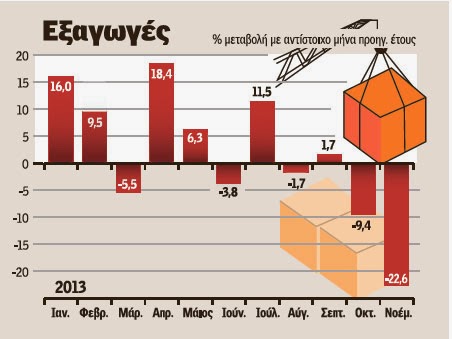
This is indeed a milestone. But another, much more important news item has received much less attention: Greece exported less in 2013 than in 2012.
More
Project Syndicate
March 6, 2014
The euro crisis seems to be largely over. Risk premiums continue to fall across the board, and two countries – Ireland and Portugal – have already exited their adjustment programs. They can now finance themselves in the market, and their economies seem to have started growing again.
By contrast, Greece is still having problems fulfilling the goals of its adjustment program and is engaged in seemingly endless negotiations over yet another multilateral financing package. The problem can be summed up in one word: exports (or, rather, lack of export growth).
The news from Greece these days has been dominated by the announcement that the government achieved a primary budget surplus (the fiscal balance minus debt service) in 2013. For the first time in decades, the Greek government has been able to pay for its expenditure with its own revenues.
This is indeed a milestone. But another, much more important news item has received much less attention: Greece exported less in 2013 than in 2012.
More
Friday, February 28, 2014
Cyprus One Year After Bank Bail-In — the Canary That Lived
by Matina Stevis
Wall Street Journal
February 28, 2014
Cyprus was the canary in a coalmine of European bank breakdowns, the country’s president, Nicos Anastasiades, told The Wall Street Journal in an interview this week.
Last March, Mr. Anastasiades oversaw the unprecedented overhaul of his country’s banking sector in exchange for €10 billion in financial assistance from the euro area and the International Monetary Fund.
Now, almost one year later, he’s trying to put it all behind him. But it’s difficult, and the state of the financial industry in Cyprus, once its crown jewel, makes it ever more so.
“The system had to be tried in a country that wouldn’t cause systemic problems to the rest of the euro area,” Mr. Anastasiades said in his office in Nicosia. “That’s why the bail-in was implemented ring-fencing the branches in Greece, to stop the virus from spreading and create repercussions to the rest of the system.”
More
Wall Street Journal
February 28, 2014
Cyprus was the canary in a coalmine of European bank breakdowns, the country’s president, Nicos Anastasiades, told The Wall Street Journal in an interview this week.
Last March, Mr. Anastasiades oversaw the unprecedented overhaul of his country’s banking sector in exchange for €10 billion in financial assistance from the euro area and the International Monetary Fund.
Now, almost one year later, he’s trying to put it all behind him. But it’s difficult, and the state of the financial industry in Cyprus, once its crown jewel, makes it ever more so.
“The system had to be tried in a country that wouldn’t cause systemic problems to the rest of the euro area,” Mr. Anastasiades said in his office in Nicosia. “That’s why the bail-in was implemented ring-fencing the branches in Greece, to stop the virus from spreading and create repercussions to the rest of the system.”
More
Berlin attacks EU’s easing of austerity demands
by Peter Spiegel
Financial Times
February 28, 2014
The German and Finnish finance ministries have issued a stinging rebuke of Brussels’ attempt to ease austerity demands on struggling eurozone countries, saying such flexibility improperly provided France and Spain with additional time to cut their budgets to meet EU deficit limits.
The rebuke, in an eight-page memo obtained by the Financial Times, accuses the European Commission of using “a somewhat arbitrary approach” in granting the budget flexibility to Madrid and Paris, and suggests “a separate pair of eyes” is needed to ensure Brussels is properly applying the new budget rules.
“Since 2012, the commission has substantially changed the way it assesses whether a member state has taken ‘effective action’ to comply with [EU budget rules],” the memo states. “The recent methodological changes imply the risk of watering down the newly strengthened [rules] at its implementation stage.”
The memo on the budget rules, which were adopted three years ago at the height of the eurozone crisis, was distributed to all 28 EU national capitals last week and debated by finance ministry deputies in Brussels on Thursday.
More
Financial Times
February 28, 2014
The German and Finnish finance ministries have issued a stinging rebuke of Brussels’ attempt to ease austerity demands on struggling eurozone countries, saying such flexibility improperly provided France and Spain with additional time to cut their budgets to meet EU deficit limits.
The rebuke, in an eight-page memo obtained by the Financial Times, accuses the European Commission of using “a somewhat arbitrary approach” in granting the budget flexibility to Madrid and Paris, and suggests “a separate pair of eyes” is needed to ensure Brussels is properly applying the new budget rules.
“Since 2012, the commission has substantially changed the way it assesses whether a member state has taken ‘effective action’ to comply with [EU budget rules],” the memo states. “The recent methodological changes imply the risk of watering down the newly strengthened [rules] at its implementation stage.”
The memo on the budget rules, which were adopted three years ago at the height of the eurozone crisis, was distributed to all 28 EU national capitals last week and debated by finance ministry deputies in Brussels on Thursday.
More
Monday, February 24, 2014
Greece in banking sector stand-off with bailout lenders
Financial Times
February 24, 2014
The Greek government and its bailout lenders are locked in a new stand-off over the health of Greece’s banking sector, with Athens contending its financial system requires less than €6bn of new capital, while international monitors insist it needs at least three times that amount.
The €6bn estimate was calculated by the Greek central bank after a long-awaited private analysis by BlackRock and was provided to monitors from the so-called “troika” of international lenders, ahead of their arrival in Athens on Monday to resume talks over their latest review of the bailout programme.
The review, the most contentious in more than a year, was to be completed in September, but troika officials say less than half of the economic reform commitments made by the Greek government have been completed. Their return to Athens on Monday is their first visit in two months.
The dispute over banks’ recapitalisation needs risks adding a new, potentially explosive point of contention between the two sides, as it will have a direct effect on whether Athens will require a third international bailout when the remaining €10.1bn in EU funding in the current €172bn rescue runs out later this year.
More
February 24, 2014
The Greek government and its bailout lenders are locked in a new stand-off over the health of Greece’s banking sector, with Athens contending its financial system requires less than €6bn of new capital, while international monitors insist it needs at least three times that amount.
The €6bn estimate was calculated by the Greek central bank after a long-awaited private analysis by BlackRock and was provided to monitors from the so-called “troika” of international lenders, ahead of their arrival in Athens on Monday to resume talks over their latest review of the bailout programme.
The review, the most contentious in more than a year, was to be completed in September, but troika officials say less than half of the economic reform commitments made by the Greek government have been completed. Their return to Athens on Monday is their first visit in two months.
The dispute over banks’ recapitalisation needs risks adding a new, potentially explosive point of contention between the two sides, as it will have a direct effect on whether Athens will require a third international bailout when the remaining €10.1bn in EU funding in the current €172bn rescue runs out later this year.
More
Thursday, February 20, 2014
Bruegel Think Tank Says Greece Needs New €40 Billion Bailout
by Gabriele Steinhauser
Wall Street Journal
February 20, 2014
Greece should get a new €40 billion bailout and the euro zone should be prepared to forego interest payments from the government if if the country’s debt remains too high, economists at a Brussels think tank argued on Thursday.
According to the paper published by economists at Bruegel, the additional easing of Greece’s bailout terms currently under discussion* would still leave Greece’s debt at 120% of gross domestic product by 2022 – far off the target of “substantially lower than 110%” that the euro zone agreed with the International Monetary Fund in November 2012. By 2030, Greece would have to issue some €74 billion in new bonds and still have a debt-to-GDP ratio of 95%.
And this calculation is based on a growth and budget performance that even the paper’s authors – economists Zsolt Darvas, André Sapir and Guntram Wolff – concede is optimistic. For their model, the three economists assumed that Greece would hit all targets for economic growth and primary budget surpluses outlined in its bailout program. Since growth forecasts only exist until 2018, they used a Consensus Economics forecast for Spain for the period after that, while the long-term primary surplus was taken from an IMF study on successful fiscal consolidations (more details on p. 6).
For Greece, that means a primary surplus of between 3.1% as well as nominal GDP growth of 3.7% from 2022 to 2030. In addition, Greece would have to be able to borrow on international markets at an interest rate of just 2 percentage points above that of Germany.
More
Read the Bruegel paper
Wall Street Journal
February 20, 2014
Greece should get a new €40 billion bailout and the euro zone should be prepared to forego interest payments from the government if if the country’s debt remains too high, economists at a Brussels think tank argued on Thursday.
According to the paper published by economists at Bruegel, the additional easing of Greece’s bailout terms currently under discussion* would still leave Greece’s debt at 120% of gross domestic product by 2022 – far off the target of “substantially lower than 110%” that the euro zone agreed with the International Monetary Fund in November 2012. By 2030, Greece would have to issue some €74 billion in new bonds and still have a debt-to-GDP ratio of 95%.
And this calculation is based on a growth and budget performance that even the paper’s authors – economists Zsolt Darvas, André Sapir and Guntram Wolff – concede is optimistic. For their model, the three economists assumed that Greece would hit all targets for economic growth and primary budget surpluses outlined in its bailout program. Since growth forecasts only exist until 2018, they used a Consensus Economics forecast for Spain for the period after that, while the long-term primary surplus was taken from an IMF study on successful fiscal consolidations (more details on p. 6).
For Greece, that means a primary surplus of between 3.1% as well as nominal GDP growth of 3.7% from 2022 to 2030. In addition, Greece would have to be able to borrow on international markets at an interest rate of just 2 percentage points above that of Germany.
More
Read the Bruegel paper
Greece Posts First Current-Account Surplus
by Stelios Bouras
Wall Street Journal
February 19, 2014
Greece's current account swung into a surplus for the first time on record in 2013, data showed Wednesday, though the economy has yet to turn the corner and join the ranks of its more competitive euro-zone peers.
The current-account surplus for the year came in at €1.2 billion ($1.65 billion), versus a deficit of €4.6 billion in 2012 and a €20.6 billion shortfall in 2011, according to figures from the country's central bank.
Plunging consumption and investment brought on by the country's six-year contraction resulted in a 4.5% drop in imports in 2013, the Bank of Greece said. Tourism proved to be a big winner in 2013, helping boost export revenues 2.3% in a trend likely to continue in the sector this year.
It is the country's first current account surplus since 1948, when the Bank of Greece started keeping records of the trade figures.
More
Wall Street Journal
February 19, 2014
Greece's current account swung into a surplus for the first time on record in 2013, data showed Wednesday, though the economy has yet to turn the corner and join the ranks of its more competitive euro-zone peers.
The current-account surplus for the year came in at €1.2 billion ($1.65 billion), versus a deficit of €4.6 billion in 2012 and a €20.6 billion shortfall in 2011, according to figures from the country's central bank.
Plunging consumption and investment brought on by the country's six-year contraction resulted in a 4.5% drop in imports in 2013, the Bank of Greece said. Tourism proved to be a big winner in 2013, helping boost export revenues 2.3% in a trend likely to continue in the sector this year.
It is the country's first current account surplus since 1948, when the Bank of Greece started keeping records of the trade figures.
More
Sunday, February 16, 2014
Greek Budget Surplus Beats Target
by Stelios Bouras
Wall Street Journal
February 16, 2014
Greece's primary budget surplus for 2013 will be nearly double its target, the country's prime minister said Sunday.
Antonis Samaras said the primary budget surplus, which doesn't take into account interest payments, will exceed €1.5 billion ($2.05 billion), compared with an upwardly revised target of €812 million.
The apparent improvement comes a year ahead of schedule and after years of tax rises and spending cuts demanded by international creditors in exchange for two bailouts worth a combined €240 billion. Athens wasn't expected to achieve a primary surplus until the end of 2014, according to goals set by the European Union and the International Monetary Fund.
"I tell you now that it exceeds €1.5 billion," Mr. Samaras is quoted as saying by weekly newspaper To Vima in comments confirmed by his office. "This means that a very large part of it will be returned this year to the community."
Under the conditions of Greece's lending agreement, the country is able to distribute 70% of any excess primary surplus above its target.
More
Wall Street Journal
February 16, 2014
Greece's primary budget surplus for 2013 will be nearly double its target, the country's prime minister said Sunday.
Antonis Samaras said the primary budget surplus, which doesn't take into account interest payments, will exceed €1.5 billion ($2.05 billion), compared with an upwardly revised target of €812 million.
The apparent improvement comes a year ahead of schedule and after years of tax rises and spending cuts demanded by international creditors in exchange for two bailouts worth a combined €240 billion. Athens wasn't expected to achieve a primary surplus until the end of 2014, according to goals set by the European Union and the International Monetary Fund.
"I tell you now that it exceeds €1.5 billion," Mr. Samaras is quoted as saying by weekly newspaper To Vima in comments confirmed by his office. "This means that a very large part of it will be returned this year to the community."
Under the conditions of Greece's lending agreement, the country is able to distribute 70% of any excess primary surplus above its target.
More
Friday, February 14, 2014
Greek Economy Contracts Less Than Expected
by Stelios Bouras
Wall Street Journal
February 14, 2014
Greece's economy contracted less than expected last year, data showed Friday, further boosting hopes of a return to growth in 2014 after six painful years of recession.
Data from the Hellenic Statistical Authority showed that Greece's gross domestic product shrank by an annual rate of 2.6% in the last quarter of 2013, slowing from a drop of 3% in the prior three-month period. It was the country's best performance since the 2010 first quarter.
The fourth-quarter data mean that Greece's economy contracted by an annual rate of 3.7% last year—beating a forecast 4% contraction by Greece and its international creditors.
Since entering recession in 2008, Greece's economy has shrunk by more than a quarter—made worse by waves of austerity measures imposed after 2010 by international creditors—while unemployment has reached a staggering 28% of the workforce. But various data have lately pointed to some signs of stabilization, suggesting that Greece's contraction is finally bottoming out.
More
Wall Street Journal
February 14, 2014
Greece's economy contracted less than expected last year, data showed Friday, further boosting hopes of a return to growth in 2014 after six painful years of recession.
Data from the Hellenic Statistical Authority showed that Greece's gross domestic product shrank by an annual rate of 2.6% in the last quarter of 2013, slowing from a drop of 3% in the prior three-month period. It was the country's best performance since the 2010 first quarter.
The fourth-quarter data mean that Greece's economy contracted by an annual rate of 3.7% last year—beating a forecast 4% contraction by Greece and its international creditors.
Since entering recession in 2008, Greece's economy has shrunk by more than a quarter—made worse by waves of austerity measures imposed after 2010 by international creditors—while unemployment has reached a staggering 28% of the workforce. But various data have lately pointed to some signs of stabilization, suggesting that Greece's contraction is finally bottoming out.
More
Tuesday, February 11, 2014
Cyprus Economy Doing Better Than Expected
by Matina Stevis
Wall Street Journal
February 11, 2014
The economy of Cyprus, which was recently on the cusp of leaving the euro zone, is doing better than expected, a team of international experts overseeing its bailout program said Tuesday.
The tiny island nation's economic output contracted by about 6% in 2013—about two percentage points less than the experts originally thought. While the recession is very deep, it compares with some private-sector estimates last year that projected the country would lose up to 15% of its economic output
The team of inspectors from the so-called troika of institutions—the European Commission, the European Central Bank and the International Monetary Fund—issued the statement after completing a review of Cyprus's bailout, a €10-billion ($13.64 billion) aid package agreed last March and funded by euro-zone countries and the IMF.
The experts said the Cypriot economy will shrink by another 4.8% in 2014 before it returns to slow growth of 1% in 2015—sticking to their original projections but warning that they too may be revised if things continue going well.
More
Wall Street Journal
February 11, 2014
The economy of Cyprus, which was recently on the cusp of leaving the euro zone, is doing better than expected, a team of international experts overseeing its bailout program said Tuesday.
The tiny island nation's economic output contracted by about 6% in 2013—about two percentage points less than the experts originally thought. While the recession is very deep, it compares with some private-sector estimates last year that projected the country would lose up to 15% of its economic output
The team of inspectors from the so-called troika of institutions—the European Commission, the European Central Bank and the International Monetary Fund—issued the statement after completing a review of Cyprus's bailout, a €10-billion ($13.64 billion) aid package agreed last March and funded by euro-zone countries and the IMF.
The experts said the Cypriot economy will shrink by another 4.8% in 2014 before it returns to slow growth of 1% in 2015—sticking to their original projections but warning that they too may be revised if things continue going well.
More
Sunday, February 9, 2014
Η Ελλάδα να βγει στις αγορές πριν από τις ευρωεκλογές
του Νίκου Οικονομίδη
Καθημερινή
9 Φεβρουαρίου 2014
Το 2009 η Ελλάδα είχε τρία μεγάλα προβλήματα. Πρώτα το τεράστιο δημόσιο χρέος. Δεύτερο το πολύ μεγάλο έλλειμμα του προϋπολογισμού. Τρίτο την έλλειψη ανταγωνιστικότητας. Στο πρώτο πρόβλημα, σε ποδοσφαιρική ορολογία, η Ελλάδα παίρνει Χ. Κατάφερε επί κυβέρνησης Παπαδήμου τη σημαντική μείωσή του (κούρεμα) και τη χρονική μετατόπιση μεγάλου μέρους του στο απώτερο μέλλον. Αλλά το δημόσιο χρέος παραμένει ακόμα μεγάλο και δυσβάστακτο, περίπου 320 δισ. ευρώ. Στο δεύτερο πρόβλημα, η Ελλάδα κέρδισε. Η μεγάλη επιτυχία της χώρας είναι η ισοσκέλιση του προϋπολογισμού του κράτους και η δημιουργία (έστω και μικρού) πρωτογενούς πλεονάσματος (δηλ. πλεονάσματος χωρίς τις δαπάνες για τόκους). Στο τρίτο πρόβλημα η Ελλάδα χάνει στα πέναλτι. Κατάφερε να κάνει σημαντικές αλλαγές στην αγορά εργασίας, αλλά απέτυχε σε πολλές άλλες διαρθρωτικές μεταρρυθμίσεις που είτε δεν έγιναν είτε καθυστέρησαν πολύ. Το οικονομικό και κοινωνικό κόστος της επιτυχίας στα δημοσιονομικά είναι η σημερινή μεγάλη ανεργία και ύφεση. Το κόστος της αποτυχίας στις διαρθρωτικές μεταρρυθμίσεις και της μη βελτίωσης της ανταγωνιστικότητας θα το πληρώνει η Ελλάδα για δεκαετίες.
Εχοντας καταγράψει τα αποτελέσματα (μία μεγάλη επιτυχία, μία ισοπαλία, μία ήττα στα πέναλτι και ένα μεγάλο κόστος) η Ελλάδα του 2014 έχει καινούργιες δυνατότητες που δεν είχε από την αρχή της κρίσης. Η σοφή επιλογή είναι τώρα πια απαραίτητη και θα καθορίσει την ευημερία για τα επόμενα δέκα χρόνια της Ελλάδας. Τρία είναι τα κύρια ερωτήματα. Πρώτα, χρειάζεται απομείωση του ελληνικού χρέους προς την Ευρωπαϊκή Ενωση. Δεύτερο και σημαντικότατο, ποτέ και πώς πρέπει να μπει η Ελλάδα στις διεθνείς χρηματαγορές. Τρίτο, πώς θα μπει η Ελλάδα σε αναπτυξιακή τροχιά.
Περισσότερα
Καθημερινή
9 Φεβρουαρίου 2014
Το 2009 η Ελλάδα είχε τρία μεγάλα προβλήματα. Πρώτα το τεράστιο δημόσιο χρέος. Δεύτερο το πολύ μεγάλο έλλειμμα του προϋπολογισμού. Τρίτο την έλλειψη ανταγωνιστικότητας. Στο πρώτο πρόβλημα, σε ποδοσφαιρική ορολογία, η Ελλάδα παίρνει Χ. Κατάφερε επί κυβέρνησης Παπαδήμου τη σημαντική μείωσή του (κούρεμα) και τη χρονική μετατόπιση μεγάλου μέρους του στο απώτερο μέλλον. Αλλά το δημόσιο χρέος παραμένει ακόμα μεγάλο και δυσβάστακτο, περίπου 320 δισ. ευρώ. Στο δεύτερο πρόβλημα, η Ελλάδα κέρδισε. Η μεγάλη επιτυχία της χώρας είναι η ισοσκέλιση του προϋπολογισμού του κράτους και η δημιουργία (έστω και μικρού) πρωτογενούς πλεονάσματος (δηλ. πλεονάσματος χωρίς τις δαπάνες για τόκους). Στο τρίτο πρόβλημα η Ελλάδα χάνει στα πέναλτι. Κατάφερε να κάνει σημαντικές αλλαγές στην αγορά εργασίας, αλλά απέτυχε σε πολλές άλλες διαρθρωτικές μεταρρυθμίσεις που είτε δεν έγιναν είτε καθυστέρησαν πολύ. Το οικονομικό και κοινωνικό κόστος της επιτυχίας στα δημοσιονομικά είναι η σημερινή μεγάλη ανεργία και ύφεση. Το κόστος της αποτυχίας στις διαρθρωτικές μεταρρυθμίσεις και της μη βελτίωσης της ανταγωνιστικότητας θα το πληρώνει η Ελλάδα για δεκαετίες.
Εχοντας καταγράψει τα αποτελέσματα (μία μεγάλη επιτυχία, μία ισοπαλία, μία ήττα στα πέναλτι και ένα μεγάλο κόστος) η Ελλάδα του 2014 έχει καινούργιες δυνατότητες που δεν είχε από την αρχή της κρίσης. Η σοφή επιλογή είναι τώρα πια απαραίτητη και θα καθορίσει την ευημερία για τα επόμενα δέκα χρόνια της Ελλάδας. Τρία είναι τα κύρια ερωτήματα. Πρώτα, χρειάζεται απομείωση του ελληνικού χρέους προς την Ευρωπαϊκή Ενωση. Δεύτερο και σημαντικότατο, ποτέ και πώς πρέπει να μπει η Ελλάδα στις διεθνείς χρηματαγορές. Τρίτο, πώς θα μπει η Ελλάδα σε αναπτυξιακή τροχιά.
Περισσότερα
Monday, February 3, 2014
Greece manufacturing sector growth boosts eurozone recovery hopes
Guardian
February 3, 2014
Greece's factory sector has finally returned to growth for the first time in more than four years, fuelling hopes that the country's long slump could be easing.
A survey released on Monday showed that Greek manufacturers finally reported their first expansion since August 2009 in January, helping Europe's manufacturing sector enjoy its strongest expansion in almost three years.
Markit, the data provider, reported that Greek factories recorded an increase in new orders and higher exports last month, although manufacturers continued to trim their workforces. Economists said the long-awaited recovery in Greek manufacturing boosted hopes the overall economy will finally stop shrinking this year – amid reports that the eurozone is close to agreeing a third bailout loan for Greece, worth up to €20bn (£16bn).
More
February 3, 2014
Greece's factory sector has finally returned to growth for the first time in more than four years, fuelling hopes that the country's long slump could be easing.
A survey released on Monday showed that Greek manufacturers finally reported their first expansion since August 2009 in January, helping Europe's manufacturing sector enjoy its strongest expansion in almost three years.
Markit, the data provider, reported that Greek factories recorded an increase in new orders and higher exports last month, although manufacturers continued to trim their workforces. Economists said the long-awaited recovery in Greek manufacturing boosted hopes the overall economy will finally stop shrinking this year – amid reports that the eurozone is close to agreeing a third bailout loan for Greece, worth up to €20bn (£16bn).
More
Friday, January 31, 2014
Top Officials Held Private Meeting on Greece Bailout
Wall Street Journal
January 31, 2014
Top officials peeled away from colleagues after a gathering of euro-zone finance ministers in Brussels on Monday evening for a private meeting to discuss mounting concerns over Greece's bailout.
Greek Finance Minister Yiannis Stournaras, who was briefing the press in a building across the street at the time, wasn't invited.
High-level officials from the International Monetary Fund, the European Commission, and the European Central Bank, as well as senior euro-zone officials and the German and French finance ministers were present.
The meeting reflects anxiety that Greece could yet disturb the relative calm in euro-zone financial markets. But the issue is unlikely to come to a head until May when Greece needs to repay some €11 billion ($14.85 billion) of maturing government bonds.
The private meeting, confirmed by several people with direct knowledge of the talks, comes as Athens struggles to meet some of the conditions set by its official creditors for further payouts from bailout funds.
More
January 31, 2014
Top officials peeled away from colleagues after a gathering of euro-zone finance ministers in Brussels on Monday evening for a private meeting to discuss mounting concerns over Greece's bailout.
Greek Finance Minister Yiannis Stournaras, who was briefing the press in a building across the street at the time, wasn't invited.
High-level officials from the International Monetary Fund, the European Commission, and the European Central Bank, as well as senior euro-zone officials and the German and French finance ministers were present.
The meeting reflects anxiety that Greece could yet disturb the relative calm in euro-zone financial markets. But the issue is unlikely to come to a head until May when Greece needs to repay some €11 billion ($14.85 billion) of maturing government bonds.
The private meeting, confirmed by several people with direct knowledge of the talks, comes as Athens struggles to meet some of the conditions set by its official creditors for further payouts from bailout funds.
More
Eurostat: «Πρωταθλήτρια» στην ανεργία η Ελλάδα - αυξήθηκε στο 27,8% τον Οκτώβριο
Τα Νέα
31 Ιανουαρίου 2014
Στο 27,8% διαμορφώθηκε η ανεργία στην Ελλάδα τον Οκτώβριο, σημειώνοντας ελαφριά αύξηση σε σχέση με τον Σεπτέμβριο (27,7%), σύμφωνα με στοιχεία της Ευρωπαϊκής Στατιστικής Υπηρεσίας (Eurostat) που δόθηκαν, την Παρασκευή, στη δημοσιότητα.
Εξάλλου, σταθερή στο 12% παραμένει η ανεργία στην ευρωζώνη από τον Οκτώβριο ως το Δεκέμβριο, ενώ στην «ΕΕ των 28» η ανεργία μειώθηκε ελαφρώς από 10,8% το Νοέμβριο σε 10,7% το Δεκέμβριο. Δεν υπάρχουν στοιχεία για την ανεργία στην Ελλάδα το Νοέμβριο και το Δεκέμβριο
Συνολικά, τον Δεκέμβριο καταγράφονται 26,200 εκατομμύρια άνεργοι στην ΕΕ και 19,010 εκατομμύρια άνεργοι στην ευρωζώνη. Σε σχέση με τον προηγούμενο μήνα, οι άνεργοι μειώθηκαν κατά 162.000 στην ΕΕ και κατά 129.000 στην ευρωζώνη.
Πληροφορίες
31 Ιανουαρίου 2014
Στο 27,8% διαμορφώθηκε η ανεργία στην Ελλάδα τον Οκτώβριο, σημειώνοντας ελαφριά αύξηση σε σχέση με τον Σεπτέμβριο (27,7%), σύμφωνα με στοιχεία της Ευρωπαϊκής Στατιστικής Υπηρεσίας (Eurostat) που δόθηκαν, την Παρασκευή, στη δημοσιότητα.
Εξάλλου, σταθερή στο 12% παραμένει η ανεργία στην ευρωζώνη από τον Οκτώβριο ως το Δεκέμβριο, ενώ στην «ΕΕ των 28» η ανεργία μειώθηκε ελαφρώς από 10,8% το Νοέμβριο σε 10,7% το Δεκέμβριο. Δεν υπάρχουν στοιχεία για την ανεργία στην Ελλάδα το Νοέμβριο και το Δεκέμβριο
Συνολικά, τον Δεκέμβριο καταγράφονται 26,200 εκατομμύρια άνεργοι στην ΕΕ και 19,010 εκατομμύρια άνεργοι στην ευρωζώνη. Σε σχέση με τον προηγούμενο μήνα, οι άνεργοι μειώθηκαν κατά 162.000 στην ΕΕ και κατά 129.000 στην ευρωζώνη.
Πληροφορίες
Euro Zone's Next Reform Candidate: Germany
Wall Street Journal
January 30, 2014
Lavish praise has been heaped in recent weeks on the economic restructuring efforts of Greece, Ireland, Portugal, Spain and Cyprus, five troubled economies united in having received euro-zone bailouts.
Others in the 18-nation euro zone have done far less. France and Italy are often criticized by officials and economists for moving too slowly. But they are not alone. The tables are turning on another group of reform laggards, led by those who have called the shots throughout the euro crisis: Germany and its fellow hard-liners, including Finland and the Netherlands.
The bailout countries have, to a greater or lesser extent, dismantled regulation, confronted labor unions and cut red tape in the public sector. For them, failure to follow sometimes tough conditions laid down by experts from the European Commission, the European Central Bank and the International Monetary Fund—in the jargon, conditionality—would have meant delaying bailout funding.
Klaus Regling, the head of the euro zone's bailout funds, claims bailout countries are now the top performers in terms of clearing away obstacles to growth in their economies.
"In the EU, we have these five countries that are really reforming because there is conditionality, and conditionality works," Mr. Regling said in a recent interview.
More
January 30, 2014
Lavish praise has been heaped in recent weeks on the economic restructuring efforts of Greece, Ireland, Portugal, Spain and Cyprus, five troubled economies united in having received euro-zone bailouts.
Others in the 18-nation euro zone have done far less. France and Italy are often criticized by officials and economists for moving too slowly. But they are not alone. The tables are turning on another group of reform laggards, led by those who have called the shots throughout the euro crisis: Germany and its fellow hard-liners, including Finland and the Netherlands.
The bailout countries have, to a greater or lesser extent, dismantled regulation, confronted labor unions and cut red tape in the public sector. For them, failure to follow sometimes tough conditions laid down by experts from the European Commission, the European Central Bank and the International Monetary Fund—in the jargon, conditionality—would have meant delaying bailout funding.
Klaus Regling, the head of the euro zone's bailout funds, claims bailout countries are now the top performers in terms of clearing away obstacles to growth in their economies.
"In the EU, we have these five countries that are really reforming because there is conditionality, and conditionality works," Mr. Regling said in a recent interview.
More
Tuesday, January 28, 2014
Jobs and Growth: Supporting the European Recovery
by Christine Lagarde
iMFdirect
January 28, 2014
As we begin the new year, Europe confronts both good and bad news. First the good news. Growth is finally picking up in the euro area as it is slowly emerging from the deep recession. The bad news? Still nearly 20 million people are unemployed. Until the effects on employment have been reversed, we cannot say that the crisis is over.
Two trends are particularly troubling, now and for the future. First, the high level of long-term unemployment gives me great cause for concern: almost half of those without a job have been unemployed for more than a year. Second, I still worry about the large number of young people without jobs: nearly one quarter of Europeans under the age of 25 who are looking for a job cannot find one. In Italy and Portugal, more than one third of under-25s are unemployed, and in Spain and Greece more than one half are.
More
iMFdirect
January 28, 2014
As we begin the new year, Europe confronts both good and bad news. First the good news. Growth is finally picking up in the euro area as it is slowly emerging from the deep recession. The bad news? Still nearly 20 million people are unemployed. Until the effects on employment have been reversed, we cannot say that the crisis is over.
Two trends are particularly troubling, now and for the future. First, the high level of long-term unemployment gives me great cause for concern: almost half of those without a job have been unemployed for more than a year. Second, I still worry about the large number of young people without jobs: nearly one quarter of Europeans under the age of 25 who are looking for a job cannot find one. In Italy and Portugal, more than one third of under-25s are unemployed, and in Spain and Greece more than one half are.
More
Is the Economic Crisis In Greece Really Over?
by Desmond Lachman
Real Clear Markets
January 28, 2014
A growing chorus of senior European policymakers, including ECB President Mario Draghi and European Commission President Jose Barroso, keep reassuring us that the worst phase of the Euro crisis is over. They also keep telling us that there is now no risk of any country leaving the Euro. Evidently they are not paying much attention to the recent worsening in political and economic developments in Greece. For those developments are now very much heightening the risk that we will again be talking about Greece leaving the Euro before the year is out.
Among the more disturbing developments is the country's apparent loss of political willingness to comply with the terms of its IMF-EU financial support program after four painful years of budget austerity. Negotiations with the IMF and EU on that program's review, which should have been completed last September, show no signs of being concluded anytime soon. This could cause real difficulties for Greece by May 2014 when large loan repayments to the European Central bank come due.
Holding up the IMF-EU negotiations is the Greek government's insistence that, with unemployment having risen to over 28 percent and with the Greek economy having shrunk by a quarter since the onset of the crisis, it simply does not have the political support to take the further budget measure or to implement the additional economic structural reforms being demanded of it. And with the country now enjoying a small budget surplus, excluding interest payments, the government believes that it has the luxury to hang tough in its IMF-EU negotiations.
More
Real Clear Markets
January 28, 2014
A growing chorus of senior European policymakers, including ECB President Mario Draghi and European Commission President Jose Barroso, keep reassuring us that the worst phase of the Euro crisis is over. They also keep telling us that there is now no risk of any country leaving the Euro. Evidently they are not paying much attention to the recent worsening in political and economic developments in Greece. For those developments are now very much heightening the risk that we will again be talking about Greece leaving the Euro before the year is out.
Among the more disturbing developments is the country's apparent loss of political willingness to comply with the terms of its IMF-EU financial support program after four painful years of budget austerity. Negotiations with the IMF and EU on that program's review, which should have been completed last September, show no signs of being concluded anytime soon. This could cause real difficulties for Greece by May 2014 when large loan repayments to the European Central bank come due.
Holding up the IMF-EU negotiations is the Greek government's insistence that, with unemployment having risen to over 28 percent and with the Greek economy having shrunk by a quarter since the onset of the crisis, it simply does not have the political support to take the further budget measure or to implement the additional economic structural reforms being demanded of it. And with the country now enjoying a small budget surplus, excluding interest payments, the government believes that it has the luxury to hang tough in its IMF-EU negotiations.
More
Monday, January 27, 2014
Μειώθηκε κατά 8% το διαθέσιμο εισόδημα των νοικοκυριών
Το Βήμα27 Ιανουαρίου 2014
Τις πιέσεις που εξακολουθεί να δέχεται το διαθέσιμο εισόδημα των νοικοκυριών από τη συνεχιζόμενη μείωση των μισθών αποτυπώνουν τα στοιχεία της Ελληνικής Στατιστικής Αρχής (ΕΛΣΤΑΤ) για τους τριμηνιαίους μη χρηματοοικονομικούς λογαριασμούς του τρίτου τριμήνου 2013.
Οι τριμηνιαίοι μη χρηματοοικονομικοί λογαριασμοί παρέχουν μια συνολική περιγραφή της ελληνικής οικονομίας, βασισμένη στην ανάλυση της οικονομικής συμπεριφοράς νοικοκυριών,μη κερδοσκοπικών ιδρυμάτων, μη χρηματοοικονομικών εταιρειών, κ.α..
Σύμφωνα με τα στοιχεία αυτά κατά το τρίτο τρίμηνο του 2013, το διαθέσιμο εισόδημα του τομέα των νοικοκυριών και των μη κερδοσκοπικών ιδρυμάτων που εξυπηρετούν νοικοκυριά μειώθηκε κατά 8% σε σύγκριση με το αντίστοιχο τρίμηνο του προηγούμενου έτους, από τα 33 δισ. ευρώ, στα 30,4 δισ. ευρώ.
Περισσότερα
Europe’s Economy is Almost Out of the Woods
Wall Street Journal
January 27, 2014
Jeroen Dijsselbloem Dutch finance minister and Eurogroup president tells WSJ’s Matina Stevis at The World Economic Forum that the worst of the euro crisis is behind us, but the bloc’s banks are gearing up for a tough review and governments mustn’t relent on budget reforms.
January 27, 2014
Jeroen Dijsselbloem Dutch finance minister and Eurogroup president tells WSJ’s Matina Stevis at The World Economic Forum that the worst of the euro crisis is behind us, but the bloc’s banks are gearing up for a tough review and governments mustn’t relent on budget reforms.
Friday, January 24, 2014
Σκληρή διαπραγμάτευση με τρόικα για τις μεταρρυθμίσεις
Καθημερινή
24 Ιανουαρίου 2014
Σημείο αιχμής στις διαπραγματεύσεις με την τρόικα, όταν αυτές επαναρχίσουν, θα αποτελέσουν οι μεταρρυθμίσεις που έχει προτείνει ο ΟΟΣΑ, όπως προκύπτει από επιστολή που απέστειλαν χθες οι δανειστές στον υπουργό Ανάπτυξης, Κ. Χατζηδάκη. Η τρόικα αναφέρεται σε πλήρη εφαρμογή των προτάσεων «με πολύ λίγες και καλά αιτιολογημένες εξαιρέσεις». Η επιστολή, το περιεχόμενο της οποίας περιήλθε στην κατοχή της «Κ», επισημαίνει τα σημαντικά οφέλη για την οικονομία που θα είχε η εφαρμογή των προτάσεων, η οποία, όπως τονίζεται, «θα στείλει ένα σημαντικό μήνυμα για την προθυμία και την ικανότητα της ελληνικής κυβέρνησης να εφαρμόσει με επιτυχία κρίσιμες για την ανάπτυξη διαρθρωτικές μεταρρυθμίσεις». Καταλήγοντας, οι επικεφαλής των ελεγκτικών κλιμακίων σημειώνουν ότι «δεν μπορούμε να δούμε πώς η τρέχουσα αξιολόγηση θα μπορούσε να ολοκληρωθεί χωρίς μια πολύ πειστική εφαρμογή των συστάσεων του ΟΟΣΑ και θέλαμε να φέρουμε αυτό το θέμα στην προσοχή σας».
Υπενθυμίζεται ότι μετά την καταγραφή των κανονισμών και των νόμων που ισχύουν σε τέσσερις τομείς της ελληνικής οικονομίας - επεξεργασία τροφίμων, λιανικό εμπόριο, υλικά οικοδομών και τουρισμό- ο ΟΟΣΑ προχώρησε σε 329 συστάσεις για την απελευθέρωση του ανταγωνισμού στη χώρα μας. Μεταξύ αυτών περιλαμβάνονται η πλήρης κατάργηση των φόρων υπέρ τρίτων, η πλήρης απελευθέρωση του ωραρίου καταστημάτων όλες τις Κυριακές, καθώς και στις περιόδους εκπτώσεων, η άρση του ορίου διάρκειας 5 ημερών για το φρέσκο γάλα, η απελευθέρωση του εμπορίου μη συνταγογραφούμενων φαρμάκων και πολλές άλλες. Ο Οργανισμός υπολογίζει ότι εφόσον εφαρμοστούν στο σύνολό τους, οι μεταρρυθμίσεις αυτές θα αποφέρουν όφελος άνω των 5 δισ. ευρώ για την ελληνική οικονομία.
Περισσότερα
24 Ιανουαρίου 2014
Σημείο αιχμής στις διαπραγματεύσεις με την τρόικα, όταν αυτές επαναρχίσουν, θα αποτελέσουν οι μεταρρυθμίσεις που έχει προτείνει ο ΟΟΣΑ, όπως προκύπτει από επιστολή που απέστειλαν χθες οι δανειστές στον υπουργό Ανάπτυξης, Κ. Χατζηδάκη. Η τρόικα αναφέρεται σε πλήρη εφαρμογή των προτάσεων «με πολύ λίγες και καλά αιτιολογημένες εξαιρέσεις». Η επιστολή, το περιεχόμενο της οποίας περιήλθε στην κατοχή της «Κ», επισημαίνει τα σημαντικά οφέλη για την οικονομία που θα είχε η εφαρμογή των προτάσεων, η οποία, όπως τονίζεται, «θα στείλει ένα σημαντικό μήνυμα για την προθυμία και την ικανότητα της ελληνικής κυβέρνησης να εφαρμόσει με επιτυχία κρίσιμες για την ανάπτυξη διαρθρωτικές μεταρρυθμίσεις». Καταλήγοντας, οι επικεφαλής των ελεγκτικών κλιμακίων σημειώνουν ότι «δεν μπορούμε να δούμε πώς η τρέχουσα αξιολόγηση θα μπορούσε να ολοκληρωθεί χωρίς μια πολύ πειστική εφαρμογή των συστάσεων του ΟΟΣΑ και θέλαμε να φέρουμε αυτό το θέμα στην προσοχή σας».
Υπενθυμίζεται ότι μετά την καταγραφή των κανονισμών και των νόμων που ισχύουν σε τέσσερις τομείς της ελληνικής οικονομίας - επεξεργασία τροφίμων, λιανικό εμπόριο, υλικά οικοδομών και τουρισμό- ο ΟΟΣΑ προχώρησε σε 329 συστάσεις για την απελευθέρωση του ανταγωνισμού στη χώρα μας. Μεταξύ αυτών περιλαμβάνονται η πλήρης κατάργηση των φόρων υπέρ τρίτων, η πλήρης απελευθέρωση του ωραρίου καταστημάτων όλες τις Κυριακές, καθώς και στις περιόδους εκπτώσεων, η άρση του ορίου διάρκειας 5 ημερών για το φρέσκο γάλα, η απελευθέρωση του εμπορίου μη συνταγογραφούμενων φαρμάκων και πολλές άλλες. Ο Οργανισμός υπολογίζει ότι εφόσον εφαρμοστούν στο σύνολό τους, οι μεταρρυθμίσεις αυτές θα αποφέρουν όφελος άνω των 5 δισ. ευρώ για την ελληνική οικονομία.
Περισσότερα
Wednesday, January 22, 2014
Nα πουλάνε επανάσταση οι πιο σκληροί υπερασπιστές των προνομίων, καταντάει γελοίο
του Φωτή Γεωργελέ
Athens Voice
22 Ιανουαρίου 2014
Στην Αργεντινή γίνονται αιματηρές συγκρούσεις. Απολογισμός 12 νεκροί. 13 χρόνια μετά τη χρεοκοπία οι άνθρωποι λεηλατούν τα σούπερ μάρκετ γιατί δεν έχουν να φάνε. Κι όμως κάποιοι μας έλεγαν μακάρι να κάναμε ό,τι η Αργεντινή. Στη Βενεζουέλα γίνονται διαδηλώσεις εναντίον της εγκληματικότητας. Οι δολοφονίες και οι ληστείες είναι οι περισσότερες στον κόσμο. Το νόμισμα υποτιμήθηκε 44%, μετά άλλο 32% κι αυτό που απέμεινε αλλάζεται στη μαύρη αγορά με δολάρια, 6 φορές κάτω από την επίσημη ισοτιμία. Μία από τις μεγαλύτερες πετρελαιοπαραγωγικές χώρες του κόσμου ζει εξαθλιωμένα. Κι όμως κάποιοι μας έλεγαν να ακολουθήσουμε το δρόμο της Βενεζουέλας και του Ισημερινού. Στην Ουκρανία, πάλι, γίνονται κάθε μέρα διαδηλώσεις. Οι Ουκρανοί πιέζουν την κυβέρνηση να προχωρήσει στη σύνδεση με την Ευρωπαϊκή Ένωση και να αψηφήσει τις αντιρρήσεις της Μόσχας. Αυτοί θέλουν να μπουν στην Ευρωπαϊκή Ένωση, εμείς τη θεωρούμε Δ΄ Ράιχ και κάποιοι μας προτρέπουν να την εγκαταλείψουμε.
Για όλο τον πλανήτη Γη, η Ευρωπαϊκή Ένωση είναι η πιο δημοκρατική περιοχή του κόσμου, με τις περισσότερες κοινωνικές παροχές, τα πιο προστατευμένα εργασιακά δικαιώματα, τις μεγαλύτερες ελευθερίες, το κράτος δικαίου. Εμείς μιλάμε για Νταχάου και εργασιακό μεσαίωνα. Για Δ΄ Ράιχ και φούρνους της Μέρκελ. Για γενοκτονίες και ανθρωπιστικές καταστροφές. Ήταν τόσο καλύτερη η κατάσταση στην Ελλάδα, ώστε να θεωρούμε την Ευρώπη, τον παράδεισο δηλαδή συγκριτικά με τον υπόλοιπο κόσμο, στρατόπεδο συγκέντρωσης όπου καταπατώνται τα ανθρώπινα δικαιώματα και διαλύεται η εργατική νομοθεσία; Φυσικά και είμαστε καλύτερα. Καλύτερα για ποιους όμως;
Παρακολουθώ την αγαπημένη μου αντιμνημονιακή εφημερίδα. Αντιμνημονιακή, βέβαια, ονομάζουμε συνήθως την εφημερίδα που δεν πληρώνει τους εργαζόμενους, που δεν έχει πληρώσει τις αποζημιώσεις, που φέσωσε τα ασφαλιστικά ταμεία, την εφορία, το κράτος, και τα χρέη της τα πληρώνουμε εμείς. Και γι’ αυτό κατηγορεί καθημερινά την τρόικα, την Ευρώπη, τα μνημόνια και την κακούργα κοινωνία. Η εφημερίδα μέρα παρά μέρα γράφει για αυτοκτονίες, γενοκτονίες, κατοχές και θυσίες του ελληνικού λαού. Τις μονές μέρες. Τις ζυγές μέρες, με τα ίδια πρωτοσέλιδα και τους τεράστιους τίτλους, γράφει Σύνταξη με 25ετία στο Δημόσιο, Σύνταξη στα 52 για τις γυναίκες, σύνταξη στα 50 για τους γονείς ανήλικων τέκνων, πώς θα βγείτε στη σύνταξη στα 58.
Περισσότερα
Athens Voice
22 Ιανουαρίου 2014
Στην Αργεντινή γίνονται αιματηρές συγκρούσεις. Απολογισμός 12 νεκροί. 13 χρόνια μετά τη χρεοκοπία οι άνθρωποι λεηλατούν τα σούπερ μάρκετ γιατί δεν έχουν να φάνε. Κι όμως κάποιοι μας έλεγαν μακάρι να κάναμε ό,τι η Αργεντινή. Στη Βενεζουέλα γίνονται διαδηλώσεις εναντίον της εγκληματικότητας. Οι δολοφονίες και οι ληστείες είναι οι περισσότερες στον κόσμο. Το νόμισμα υποτιμήθηκε 44%, μετά άλλο 32% κι αυτό που απέμεινε αλλάζεται στη μαύρη αγορά με δολάρια, 6 φορές κάτω από την επίσημη ισοτιμία. Μία από τις μεγαλύτερες πετρελαιοπαραγωγικές χώρες του κόσμου ζει εξαθλιωμένα. Κι όμως κάποιοι μας έλεγαν να ακολουθήσουμε το δρόμο της Βενεζουέλας και του Ισημερινού. Στην Ουκρανία, πάλι, γίνονται κάθε μέρα διαδηλώσεις. Οι Ουκρανοί πιέζουν την κυβέρνηση να προχωρήσει στη σύνδεση με την Ευρωπαϊκή Ένωση και να αψηφήσει τις αντιρρήσεις της Μόσχας. Αυτοί θέλουν να μπουν στην Ευρωπαϊκή Ένωση, εμείς τη θεωρούμε Δ΄ Ράιχ και κάποιοι μας προτρέπουν να την εγκαταλείψουμε.
Για όλο τον πλανήτη Γη, η Ευρωπαϊκή Ένωση είναι η πιο δημοκρατική περιοχή του κόσμου, με τις περισσότερες κοινωνικές παροχές, τα πιο προστατευμένα εργασιακά δικαιώματα, τις μεγαλύτερες ελευθερίες, το κράτος δικαίου. Εμείς μιλάμε για Νταχάου και εργασιακό μεσαίωνα. Για Δ΄ Ράιχ και φούρνους της Μέρκελ. Για γενοκτονίες και ανθρωπιστικές καταστροφές. Ήταν τόσο καλύτερη η κατάσταση στην Ελλάδα, ώστε να θεωρούμε την Ευρώπη, τον παράδεισο δηλαδή συγκριτικά με τον υπόλοιπο κόσμο, στρατόπεδο συγκέντρωσης όπου καταπατώνται τα ανθρώπινα δικαιώματα και διαλύεται η εργατική νομοθεσία; Φυσικά και είμαστε καλύτερα. Καλύτερα για ποιους όμως;
Παρακολουθώ την αγαπημένη μου αντιμνημονιακή εφημερίδα. Αντιμνημονιακή, βέβαια, ονομάζουμε συνήθως την εφημερίδα που δεν πληρώνει τους εργαζόμενους, που δεν έχει πληρώσει τις αποζημιώσεις, που φέσωσε τα ασφαλιστικά ταμεία, την εφορία, το κράτος, και τα χρέη της τα πληρώνουμε εμείς. Και γι’ αυτό κατηγορεί καθημερινά την τρόικα, την Ευρώπη, τα μνημόνια και την κακούργα κοινωνία. Η εφημερίδα μέρα παρά μέρα γράφει για αυτοκτονίες, γενοκτονίες, κατοχές και θυσίες του ελληνικού λαού. Τις μονές μέρες. Τις ζυγές μέρες, με τα ίδια πρωτοσέλιδα και τους τεράστιους τίτλους, γράφει Σύνταξη με 25ετία στο Δημόσιο, Σύνταξη στα 52 για τις γυναίκες, σύνταξη στα 50 για τους γονείς ανήλικων τέκνων, πώς θα βγείτε στη σύνταξη στα 58.
Περισσότερα
Eurostat: Στο 171,8% το χρέος της Ελλάδας
Τα Νέα
22 Ιανουαρίου 2014
Το δημόσιο χρέος της Ελλάδας στο τέλος του τρίτου τριμήνου του 2013 διαμορφώθηκε στο 171,8% του ΑΕΠ, παραμένοντας το υψηλότερο στην Ε.Ε, σύμφωνα με στοιχεία που δόθηκαν στη δημοσιότητα από τη Eurostat.
Ακολουθούν η Ιταλια με χρέος στο 132,9% του ΑΕΠ, η Πορτογαλια με χρέος 128,7% και η Ιρλανδία με χρέος 124,8%. Στον αντίποδα, το χαμηλότερο χρέος ως ποσοστό του ΑΕΠ εμφανίζουν η Εσθονία με 10%, η Βουλγαρία με 17,3% και το Λουξεμβούργο με χρέος 27,7%.
Από τα στοιχεία της κοινοτικής στατιστικής υπηρεσίας προκύπτει ότι το χρέος στο σύνολο της Ευρωζώνης μειώθηκε στο 92,7% του ΑΕΠ από 93,4% που ήταν στο τέλος του δεύτερου τριμήνου. Πρόκειται για την πρώτη μείωσή του, σε απόλυτους όρους, από το τέταρτο τρίμηνο του 2007.
Περισσότερα
22 Ιανουαρίου 2014
Το δημόσιο χρέος της Ελλάδας στο τέλος του τρίτου τριμήνου του 2013 διαμορφώθηκε στο 171,8% του ΑΕΠ, παραμένοντας το υψηλότερο στην Ε.Ε, σύμφωνα με στοιχεία που δόθηκαν στη δημοσιότητα από τη Eurostat.
Ακολουθούν η Ιταλια με χρέος στο 132,9% του ΑΕΠ, η Πορτογαλια με χρέος 128,7% και η Ιρλανδία με χρέος 124,8%. Στον αντίποδα, το χαμηλότερο χρέος ως ποσοστό του ΑΕΠ εμφανίζουν η Εσθονία με 10%, η Βουλγαρία με 17,3% και το Λουξεμβούργο με χρέος 27,7%.
Από τα στοιχεία της κοινοτικής στατιστικής υπηρεσίας προκύπτει ότι το χρέος στο σύνολο της Ευρωζώνης μειώθηκε στο 92,7% του ΑΕΠ από 93,4% που ήταν στο τέλος του δεύτερου τριμήνου. Πρόκειται για την πρώτη μείωσή του, σε απόλυτους όρους, από το τέταρτο τρίμηνο του 2007.
Περισσότερα
Tuesday, January 21, 2014
Three lessons for Mario Draghi
by Desmond Lachman
Yahoo Finance
January 21, 2014
History is bound to judge harshly the European Central Bank’s recent decision to leave policy interest rates unchanged. For it did so despite the fact that European inflation is now running at less than half of the ECB’s 2 percent inflation target. The ECB also did so despite the fact that European unemployment remains at record high levels and that Europe remains in the grips of a crippling credit crunch that very much clouds its economic recovery prospects.
Among the more troubling developments in the European economy of late has been the precipitous decline in inflation. Excluding volatile items like food and energy, over the past year overall European inflation more than halved from 1.5 percent to 0.7 percent. This takes European inflation to its lowest level in the Euro’s 15 year history, which has to raise the specter that the overall European economy could succumb to deflation.
Equally troubling is the fact that the highly indebted countries in the European economic periphery, like Cyprus, Greece, Ireland, and Portugal, are now either experiencing outright deflation or else are on the cusp of deflation. For deflation will make it very difficult for these countries to dig themselves out from under their very large public and private sector debt burdens.
More
Yahoo Finance
January 21, 2014
History is bound to judge harshly the European Central Bank’s recent decision to leave policy interest rates unchanged. For it did so despite the fact that European inflation is now running at less than half of the ECB’s 2 percent inflation target. The ECB also did so despite the fact that European unemployment remains at record high levels and that Europe remains in the grips of a crippling credit crunch that very much clouds its economic recovery prospects.
Among the more troubling developments in the European economy of late has been the precipitous decline in inflation. Excluding volatile items like food and energy, over the past year overall European inflation more than halved from 1.5 percent to 0.7 percent. This takes European inflation to its lowest level in the Euro’s 15 year history, which has to raise the specter that the overall European economy could succumb to deflation.
Equally troubling is the fact that the highly indebted countries in the European economic periphery, like Cyprus, Greece, Ireland, and Portugal, are now either experiencing outright deflation or else are on the cusp of deflation. For deflation will make it very difficult for these countries to dig themselves out from under their very large public and private sector debt burdens.
More
Saturday, January 11, 2014
Privatisation in Greece Hellishly Hellenic
Economist
January 11, 2014
Greece is a bad advertisement for government ownership—and for privatisation. Its state holdings are poorly managed and mostly subject to political meddling. The privatisation programme, launched through gritted teeth when the economy imploded, is woefully behind schedule. The government managed to miss its revenue target for 2013 even after scaling it back twice, to just €1.3 billion. Everyone knows that sell-offs could do little to close Greece’s 12-figure financing shortfall. But they could help, and the country’s creditors are impatient.
The programme is under review, but Greece’s institutions and polity are so dysfunctional that “nothing short of a bone-marrow transplant” will do, says a consultant to international lenders. One promising idea—to transfer assets that could be sold or restructured to a holding company abroad, say in Luxembourg, where they would be insulated from interfering politicians—has already been shot down. The Finns pushed this proposal, believing it could serve as a model for other troubled economies, such as Portugal. But it was met with hostility by Greek ministers.
More
January 11, 2014
Greece is a bad advertisement for government ownership—and for privatisation. Its state holdings are poorly managed and mostly subject to political meddling. The privatisation programme, launched through gritted teeth when the economy imploded, is woefully behind schedule. The government managed to miss its revenue target for 2013 even after scaling it back twice, to just €1.3 billion. Everyone knows that sell-offs could do little to close Greece’s 12-figure financing shortfall. But they could help, and the country’s creditors are impatient.
The programme is under review, but Greece’s institutions and polity are so dysfunctional that “nothing short of a bone-marrow transplant” will do, says a consultant to international lenders. One promising idea—to transfer assets that could be sold or restructured to a holding company abroad, say in Luxembourg, where they would be insulated from interfering politicians—has already been shot down. The Finns pushed this proposal, believing it could serve as a model for other troubled economies, such as Portugal. But it was met with hostility by Greek ministers.
More
Aegean stables
Economist
January 11, 2014
KALI chronia: happy new year. Greece starts 2014 with an unaccustomed run of good news. Not long ago the country was in a death spiral of missed fiscal targets, panicked markets and threats to force it out of the euro. Now the euro zone’s first and most difficult problem child is exceeding expectations.
Ahead of schedule, Greece has closed its scary deficit and moved into primary budget surplus (ie, before interest payments). Yields on ten-year bonds have fallen below 8%, from a peak of well over 40% at the height of the Grexit panic. The government plans to issue fresh debt later this year. Some foreign investors are testing the waters of the Aegean. Competitiveness is being restored. Greece has enjoyed a bumper tourist season. This year should see the first GDP growth after six years of recession.
Once-exasperated German officials now hail the Greek prime minister, Antonis Samaras, as the saviour of his country—and, indeed, of the euro. As Greece assumed the half-yearly rotating presidency of the European Union this month, EU dignitaries came to Athens this week to praise it, not to bury it.
More
January 11, 2014
KALI chronia: happy new year. Greece starts 2014 with an unaccustomed run of good news. Not long ago the country was in a death spiral of missed fiscal targets, panicked markets and threats to force it out of the euro. Now the euro zone’s first and most difficult problem child is exceeding expectations.
Ahead of schedule, Greece has closed its scary deficit and moved into primary budget surplus (ie, before interest payments). Yields on ten-year bonds have fallen below 8%, from a peak of well over 40% at the height of the Grexit panic. The government plans to issue fresh debt later this year. Some foreign investors are testing the waters of the Aegean. Competitiveness is being restored. Greece has enjoyed a bumper tourist season. This year should see the first GDP growth after six years of recession.
Once-exasperated German officials now hail the Greek prime minister, Antonis Samaras, as the saviour of his country—and, indeed, of the euro. As Greece assumed the half-yearly rotating presidency of the European Union this month, EU dignitaries came to Athens this week to praise it, not to bury it.
More
Thursday, January 9, 2014
Greece Takes EU Helm, Still Focused on Self
by Matina Stevis
Wall Street Journal
January 9, 2014
Greece's turn at the helm of the European Union, a largely administrative role that rotates every six months, could find itself overshadowed by something close to home: Greece's own bailout.
According to EU etiquette, the country holding the presidency is expected to leave aside its national agenda and focus on managing legislative drafts and negotiations, wearing a neutral, EU hat. That option isn't available to Athens.
"We have full understanding of the European nature" of the presidency, Deputy Prime Minister Evangelos Venizelos told the foreign press in a briefing Wednesday. He then went on to tackle at length and in detail questions about Greece's bailout.
Greece's role as administrator of EU legislative affairs for the next few months will be limited. Its effective term—cut short by elections for the European Parliament in May—will largely focus on striking a deal with the Parliament to advance the euro zone's banking union.
But the country's battered economy, the management of its €240-billion ($326 billion) bailout and a dreaded discussion about its heavy debt load are much likelier to make headlines over the period.
More
Wall Street Journal
January 9, 2014
Greece's turn at the helm of the European Union, a largely administrative role that rotates every six months, could find itself overshadowed by something close to home: Greece's own bailout.
According to EU etiquette, the country holding the presidency is expected to leave aside its national agenda and focus on managing legislative drafts and negotiations, wearing a neutral, EU hat. That option isn't available to Athens.
"We have full understanding of the European nature" of the presidency, Deputy Prime Minister Evangelos Venizelos told the foreign press in a briefing Wednesday. He then went on to tackle at length and in detail questions about Greece's bailout.
Greece's role as administrator of EU legislative affairs for the next few months will be limited. Its effective term—cut short by elections for the European Parliament in May—will largely focus on striking a deal with the Parliament to advance the euro zone's banking union.
But the country's battered economy, the management of its €240-billion ($326 billion) bailout and a dreaded discussion about its heavy debt load are much likelier to make headlines over the period.
More
Wednesday, January 8, 2014
Αρνητικό ρεκόρ τετραετίας για τις εξαγωγές
Ημερησία
8 Ιανουαρίου 2014
Αρνητικό ρεκόρ τετραετίας σημειώθηκε τον Νοέμβριο 2013 στις ελληνικές εξαγωγές, καθώς σύμφωνα με τα στοιχεία που ανακοίνωσε η ΕΛΣΤΑΤ η συνολική αξία των εξαγωγών μειώθηκε κατά 22,6%. Δηλαδή διαμορφώθηκαν στα 2,13 δισ. ευρώ, έναντι 2,76 δισ. ευρώ τον Νοέμβριο του 2012. Η αξία των εξαγωγών τον Νοέμβριο, χωρίς τα πετρελαιοειδή, παρουσίασε μείωση κατά 7,9%.
Ετσι, οι ρυθμοί αύξησης των εξαγωγών περιορίστηκαν στα επίπεδα του 1,2% την περίοδο Δεκεμβρίου 2012 - Νοεμβρίου 2013, σε σύγκριση με το δωδεκάμηνο Δεκεμβρίου 2011- Νοεμβρίου 2012.
Σύμφωνα με τον Πανελλήνιο Σύνδεσμο Εξαγωγέων η μείωση των εξαγωγών τον περασμένο Νοέμβριο κατά 22,6%, αποδίδεται κυρίως στη μείωση των εξαγωγών προς Τρίτες Χώρες (-28,8%), που αφορούν κυρίως τα πετρελαιοειδή, και λιγότερο προς τις χώρες της Ε.Ε. (-13,8%). Εξαιρουμένων των πετρελαιοειδών, οι ελληνικές εξαγωγές προς Τρίτες Χώρες μειώθηκαν κατά 10,6% και στις χώρες της Ε.Ε. κατά 6,1%.
Συνέπεια αυτών των μεταβολών, ήταν το ποσοστό της συνολικής αξίας των εξαγωγών που αντιστοιχεί στα κράτη-μέλη της Ε.Ε. να διαμορφωθεί στο 45,7% (έναντι 54,3% των Τρίτων Χωρών), ενώ εξαιρουμένων των πετρελαιοειδών προκύπτει η αναλογία 60,63% υπέρ των χωρών της Ε.Ε., έναντι 39,37% προς Τρίτες Χώρες.
Περισσότερα
8 Ιανουαρίου 2014
Αρνητικό ρεκόρ τετραετίας σημειώθηκε τον Νοέμβριο 2013 στις ελληνικές εξαγωγές, καθώς σύμφωνα με τα στοιχεία που ανακοίνωσε η ΕΛΣΤΑΤ η συνολική αξία των εξαγωγών μειώθηκε κατά 22,6%. Δηλαδή διαμορφώθηκαν στα 2,13 δισ. ευρώ, έναντι 2,76 δισ. ευρώ τον Νοέμβριο του 2012. Η αξία των εξαγωγών τον Νοέμβριο, χωρίς τα πετρελαιοειδή, παρουσίασε μείωση κατά 7,9%.
Ετσι, οι ρυθμοί αύξησης των εξαγωγών περιορίστηκαν στα επίπεδα του 1,2% την περίοδο Δεκεμβρίου 2012 - Νοεμβρίου 2013, σε σύγκριση με το δωδεκάμηνο Δεκεμβρίου 2011- Νοεμβρίου 2012.
Σύμφωνα με τον Πανελλήνιο Σύνδεσμο Εξαγωγέων η μείωση των εξαγωγών τον περασμένο Νοέμβριο κατά 22,6%, αποδίδεται κυρίως στη μείωση των εξαγωγών προς Τρίτες Χώρες (-28,8%), που αφορούν κυρίως τα πετρελαιοειδή, και λιγότερο προς τις χώρες της Ε.Ε. (-13,8%). Εξαιρουμένων των πετρελαιοειδών, οι ελληνικές εξαγωγές προς Τρίτες Χώρες μειώθηκαν κατά 10,6% και στις χώρες της Ε.Ε. κατά 6,1%.
Συνέπεια αυτών των μεταβολών, ήταν το ποσοστό της συνολικής αξίας των εξαγωγών που αντιστοιχεί στα κράτη-μέλη της Ε.Ε. να διαμορφωθεί στο 45,7% (έναντι 54,3% των Τρίτων Χωρών), ενώ εξαιρουμένων των πετρελαιοειδών προκύπτει η αναλογία 60,63% υπέρ των χωρών της Ε.Ε., έναντι 39,37% προς Τρίτες Χώρες.
Περισσότερα
Subscribe to:
Posts (Atom)


.jpg)

.jpg)