Friday, September 14, 2012

Η απειλή του ανορθολογισμού

του Γιάννη Αναστασάκου

Protagon.gr

14 Σεπτεμβρίου 2012

To ενδιαφέρον του βιβλίου που εμφανίσθηκε και στα Ελληνικά το 2007 (Ρίτσαρντ Γουόλιν, Εκδόσεις Πόλις, Η γοητεία του ανορθολογισμού) ήταν η ορθολογική, δηλαδή στηριγμένη στις αρχές του ορθού λόγου αφήγηση του νήματος που συνδέει την ακροδεξιά και το φασισμό με τη μεταμοντέρνα σκέψη, τον αντι-διαφωτισμό με την αποδόμηση.

Στην ουσία συμπλήρωσε την κοινή πεποίθηση που συνέδεε αυτά τα κινήματα με την αριστερά και όρισε, κατάδειξε το κοινό σκοτεινό πεδίο όπου τα άκρα συναυτουργούν.

Εύκολα μπορεί κανείς να αφηγηθεί την μεταπολιτευτική περίοδο, κυρίως τις παθογένειες της με όρους συστημικού ανορθολογισμού. Το χειρότερο και το πιο επικίνδυνα κρίσιμο για σήμερα είναι πως οι περισσότερες ανορθολογικές στιγμές της αποτελούν για μεγάλες κοινωνικές ομάδες ή επαγγέλματα αυτονόητα ή κεκτημένη γνώση.

Για να το πούμε πιο απλά: το σημείο ισορροπίας του μεταπολιτευτικού συστήματος λόγω των ανορθολογισμών του χρειάσθηκε εξωσυστημικά στηρίγματα (δανεικά) και το κοινό συμφέρον-το σημείο ισορροπίας- εμπεδώθηκε ως μόνιμος συμψηφισμός των επιμέρους παραλογισμών.

Περισσότερα

Thursday, September 13, 2012

Euro Ruling Not as Simple as It Seems

Spiegel
September 13, 2012

The winners and losers in Wednesday's ruling on the permanent euro bailout fund by Germany's highest court may appear clear cut, but the decision is more complicated than it seems. Before the European Stability Mechanism can be ratified, the German government must answer complicated legal questions.


In its press release on Wednesday, Germany's Federal Constitutional Court said that the petitions for the issue of temporary injunctions that would block the ratification of the European Stability Mechanism (ESM) had been "unsuccessful for the most part." But "for the most part" does not mean "entirely". Indeed, in the aftermath of the ruling, the roles of winners and losers are not as clear as they may have seemed at first glance.

It would, of course, be going too far to say that the verbal lapse of court President Andreas Vosskuhle was a Freudian slip. Right in the first sentence of the text of the ruling, Vosskuhle involuntarily caused a wave of laughter when he said that the petitions were "for the most part well-founded" -- which would have meant that the plaintiffs had won. Vosskuhle corrected himself with a laugh, saying that the petitions were actually "unfounded."

But the slip of the tongue reflects a deeper truth. Nobody seriously believed that the plaintiffs, led by the stubborn conservative Bavarian politician Peter Gauweiler, would win an outright victory. But the court's ruling contains a number of details that could cast a shadow over the winning side's victory, and possibly grant a not insignificant triumph to the other side -- which is why Gauweiler himself spoke of a "huge success."

More

Fiddling at the Fire

by Nouriel Roubini

Project Syndicate

September 13, 2012

Financial markets have rallied since July on the hope that the global economic and geopolitical outlook will not worsen, or, if it does, that central banks stand ready to backstop economies and markets with additional rounds of liquidity provision and quantitative easing. So, not only has good – or better-than-expected – economic news boosted the markets, but even bad news has been good news, because it increases the probability that central-banking firefighters like US Federal Reserve Chairman Ben Bernanke and European Central Bank President Mario Draghi will douse the markets with buckets of cash.

But markets that rise on both good and bad news are not stable markets. “Risk-off” episodes, in which investor sentiment sours, are likely to return if economic news worsens and confidence in policymakers’ effectiveness drops.

In the eurozone, euphoria followed the ECB’s decision to provide support with potentially unlimited purchases of distressed countries’ bonds. But the move is not a game changer; it only buys time for policymakers to implement the tough measures needed to resolve the crisis. And the policy challenges are daunting: the eurozone’s recession is deepening as front-loaded fiscal consolidation and severe credit rationing continues. And, as eurozone banks and public-debt markets become increasingly balkanized, establishing a banking union, a fiscal union, and an economic union while pursuing macroeconomic policies that restore growth, external balance, and competitiveness will be extremely difficult.

More

'The ECB Wields the Baton, Not Karlsruhe'

Spiegel
September 13, 2012

With the green light now given for ratification of the European Stability Mechanism, euro-zone leaders appear to be a step closer to saving the common currency. But many German newspaper editorialists see faults in the ruling by the Constitutional Court and warn that a major new fight is brewing over the European Central Bank's role in efforts to save the euro.


A day has passed since Germany's highest court gave its blessing to the treaty that will cement the euro's long-term bailout fund, but the debate over the rescue program continues. Opponents of the European Stability Mechanism (ESM) had warned that it would strip Germany's parliament of its right to determine the national budget. In a preliminary ruling, the court said Germany could move ahead and ratify the treaty so the ESM can start doing its work.

However, in what the German media has dubbed a "yes, but" ruling, the court also set conditions, demanding, for example, a legally binding statement from the government in Berlin that Germany's total potential liability with the ESM would not exceed €190 billion ($245 billion) unless that change were approved by the German representative on the ESM board.

The ruling also left a number of points open, including what the ESM's future relationship will be to the European Central Bank. Just days before the ruling, ECB President Mario Draghi announced the central bank is prepared to pull out its bazooka and buy up unlimited quantities of government bonds from beleaguered euro-zone countries in order to shore up the common currency. But Draghi also said that the ECB would only initiate a bond-buying program for countries if they first applied for aid through the ESM and submitted to strict reform and austerity measures.

Although a full ruling that takes into account the ECB's decision is not expected until the fall, the court did lay out one clear limitation for interactions between the two institutions. It warned that the ESM could not be bestowed with a banking license in order to borrow money from the ECB. Under current European law, it is only able to raise money from the markets. The court warned that the ESM cannot become "the vehicle of unconstitutional state financing" by the ECB.

More

A way to break the eurozone deadlock

by Stephen King

Financial Times

September 13, 2012

Mario Draghi’s bond buying plan has restored some control over interest rates in those parts of the eurozone which, it seemed, were in danger of becoming detached from the European Central Bank mothership. While many in the private sector harbour doubts, the ECB president has to be fully signed up to the euro’s survival. It can therefore justify purchasing assets that others might regard as untouchable. And with yesterday’s qualified ratification of the EU bailout programmes by the German constitutional court, the ECB can look back on an effective week.

Yet problems remain. To get their hands on the ECB’s largesse, countries have to sign up to austerity and structural reform programmes. That’s entirely understandable. No one – least of all, the Bundesbank – wants to see the ECB writing unconditional cheques to renegade governments with dubious fiscal ambitions. However, no government will want to sign up for blank cheques if the cost ends up being excessive austerity and political downfall – one reason why Mariano Rajoy, Spanish prime minister, nervously looking at Catalonian protests, has yet to buy into the ECB’s plan.

Imagine that a country volunteers for the ECB’s deal. Once the European Financial Stability Facility or the European Stability Mechanism buys in the primary market, the ECB buys bonds in the secondary market at the short-end of the yield curve, ensuring relatively low interest rates.

More

Σε βάλτο ανεργίας παραμένει η χώρα, με 23,6% στο β’ τρίμηνο

Καθημερινή
13 Σεπτεμβρίου 2012

Στο 23,6% εκτοξεύθηκε η ανεργία στη χώρα το β΄ τρίμηνο εφέτος, κατά 7 και πλέον μονάδες υψηλότερα από το αντίστοιχο τρίμηνο του 2011 (ποσοστό 16,3%) και από 22,6% το α΄ τρίμηνο εφέτος.

Οι άνεργοι ανήλθαν σε 1.168.761 άτομα, καθώς τον τελευταίο χρόνο περίπου 1.000 πολίτες κάθε ημέρα χάνουν την εργασία τους (β΄ τρίμηνο πέρυσι, 810.821 άτομα).

Εφιαλτικά είναι τα στοιχεία για τους νέους 15- 24 ετών, όπου η ανεργία έφτασε στο 53,9% και ειδικά για τις νέες γυναίκες, στο 62,1%. Σοκ, επίσης, προκαλεί το γεγονός ότι οι μακροχρόνια άνεργοι (που αναζητούν εργασία πάνω από ένα έτος) έφτασαν στο 59% του συνόλου των ανέργων, ενώ ειδικά στη Δυτική Μακεδονία περίπου ένας στους τρεις είναι άνεργος (ποσοστό ανεργίας 30%).

Περισσότερα

Aπόφαση-σταθμός στη Γερμανία

του Τάσου Τέλλογλου

Καθημερινή

13 Σεπτεμβρίου 2012

Με την προσπάθεια να περιορίσει τη συμμετοχή της Γερμανίας σε μία οροφή της τάξεως των 190.024.800.000 ευρώ, το συνταγματικό δικαστήριο απέρριψε τις αιτήσεις ασφαλιστικών μέτρων για να αποτραπεί η υπογραφή από τον πρόεδρο της Ομοσπονδιακής Δημοκρατίας της Γερμανίας του νόμου που προηγουμένως είχε ψηφίσει η Βουλή για την κύρωση της συνθήκης του μόνιμου μηχανισμού στήριξης (ESM) της Ευρωζώνης.

Το δικαστήριο απέρριψε τις αιτήσεις, βρίσκοντας κατ’ αρχήν ότι τίποτα δεν εμποδίζει την υπογραφή του νόμου, διατύπωσε ωστόσο την άποψη ότι «η Oμοσπονδιακή Δημοκρατία της Γερμανίας θα πρέπει να εκφράσει πως δεν δεσμεύεται από τη συνθήκη για τον μόνιμο μηχανισμό στήριξης αν οι επιφυλάξεις της αποδειχθούν ανίσχυρες».

Στο ερώτημα με ποιον τρόπο θα διασφαλίσει η γερμανική Βουλή τον έλεγχο του μηχανισμού, το δικαστήριο σημείωσε ότι το γερμανικό Σύνταγμα δεν αντιμετωπίζει το θέμα αφήνοντας στην κυβερνητική πλειοψηφία «χώρο» να διαμορφώσει αυτό τον μηχανισμό. Ταυτόχρονα, όμως, προειδοποίησε ότι θα αποφανθεί για το ζήτημα αναλυτικότερα στην ουσία την προσφυγών –χθες ανακοινώθηκαν οι αποφάσεις μόνο για τα ασφαλιστικά μέτρα– ενώ επισήμανε ταυτόχρονα ότι τα δικαιώματα του Kοινοβουλίου εξυπηρετούνται κατά τον καλύτερο τρόπο όταν αποφασίζει για παρόμοια ζητήματα η ολομέλεια και όχι η Eπιτροπή Oικονομικών Yποθέσεων. To δικαστήριο, όμως, αποφαίνεται σαφώς ότι κάθε αύξηση της γερμανικής συμμετοχής στον μηχανισμό στήριξης πάνω από τα 190 δισ., θα πρέπει να εγκρίνεται «κατά περίπτωση» από την ολομέλεια του γερμανικού Kοινοβουλίου. Επικαλούμενο, ωστόσο, την απόφασή του για τη βοήθεια στην Ελλάδα, το δικαστήριο αναφέρει ότι απαγορεύεται «στη Βουλή να δημιουργεί μόνιμους μηχανισμούς στη βάση διεθνών συνθηκών που οδηγούν στην ανάληψη χρεών επί της βάσης της έκφρασης βούλησης άλλων κρατών με συνέπειες που είναι δύσκολο να καθορισθούν για την Ομοσπονδιακή Δημοκρατία της Γερμανίας».

Περισσότερα

European Leaders Have New Weapons to Save Euro

Spiegel
September 13, 2012

The Constitutional Court's ruling on the ESM has provided relief to markets and European leaders. With the bailout fund and the ECB's bond-buying program, the euro zone now has an impressive arsenal of weapons at its disposal. Politicians will soon be turning their attention to the next major project: a European banking union.


On Wednesday, Europe breathed a massive sigh of relief: Germany is not going to stop the efforts to save the euro.

The Federal Constitutional Court's green light for the European Stability Mechanism (ESM), the permanent euro bailout fund, has been welcomed across the continent. European leaders spoke of a "good day for Europe." European Parliament President Martin Schulz remarked with satisfaction that the ruling will help to stop speculation against countries in crisis on the financial markets.

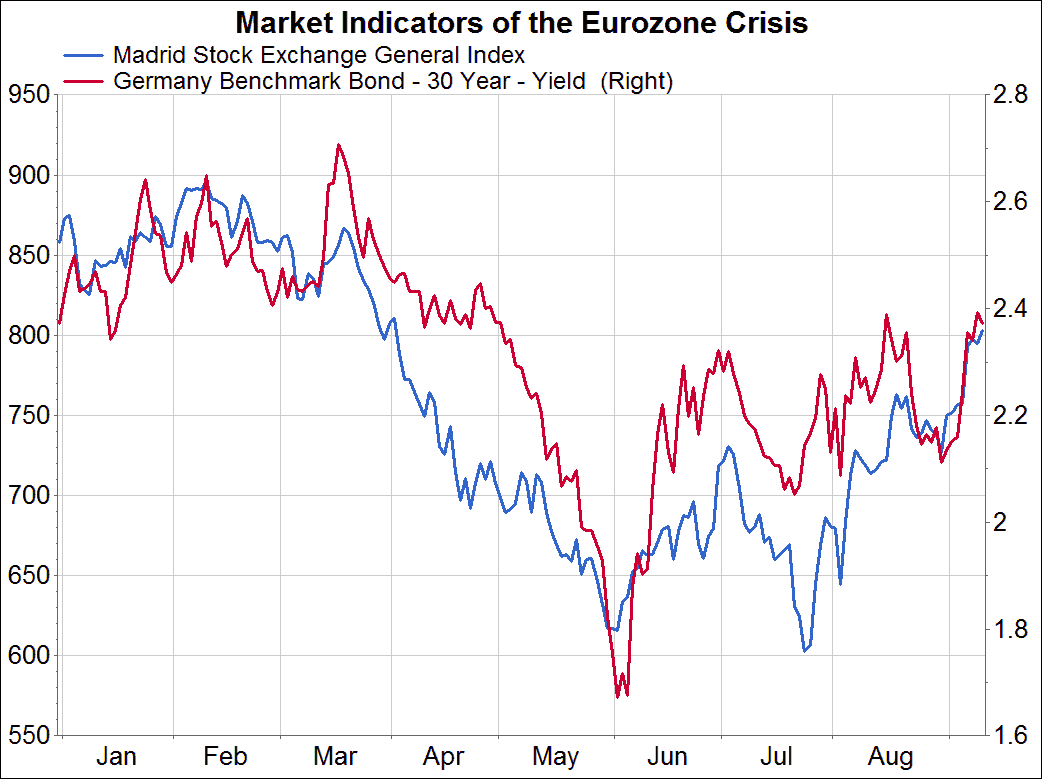
Those markets reacted with relief to the ruling. Share prices and the value of the euro rose, while yields on Spanish and Italian bonds fell. The euro zone will now be "more stable, less risky," said David Thebault, a trader at the Paris-based financial services company Global Equities, in remarks to Reuters.

From the perspective of European leaders, the ruling from the Karlsruhe-based court was the second piece of good news in a week. Last Thursday, Mario Draghi, president of the European Central Bank, announced that the ECB would make unlimited purchases of sovereign bonds of crisis-hit countries on the secondary market to reduce yields. Now, the ESM adds another powerful weapon to the arsenal. The fund can make loans of up to €500 billion ($645 billion) to euro-zone states in crisis.

Taken together, both instruments form the new backbone for the monetary union. They are expected to usher in a long period of calm in the euro crisis. They make betting on a national default or exit from the euro zone suddenly less attractive.

More

Fiscal consolidation and reforms: Substitutes, not complements

by Coen Teulings

Vox

September 13, 2012

Many OECD countries suffer from high sovereign debts. Sooner or later, this problem must be addressed. Many argue that this will require some form of fiscal retrenchment or institutional reform or a combination of the two. This column argues that the two are not complements as many suggest – they are instead substitutes.


Many OECD countries suffer from high sovereign debts. Sooner or later, this problem must be addressed. That will require some form of fiscal retrenchment.

Quite often the fiscal problems are due to market rigidities, barriers to entry, and distortive tax systems. A programme of reform must therefore include both fiscal consolidation and institutional reform to enhance future growth. Growth and the larger tax base that goes with it provides the best prospect for solving the fiscal problems.

The obvious question regards timing. What should have priority: fiscal consolidation or institutional reform? A hard-line reasoning would argue that both should go hand in hand.
  • Immediate fiscal consolidation to convince financial markets that policymakers stand to get the budget under control, and
  • Institutional reform to increase the future tax base.
In this view, fiscal consolidation and institutional reform are complements. I believe the contrary.

The more consolidation is put in place, the smaller the scope for institutional reform. Policymakers therefore face a trade off. The argument does not rely on political fatigue, but on the distribution of wealth between generations:
  • Both consolidation and reform reduce the current generation’s wealth and hence their consumption.
There is a limit to the fall in current consumption that is helpful for the resolution of a country’s fiscal problems.
  • Too sharp a fall in consumption will lead to costly adjustment of production capacity, from consumption goods and non-tradables (which can only be sold on the home market) to investment goods and tradables (which can be sold abroad).
Fiscal consolidation and institutional reform are therefore substitutes, not complements. The more a policymaker focuses on the one, the less scope there is for the other. Whether consolidation takes the form of lower expenditures or higher tax rates does not matter at this stage.

More

Συμφιλιώνοντας τον κ. Στουρνάρα με τον κ. Βαρουφάκη: μια πρόταση οικονομικής πολιτικής

του Γιάννη Ματθαιουδάκη

Το Βήμα

13 Σεπτεμβρίου 2012

H αβεβαιότητα και η κρίση εμπιστοσύνης συγκρατούν τους ξένους επενδυτές και την εγχώρια ιδιωτική πρωτοβουλία. Οι τράπεζες πληγωμένες από την ύφεση και το PSI αποφεύγουν την ανάληψη κινδύνου. Συρρίκνωση 7% του ΑΕΠ για πέμπτη χρονιά. Ανεργία στο 24,5%. Τα έργα έχουν κολλήσει. Από την Ευρώπη τίποτα σε αναπτυξιακό επίπεδο μόνο μεταρρυθμίσεις, εσωτερική υποτίμηση και ισοσκέλιση προϋπολογισμών (αντίθετα η ΕΤΕπ με τον Άκτωρ κάνουν έργα υποδομής στην Αλβανία).

Η ανακύκλωση των πλεονασμάτων του Βορρά στο Νότο και η νομισματικοποίηση των χρεών των χωρών δεν είναι υλοποιήσιμα στο άμεσο μέλλον ενώ οι τρέχουσες εξελίξεις δεν μας αφορούν προς το παρόν. Στο μεταξύ εμείς βρισκόμαστε υπό τον κίνδυνο ολικής κατάρρευσης.

Με την παραπάνω ανάγνωση λίγοι θα διαφωνήσουν. Ωστόσο οι προτεινόμενες λύσεις είναι δυο και μπορούν να συνοψιστούν στο διαλεκτικό σχήμα Στουρνάρας – Βαρουφάκης από τους δύο επιφανείς Καθηγητές Οικονομικής Θεωρίας που συμμετέχουν στα δημόσια πράγματα. Αδρομερώς, υπάρχει η μια άποψη που θέλει να προχωρήσουμε τα μέτρα και να περιμένουμε να αλλάξει κάτι σε ευρωπαϊκό επίπεδο(άποψη κ.Στουρνάρα) και η ακριβώς αντίθετη που θέλει εδώ και τώρα συνολική αναθεώρηση της ευρωπαϊκής πολιτικής απέναντι στην κρίση (άποψη κ. Βαρουφάκη).

Περισσότερα

Wednesday, September 12, 2012

Eurozone relief rally may run its course

by James Mackintosh

Financial Times

September 12, 2012

Relief rallies rarely last. This is a shame, as we have just seen one of the biggest relief rallies on record, at least in eurozone bank shares. After the German constitutional court waved through the eurozone’s new rescue fund on Wednesday, the boost brought the rise in the region’s banks to 50 per cent in 35 trading days.

This is the second-biggest rise over so short a period since the currency began, and brings the banks back to where they were in March, before the latest round of the crisis.

The banks led the way for Europe’s risky assets, which all soared after Mario Draghi’s late-July promise that his European Central Bank would save the euro. Italian and Spanish shares are up a third, the euro briefly passed $1.29 on Wednesday and wider equity markets are up 16 per cent.

More

German Decision on Euro Fund Is Good, But Not Enough

Bloomberg
Editorial
September 12, 2012


The euro dodged another bullet with today’s decision by Germany’s constitutional court not to block the creation of a European Stability Mechanism, the latest just- in-time measure by the continent’s leaders to save the currency. That’s good news, but not enough.

Far from being reassured, Chancellor Angela Merkel should take the decision as the starting point for a campaign to explain to Germans why saving the euro is in their best interest. If that doesn’t work, she should call a referendum on Europe.

Had the judges in Karlsruhe refused to allow the fund’s ratification, Europe’s already sick economy could have imploded, dragging down the rest of the world with it. So the ruling came as a huge relief, cheering the equity markets and boosting the euro.

But the case also shows that Germans remain reluctant as a nation to do “whatever it takes,” in the words of European Central Bank President Mario Draghi, to rescue the common currency. That reluctance on the part of the euro area’s main creditor will probably continue to prevent a lasting solution to the debt crisis.

That needs to change, and the spectacle of global markets, governments and central banks awaiting the words of eight Germans dressed in red robes and white bibs helps explain why.

More

Germany Rejects Blank Check for Euro’s Fiscal Laggards

by David Henry

Bloomberg

September 12, 2012

So there we have it. Germany's constitutional court has ruled that the president can ratify the treaty on euro-area bailouts. With all the enthusiasm of a bride on her way to an arranged marriage, the country's voters can now be dragged kicking and screaming to help finance the European Stability Mechanism.

But the champagne corks may not be popping in peripheral capitals over the court's decision because the conditions imposed only add to those already in place. Euro members that tap the ESM will have to meet tough budget criteria similar to those demanded by the International Monetary Fund of its aid recipients. The question now is whether indebted countries are willing to meet those conditions.

European Central Bank President Mario Draghi took the courageous and laudable step last week of offering to buy an unlimited number of bonds in the secondary market as a way to bring down the borrowing costs of troubled euro members. Again, that type of aid would come with strict conditions. Clearly, the ECB and the German constitutional court have now drawn a line in the sand over measures to help Europe's fiscally challenged nations, five of which have already asked for bailouts.

More

A Setback for Germany's Euroskeptics

by Roland Nelles and Severin Weiland

Spiegel

September 12, 2012

Germany's Federal Constitutional Court has rejected a lawsuit brought by opponents of the euro, and has set only a few conditions for the ratification of the European Stability Mechanism and the fiscal pact. The main proviso is that the ESM cannot increase the scope of Germany's liability without the country's agreement. What will the ruling mean for Berlin and Europe?


The material he had to work with was indeed highly complex, but for a moment, the president of Germany's Federal Constitutional Court even managed to generate a bit of laughter when he announced the decision in Karlsruhe on Wednesday morning. The clamor came at the moment when Andreas Vosskuhle misspoke and stated that the petitions by the plaintiffs had been largely "founded." But it had been a Freudian slip and he quickly corrected himself after a colleague pointed this out, saying "unfounded."

On Wednesday, the petitioners in the case challenging the ratification of the permanent euro bailout fund, the European Stability Mechanism (ESM), and the fiscal pact failed. They included Peter Gauweiler, a conservative member of parliament with the Christian Social Union, the Bavarian sister party to Chancellor Angela Merkel's Christian Democratic Union party, as well as the Left Party.

With its decision, Germany's highest court has remained true to its previous decisions regarding the common currency. So far, the court has not yet not rejected a single measure taken by the government in its efforts to save the euro. As in previous rulings on the euro bailout, the court stipulated the conditions under which the ESM treaty, which will be international law, can be ratified.

More

Key Facts About the ESM

by Matina Stevis

Wall Street Journal

September 12, 2012

Following this morning’s largely positive decision by the German Constitutional Court to allow the treaty establishing the European Stability Mechanism to move to the country’s parliament for ratification, we take a look at what the ESM is, what it will do and what it won’t, and how it fits into the overall euro-zone crisis response.

WHAT IS THE ESM?

The European Stability Mechanism (the full treaty establishing it is here) is the permanent bailout fund that the euro-zone countries are putting together to finance rescue packages for ailing member states. It is the “permanent” institution that will take over from the temporary fund, the European Financial Stability Facility.

The ESM’s managing director will be Klaus Regling. He is German, and is also the boss at the EFSF. Its headquarters will be in Luxembourg.

HOW MUCH MONEY CAN IT LEND?

The 17 euro-zone countries will pay €80 billion in cash into the ESM. That cash–to be paid in installments—will act as a capital cushion, allowing the fund to lend on to members in need several times the amount. Specifically, the ESM will be able to lend €500 billion in total. That’s on top of what the EFSF lends to Greece, Portugal, and Ireland. (*For correction see below.)

The capital installments are planned like this:

In the second half of 2012, €32 billion of capital will allow it to lend €210 billion

In July 2013, another €32 billion will allow it to lend €420 billion

And the remaining €16 billion, due to be paid in in early 2014, will raise the lending capacity to €500 billion.

More

Where the eurozone crisis may go from here

by Lorenzo Bini Smaghi

Financial Times

September 12, 2012

With its decision of September 6 the European Central Bank has taken a large part of the “convertibility risk”, i.e. the risk of a break-up of the eurozone, off the table. Spreads have come down substantially in the following days, especially in Spain and Italy. Today’s decision by the German constitutional court to allow ratification of the bailout programmes should see those spreads come down further still.

The question now is whether countries will decide to activate the ECB’s intervention.

Requesting such programs entails costs and benefits.

The cost is mainly political, due to the stigma attached to any type of IMF or EU support. By asking for support, a government implicitly admits that its previous policies have not succeeded in convincing the markets. The negotiation of an adjustment program and the regular monitoring by the so-called troika (IMF-EU-ECB) is considered to entail a loss of sovereignty. Any government accepting intervention also fears losing political support. And the tougher the conditions attached to a programme, the higher the political cost associated with it.

More

Good week for the euro - but also a warning

by Stephanie Flanders

BBC News

September 12, 2012

The German chancellor says it's a "good day for Germany and a good day for Europe". Better than that, it's been a good week.

First, the European Central Bank delivered on its pledge to do more - possibly quite a lot more - to hold the euro together. Now the German constitutional court has ruled in favour the new European bailout fund, the ESM.

Cue sighs of relief in financial markets around the world. But there's an irony in both decisions which should not be lost on the financial markets or Europe's politicians: the institutions that seem to be most keen to put control over the future of the euro into the hands of the voters are the ones that are least accountable to them.

This is quite clear in the case of the German constitutional court's judgement. As expected, there were conditions attached to the court's decision to allow the ESM to go ahead: Germany's potential liability must remain at the current level of 190bn euros (£152bn; $245bn).

More

Eurozone building blocks are falling into place

by Gavyn Davies

Financial Times

September 10, 2012

Today’s decision from the German Constitutional Court in Karlsruhe is a major victory for Angela Merkel and for Germany’s preferred approach to handling the eurozone crisis. The court has approved the ratification of the ESM treaty, with only minor conditions attached.

It looks like a comprehensive defeat for those trying to mobilise political opinion inside Germany to block the treaty. As a result, the ESM and the fiscal compact can now be safely launched, and any immediate obstacle to Mario Draghi’s bond buying plan at the ECB has disappeared. What has emerged from this messy process is, in effect, an ESM leveraged by the ECB, something which seemed impossible this spring.

This represents a very large building block in the rescue strategy which the eurozone has gradually pieced together in the last three months.

The acute phase of the crisis peaked in mid June with the Greek election, which reduced the probability of a disorderly Greek exit.

Then, the eurozone summit in late June announced a roadmap for the long term reform of the eurozone. Mr Draghi was a co-author of the plan, and in retrospect it was a very important step, not least because he deemed it to be so.

More

Court Allows Germany to Ratify Bailout Fund

Wall Street Journal
September 12, 2012

Germany's highest court Wednesday threw out attempts to delay the country's ratification of the European Stability Mechanism and the so-called "Fiscal Pact" but placed strict conditions on expanding it beyond its foreseen limits.

The ruling, which was broadly as expected, removes a major question mark over two crucial elements of the euro zone's plan to manage its debt crisis. It paves the way for the creation of a permanent bailout mechanism in the region that will be able to provide large-scale financial assistance to heavily indebted euro-zone economies.

The news was welcomed by European and German politicians. The head of the euro zone's college of finance ministers, Jean-Claude Juncker, who is also Prime Minister of Luxembourg, said that following the court's decision he will convene the first meeting of the ESM's board of governors on Oct. 8 in Luxembourg.

More

Read the Press Release of the court

See also

Germany’s Currency Nostalgia Is Badly Off the Mark

by Clive Crook

Bloomberg

September 12, 2012

Let’s hope Germany thinks hard about George Soros’s proposal that it should lead the euro system or leave it. The more carefully Germans study this choice, the more eager they will be to make the present system work.

Many German voters are understandably sick of their euro adventure. The next phase of crisis management, following the European Central Bank’s promise last week to buy the bonds of struggling economies, will demand new fiscal outlays from German taxpayers and expose them to greater risk of losses later. Their growing resentment of Greece, Ireland and Portugal -- and soon Spain and Italy, whose appetite for assistance is vastly bigger -- calls into doubt Europe’s efforts to stem the crisis and threatens the euro’s viability.

Germans might reconsider their nostalgia for the deutsche mark, though, if somebody -- their own government, for instance -- had bothered to spell out the alternatives to the bailouts. Maybe Soros’s intervention will help that to happen.

Up to now, the obvious alternative to keeping Greece and the others afloat within the euro system has been for them to leave or be ejected. This used to be unthinkable but isn’t any longer. The doomsday option has become a bargaining chip that weak and strong countries alike are trying to use.

More

Tuesday, September 11, 2012

ECB Unlimited Support of Bonds

by Patrick Chappatte

New York Times

September 11, 2012

Draghi alone cannot save the euro

by Martin Wolf

Financial Times

September 11, 2012

Last week’s decision by the European Central Bank to make unlimited purchases of government bonds in secondary markets was both necessary and bold. Mario Draghi, the ECB’s president, deserves credit for having obtained agreement for this controversial step, against the sole, albeit significant, opposition of Jens Weidmann, president of Germany’s redoubtable Bundesbank. It is a pity that the ECB did not do this before the crisis in sovereign debt reached Spain and Italy. Yet this delay is not surprising: eurozone policy makers have, perhaps inevitably, done too little, too late.

It is not the ECB’s fault that this action is too little. Its aim is to eliminate the risk of a eurozone breakup forced by the markets. But it cannot achieve this on its own. Ensuring the survival of the eurozone is a political decision. The ECB can only influence, not determine, the outcome.

The rationale offered for the programme of “Outright Monetary Transactions” is ingenious. The ECB insists that it does not aim to finance governments in difficulty. That, it insists, is a mere byproduct. At last week’s press conference, Mr Draghi stated that: “We aim to preserve the singleness of our monetary policy and to ensure the proper transmission of our policy stance to the real economy throughout the area. OMTs will enable us to address severe distortions in government bond markets which originate from, in particular, unfounded fears on the part of investors of the reversibility of the euro.” In making this case, Mr Draghi argued that “you have large parts of the euro area in what we call a ‘bad equilibrium’ ... So, there is a case for intervening ... to “break” these expectations, which ... do not concern only the specific countries, but the euro area as a whole. And this would justify the intervention of the central bank”. This then marks belated acceptance of strong arguments made by the Belgian economist, Paul de Grauwe, at the London School of Economics.

More

Brussels Pushes Forward with EU Banking Union

Spiegel
September 11, 2012

On Wednesday, European Commission President José Manuel Barroso is expected to unveil his plans for a unified banking supervisory system led by the European Central Bank. It is intended to break a vicious cycle of crisis-shaken banks and bailouts. But the plan is facing some resistance from Germany.


José Manuel Barroso wants to present himself as a true president of Europe. Following the example of American presidents, this Wednesday morning he will address the 754 representatives of the European Parliament in Strasbourg, giving a speech on the state of the European Union. He will evoke the dangers of the financial crisis -- and then present a way out.

The representatives in Brussels have been working all summer on this solution: By the end of the year, they plan to have a common banking union in place for the 17 euro-zone countries, a unified supervisory system led by the European Central Bank (ECB) in Frankfurt. The banking union is intended to break a vicious cycle of crisis-shaken banks and governments forced to shell out massive amounts of aid.

"Barroso wants to make it into Europe's history books," says one of his commissioners in Brussels. The president of the European Commission, the EU executive, has taken personal responsibility for creating this new system, taking it out of the hands of Internal Market Commissioner Michel Barnier, to whose portfolio a responsibility like that would usually belong. Barroso wants to turn over supervision of all 6,000 banks in the euro zone to the ECB; he will also present plans for joint bank supervision and for deposit insurance. Both these plans have the same ultimate effect: German savers and taxpayers will be made liable for problems experienced by all euro-zone banks.

More

In a Greek junkyard, signs red tape defeating cuts

Reuters
September 11, 2012

In a sprawling yard in Athens, a yellow Porsche rusts among dusty motorcycles, police cars with bullet holes and wrecked city buses - a telling image of one Greek government agency's slide into bureaucratic quagmire.

Known by its Greek acronym ODDY, the Organisation for Public Property Management ran warehouses nationwide that auctioned off anything from old sofas discarded from city hall waiting rooms to luxury cars confiscated from drug dealers.

Now, efforts to consign ODDY itself to the scrapheap, along with its loss-making payroll costs, show just how hard it is for the Greek government to satisfy foreign creditors' demands that it shut down dozens of state agencies to save money; it may say it is waging war on red tape, but the red tape may be winning.

Set up to offload army surplus after World War Two, ODDY began showing losses a decade ago, squeezed by competition while maintaining dozens of employees on staff. So when some 50 state entities were slated for closure in 2011, ODDY was on the list.

More

European Luminaries: Reflect on Euro 'Seventeen Countries Were Far Too Many'

Spiegel
September 11, 2012

Former German Chancellor Helmut Schmidt and former French President Valéry Giscard d'Estaing are two of the leading architects of the European Union. In a SPIEGEL interview, the veteran statesmen discuss the causes of the euro crisis and the lack of vision among today's European politicians.


Seldom have a German chancellor and a French president seen eye to eye on so many economic and fiscal policy issues as Helmut Schmidt, 93, and Valéry Giscard d'Estaing, 86. During their terms in office, which began in 1974, both had to deal with the oil crisis, stagnating economic growth, rising inflation and unemployment. After the demise of the Bretton Woods international monetary system, in which the dollar served as the world's key currency, they strongly advocated the introduction of the European Monetary System (EMS), with stable yet adaptable exchange rates and the European Currency Unit (ECU), as the standard unit of account.

In 1975, their efforts also led to the founding of the Group of Six (G6), which consisted of the world's leading industrialized countries -- France, Germany, Italy, Japan, the UK and the US -- which met once a year for a global economic summit. After they were voted out of office (Giscard in May 1981, Schmidt in Oct. 1982), they both remained true to their European ideals. In 2001, Giscard was elected chairman of the European Convention, which was tasked with drafting a constitution for Europe. To this day, the two statesmen have maintained a close friendship.

SPIEGEL: Over 30 years ago, you both initiated the establishment of the European Monetary System, which was a decisive preliminary step toward European monetary union. Now, as elder statesmen, do you have reason to fear that you will live to see the collapse of the euro?

Schmidt: The euro will, of course, still exist a few years from now. I am certain that it will outlive me. It could be that it outlives us all, and that is what I assume will happen.

Giscard: The euro will certainly be around longer than us. Your question is interesting because it is highly unusual. Why don't you ask for instance whether the US dollar will still exist in a few years' time, or the Japanese yen or the Chinese yuan?

More

Eνα βήμα προόδου στις μεταρρυθμίσεις

του Στέφανου Κασιμάτη

Καθημερινή

11 Σεπτεμβρίου 2012

Hταν ένα αποφασιστικό βήμα για τις αποκρατικοποιήσεις, που καθυστέρησε εννέα ολόκληρα χρόνια και όταν, επιτέλους, έγινε την περασμένη εβδομάδα πέρασε σχετικά απαρατήρητο. Εννοώ την Πράξη Νομοθετικού Περιεχομένου, που υπεγράφη με απόφαση του υπουργικού συμβουλίου την περασμένη Πέμπτη, βάσει της οποίας όχι μόνο καταργείται το ελάχιστο ποσοστό συμμετοχής του Δημοσίου σε μια σειρά κρατικών επιχειρήσεων (ΔΕΗ, ΕΛΠΕ, ΕΥΔΑΠ, ΕΥΑΘ, ΟΠΑΠ, Οργανισμός Λιμένος Πειραιώς, Θεσσαλονίκης κ. ά.), μα προπαντός καθιερώνεται ο ρυθμιστικός ρόλος των Ανεξαρτήτων Αρχών στη λειτουργία των αγορών από τις οποίες αποσύρεται το Δημόσιο.

Με την ανάθεση ρυθμιστικού ρόλου στις Ανεξάρτητες Αρχές λύνεται κυρίως το πρόβλημα της εκχώρησης σε ιδιώτες των υποδομών και του δικτύου διανομής σε αγορές όπως λ. χ. της ενέργειας. Εφόσον οι Ανεξάρτητες Αρχές θα ορίζουν, πρώτον, το ποσοστό κερδοφορίας από τη χρήση του δικτύου (και όχι την τελική τιμή των υπηρεσιών), δεύτερον, την αναγκαιότητα των επενδύσεων στο δίκτυο και, τρίτον, την ομαλή χρήση του, το δημόσιο συμφέρον από την εκχώρηση σε ιδιώτες υποδομών που δημιουργήθηκαν με δημόσιες επενδύσεις δεκαετιών διασφαλίζεται.

Η σχετική τεχνογνωσία δεν είναι ελληνική επινόηση. Δοκιμάστηκε και τελειοποιήθηκε στη Βρετανία επί κυβερνήσεων Θάτσερ και εφαρμόσθηκε αργότερα με επιτυχία και στις Ηνωμένες Πολιτείες. Στην Ελλάδα, έγινε σοβαρή προσπάθεια για την εισαγωγή της στην τελευταία κυβέρνηση του Κώστα Σημίτη επί υπουργίας Νίκου Χριστοδουλάκη, με αφορμή το σχέδιο ιδιωτικοποίησης της ΔΕΠΑ. Κατά ιστορικώς παράδοξο τρόπο, ωστόσο, η προσπάθεια ματαιώθηκε, όταν την εξουσία ανέλαβε το 2004 η κεντροδεξιά κυβέρνηση του Κώστα Καραμανλή, το πρόγραμμα της οποίας -εμπνεύσεως Γεωργίου Σουφλιά- όριζε την κυριότητα του κράτους στα λεγόμενα «φυσικά μονοπώλια». Eτσι η ευκαιρία χάθηκε και ο κρατικός -στην πραγματικότητα, κομματικός- έλεγχος σε βασικές αγορές διατηρήθηκε.

Ο ρυθμιστικός ρόλος των Ανεξαρτήτων Αρχών σημαίνει ουσιαστικά τη διαπραγμάτευση και, εντέλει, την εξισορρόπηση μεταξύ δημοσίου και ιδιωτικού συμφέροντος, χωρίς την παρεμβολή κομματικών και πελατειακών σκοπιμοτήτων. Eχω την εντύπωση ότι στον τομέα των μεταρρυθμίσεων, μέχρι τώρα τουλάχιστον, η συγκεκριμένη απόφαση του υπουργικού συμβουλίου είναι το σημαντικότερο έργο τούτης της κυβέρνησης και οφείλεται, προφανώς, στην παραγωγική συνεργασία του Αντώνη Σαμαρά με τον Γιάννη Στουρνάρα.

Περισσότερα

Monday, September 10, 2012

Democracy loses in struggle to save euro

by Gideon Rachman

Financial Times

September 10, 2012

The European Central Bank has fired its magic bullet. By promising “unlimited” purchases of sovereign bonds, Mario Draghi, the ECB’s president, may have kept his pledge to do “whatever it takes” to save the euro. But in rescuing the currency, Mr Draghi’s magic bullet has badly wounded something even more important – democracy in Europe.

As a result of the ECB’s actions, voters from Germany to Spain will increasingly find that crucial decisions about national economic policy can no longer be changed at the ballot box. In Germany, in particular, there is a growing realisation that the ECB, an unelected body that prides itself on its independence from government, has just taken a decision that has profound implications for German taxpayers – but one that they cannot challenge or change.

Previous European bailouts had to be approved by the German parliament and were subject to review by the German courts. Indeed the German supreme court will rule on the constitutionality of the most recent bailout, tomorrow. But the ECB’s decision to accept unlimited bond purchases is immune to such democratic controls. The bank cannot be overruled by the German parliament. And because it is an EU institution, the ECB cannot be checked by the German courts – only by the European Court of Justice.

At the ECB, the president of the German central bank has just one vote – the same as the presidents of the central banks of Malta or Slovenia. Jens Weidmann, the head of the Bundesbank, cast the sole vote against the bond-buying plans.

More

Eurostat: Αύξηση 50% της ανεργίας στους νέους την τελευταία πενταετία

Το Βήμα
10 Σεπτεμβρίου 2012

Κατά 50% αυξήθηκε η ανεργία των νέων ηλικίας 15- 24 ετών στην Ευρωπαϊκή Ένωση από την έναρξη της οικονομικής κρίσης, σύμφωνα με έκθεση της Ευρωπαϊκής Επιτροπής.

Όπως επισημαίνεται στην έκθεση, η ανεργία των νέων στην Ευρώπη αυξήθηκε από έναν μέσο όρο 15% τον Φεβρουάριο του 2008, σε 22,5% τον Ιούλιο του 2012.

Τα τελευταία στοιχεία που δημοσίευσε η Eurostat δείχνουν ότι τα υψηλότερα ποσοστά ανεργίας των νέων αφορούν την Ελλάδα (53,8%) και την Ισπανία (52,9%).

Σε όλη την ΕΕ, πάνω από το 30% των άνεργων νέων ήταν άνεργοι για περισσότερο από ένα χρόνο.

Στην έκθεση της Επιτροπής ζητείται να καταστούν η απασχόληση των νέων, η κοινωνική ένταξη, η υγεία και η ευημερία των νέων, βασικές προτεραιότητες της ευρωπαϊκής πολιτικής για τη νεολαία.

Υπογραμμίζεται ακόμη ότι η ΕΕ και τα κράτη- μέλη πρέπει να καταβάλουν μεγαλύτερες προσπάθειες για την υποστήριξη των νέων, οι οποίοι υφίστανται σε μεγαλύτερο βαθμό τις συνέπειες της οικονομικής κρίσης.

Περισσότερα

Lazaridis: Investors Have More Faith in Greece

Bloomberg
September 10, 2012

Socrates Lazaridis, chief executive officer of Hellenic Exchanges, discusses foreign investment in Greece. He appeared on Bloomberg Television's "Countdown" on September 7.


More

Super Mario to the Rescue

by Roger Cohen

New York Times

September 6, 2012

Germany’s Mannschaft has always been a formidable soccer team. Its chief quality has been a tenacity and tempo capable of overcoming all odds. This is not to say that Germany has failed to produce great footballers — Gerd Müller, Karl-Heinz Rummenigge and Franz Beckenbauer come to mind. It is merely to say collective power has trumped individual prowess.

But against one team Germany always breaks down as if caught in a web. It pushes, it presses, it pounds — and it flounders. That team is Italy, whose 2-1 victory over the favored German side in this year’s European Championship extended a long run of major-tournament domination over Germany. Italian malleability and artistry are too much for German diktat.

All of this comes to mind as I watch Super Mario undo Germany with a series of feints that have left hardline Bundesbank bruisers looking as nimble and effective as beached whales. (With a battle cry of “You will not short me!” Super Mario has also gone mano-a-mano with the hedgies betting against the euro, but that is another story.)

Little by little, Mario Draghi, the Italian president of the European Central Bank, has taken an institution whose overriding mission was to keep inflation in check — the obsession that built the Deutsche Mark — and turned it into a lender of last resort prepared to throw everything into buying the distressed euro-zone sovereign debt of countries like Spain and Italy and so preserve the euro. “Whatever it takes,” Draghi says. He means it.

More

Why ECB Bond-Buying Plans Undermine Democracy

by Armin Mahler

Spiegel

September 10, 2012

The ECB's plan to restart its bond-buying program is possibly the most important decision of the euro crisis. But the bank is not subject to control by national parliaments. Europe's leaders seem to consider saving the euro to be more important than preserving democracy.


Anyone who breaks a law can hardly excuse his actions by claiming that he is acting within the scope of the law. In any case, it won't help him much -- unless his name is Mario Draghi and he is the president of the European Central Bank (ECB).

The ECB is politically independent, but it is not above the law. It is only independent within its mandate, which is clearly defined by the European treaties: The central bank is tasked with safeguarding price stability in the euro zone -- no more and no less.

Draghi wants more, though; he wants to save the European common currency at all costs. The euro, he says, is "irreversible."

Many similar statements have already been made over the course of the euro rescue. There is no alternative to the measures that have been agreed, said German Chancellor Angela Merkel. But aside from the fact that there are always alternatives, the chancellor has been democratically legitimized; anyone who disagrees with her actions can punish her at the polls in the next election.

More

Greece's Governing Coalition Seeks New Cuts

Wall Street Journal
September 10, 2012

International inspectors from the IMF, the European Central Bank and the European Commission, rejected parts of Greece's proposed austerity plan, forcing the country's coalition government to seek fresh spending cuts. Alkman Granitsas and Costas Paris discuss.


More

Why Merkel Wants To Keep Greece in Euro Zone

Spiegel
September 10, 2012

Angela Merkel has made a surprising U-turn in her policy on Greece. The German chancellor now wants to stop Athens from leaving the euro zone at all costs -- even if it means massaging the figures in the upcoming troika report. For the German leader, it is essential to avoid the consequences of a Grexit before national elections next year.


Mantras are short, formulaic phrases that are repeated over and over for meditative purposes. They can be spoken, sung, whispered, recited mentally or even written down and eaten.

The German chancellor has recently opted for the spoken variety, which is the conventional form. Angela Merkel's mantra consists of a short German sentence. It translates as: "We are waiting for the troika report." She repeats it whenever the opportunity arises -- such as two weeks ago, when Greek Prime Minister Antonis Samaras visited Berlin.

One doesn't need to be a rocket scientist to see through Merkel's maneuver: The chancellor wants to buy time. She hopes to calm the general public and the notoriously nervous financial markets through meditative repetition -- and ultimately create the impression that it actually matters what the troika finds out during its mission to Greece.

But it doesn't. In reality, Merkel has already made up her mind. After long hesitation, she has sided with French President François Hollande and the European Commission. The report from the troika -- which consists of the European Commission, the International Monetary Fund (IMF) and the European Central Bank (ECB) and which departed on its fact-finding tour last week -- will undoubtedly conclude that Greece can remain in the euro zone.

More

German Court Holds Bailout Fund's Fate

Wall Street Journal
September 9, 2012

Eight judges in a sleepy German town on Wednesday will decide whether to torpedo European leaders' strategy for taming the euro-zone debt crisis.

The German government and most legal analysts predict the country's constitutional court won't block the currency bloc's planned permanent bailout fund, the European Stability Mechanism. If they are wrong, however, the euro zone could find itself short of authorized funds to prop up struggling members such as Spain, forcing Europe to redesign its safety net for crisis-hit countries.

The Karlsruhe-based court is deciding only whether to grant a preliminary injunction that would suspend Germany's ratification of the ESM, pending a full ruling on whether the ESM is compatible with Germany's constitution, expected in December. But analysts say Wednesday's verdict will send a clear signal about the court's final decision.

More

Jobless Greeks Resolved to Work Clean Toilets in Sweden

by Oliver Staley

Bloomberg

September 10, 2012

As a pharmaceutical salesman in Greece for 17 years, Tilemachos Karachalios wore a suit, drove a company car and had an expense account. He now mops schools in Sweden, forced from his home by Greece’s economic crisis.

“It was a very good job,” said Karachalios, 40, of his former life. “Now I clean Swedish s---.”

Karachalios, who left behind his 6-year-old daughter to be raised by his parents, is one of thousands fleeing Greece’s record 24 percent unemployment and austerity measures that threaten to undermine growth. The number of Greeks seeking permission to settle in Sweden, where there are more jobs and a stable economy, almost doubled to 1,093 last year from 2010, and is on pace to increase again this year.

“I’m trying to survive,” Karachalios said in an interview in Stockholm. “It’s difficult here, very difficult. I would prefer to stay in Greece. But we don’t have jobs.”

Greece is in its fifth year of recession, with the economy expected to contract 6.9 percent this year, the same as in 2011, according to the Athens-based Foundation for Economic and Industrial Research. Since 2008, the number of jobless has more than tripled to a record 1.22 million as of June, out of a total population of 10.8 million.

“In Greece, there was no future,” said Ourania Michtopoulou, who moved with her husband to Sweden in 2010 after both lost textile industry jobs in Thessaloniki, where they had a comfortable life with a house and car. “Here, I can hope for something good to happen. Maybe not for me -- I’m 48 -- but maybe for my children.”

More

Sunday, September 9, 2012

Primary Greek tax evaders are the professional classes

by Phillip Inman

Guardian

September 9, 2012

There is one good reason for Greece to stay in the euro: to combat corruption. It is a sad fact that the country is riddled with it and needs outside pressure and support to sort things out. Athens is not the only place in Europe wrestling with corruption, but we'll come to that later.

Even if Greece and its prime minister, Antonis Samaras, could overcome the huge loss of pride and reap some of the economic benefits of quitting the single currency, they would still be left with a corrupt economy, much of which strengthens the power of unions and trade associations.

City economists tend to ignore the problem when they assess the pros and cons of euro membership. They have arrived at the collective opinion that leaving the eurozone is the best, if not the only, option for Athens. Central to the argument is that an independent drachma would immediately be devalued, making Greek exports more competitive and at a stroke wiping out many, if not all, of the country's debts.

More

Εισόδημα €7.500 δήλωσαν 457.377 επαγγελματίες!..

Το Βήμα
9 Σεπτεμβρίου 2012

Σοκ προκαλούν τα στοιχεία του υπουργείου Οικονομικών, καθώς 6 στους 10 επαγγελματίες, εμπόρους, βιοτέχνες δήλωσαν το 2011 εισοδήματα κάτω από το αφορολόγητο όριο των 12.000 ευρώ. Το μέσο ατομικό εισόδημα 457.377 επιτηδευματιών (σε σύνολο 779.319) δεν ξεπέρασε τα 7.500 ευρώ, δείχνοντας πόσο βαθύ είναι το πρόβλημα της φοροδιαφυγής στην Ελλάδα.

Σύμφωνα με τα στοιχεία που έχει στα χέρια του ο υπουργός Οικονομικών Γιάννης Στουρνάρας μόλις 36.443 επιτηδευματίες δήλωσαν το 2011 μέσο ατομικό εισόδημα πάνω από 30.000 ευρώ, ενώ, αντίθετα, πολύ χαμηλά εισοδήματα δήλωσαν κατηγορίες επαγγελματιών που βρίσκονται κάθε τόσο στις πρώτες θέσεις της φοροδιαφυγής.

Γνωστές επαγγελματικές ομάδες δηλώνουν κατά μέσο όρο εισοδήματα κάτω και από το όριο της φτώχειας, δηλαδή κάτω από 7.400 ευρώ ετησίως.

Την ίδια στιγμή το ΣΔΟΕ σε ελέγχους που πραγματοποιεί ανά την επικράτεια διαπιστώνει ότι σταθερά ένας στους δύο επιτηδευματίες φοροδιαφεύγει, ενώ κάποιοι έχουν βγάλει εκατομμύρια ευρώ στο εξωτερικό με τραπεζικά εμβάσματα, ποσά τα οποία δεν δικαιολογούνται από τα δηλωθέντα εισοδήματά τους.

Η Γενική Γραμματεία Πληροφοριακών Συστημάτων επεξεργάστηκε τα στοιχεία του συνόλου των επαγγελματιών, των εμπόρων και των βιοτεχνών ανά Κωδικό Αριθμό Δραστηριότητας (ΚΑΔ) και τα συμπεράσματα είναι πράγματι εξοργιστικά, ειδικά για ορισμένες κατηγορίες επαγγελματιών που όταν τους ζητούν οι πελάτες τους απόδειξη δυσανασχετούν.

Περισσότερα

Saturday, September 8, 2012

Ηττήθηκαν οι δογματισμοί

του Πάνου Καζάκου

Τα Νέα

8 Σεπτεμβρίου 2012

Οι ανακοινώσεις Ντράγκι έδειξαν για άλλη μια φορά ότι το θεσμικό σύστημα και η πολιτική στην ΕΕ εξελίσσονται κάθε φορά που αντιμετωπίζουν κρίσεις. Οι ανακοινώσεις του επικεφαλής της Ευρωπαϊκής Κεντρικής Τράπεζας (ΕΚΤ) συμπληρώνουν σειρά άλλων πρόσφατων πρωτοβουλιών όπως π.χ. της αναπτυξιακής δέσμης του Ιουλίου 2012 και των μέτρων που συνοψίζουμε κάτω από τον όρο «τραπεζική ένωση - κοινή εγγύηση» καταθέσεων ώστε να ανακοπεί η φυγή τους από τις τράπεζες του Νότου, συγκεντρωτική εποπτεία των τραπεζών κ.ά. Υπηρετούν αλληλένδετους στόχους.

Συνοπτικά, και παραβλέποντας τις τεχνικές λεπτομέρειες, κεντρικό στοιχείο των ανακοινώσεων Μ. Ντράγκι είναι ότι η ΕΚΤ θα αγοράζει ομόλογα μέχρι τριετούς διάρκειας (δηλαδή βραχυπρόθεσμους τίτλους) από τη λεγόμενη δευτερογενή αγορά. Αλλά η παρέμβαση θα συνοδεύεται από αυστηρούς όρους οικονομικής πολιτικής και θα διακόπτεται αν δεν εφαρμόζονται τα σχετικά προγράμματα μακροοικονομικής προσαρμογής. Ουσιαστικά, καθιερώνεται μια συντονισμένη παρέμβαση της ΕΚΤ και του Ευρωπαϊκού Μηχανισμού Σταθερότητας (EMΣ), με άλλα λόγια γίνεται σύζευξη της νομισματικής πολιτικής με τη δημοσιονομική πειθαρχία σε ευρωπαϊκό επίπεδο.

Ενδιαφέρον έχει η αιτιολόγηση των αποφάσεων της ΕΚΤ: θεωρήθηκαν αναγκαίες για να σταματήσει ο φαύλος κύκλος που προκαλούσαν οι ίδιες οι χρηματοπιστωτικές αγορές. Αυτές, αδικαιολόγητα κατά τον Ντράγκι, αμφισβητούσαν τη βιωσιμότητα του ευρώ, με βάση αυτήν την αμφισβήτηση απαιτούσαν υψηλά επιτόκια που με τη σειρά τους υπονόμευαν το ευρώ! Ουσιαστικά οι δηλώσεις αυτές αποτελούσαν ευθεία κριτική στον ανορθολογισμό των εν λόγω αγορών. Σημειώστε ότι η ΕΚΤ δεν θα εξαρτά τις αποφάσεις της από τις αξιολογήσεις των διαφόρων οίκων αξιολόγησης χωρών.

Περισσότερα

Greece: The pain behind the beauty

by Mark Lowen

BBC News

September 8, 2012

Holidaymakers in Greece this summer said the beaches were as lovely as ever and the ancient sites as fascinating as they have always been. But the effects of five years of recession in the country are becoming more and more evident.

I get a little tired after a while of the endless sheet-washing, itinerary-planning and bread-buying but then, living abroad, you come to expect it.

For every summer, my humble apartment in whichever country I am posted, turns into a convenient hotel for friends, family and anybody I may have met at a party years ago, who decides they fancy a free stay.

It can get a little trying but, on the whole, I enjoy showing my guests a new city through my eyes, taking them to my favourite spots. Seeing their reaction is the interesting bit.

And nowhere more so than in Athens.

For months they have watched footage of angry street protests in the capital and heard stories of the impact of austerity. They come expecting the place to look and feel almost like a war zone.

When a visitor of mine this summer told his colleagues he was going to Athens for a few days, one seriously asked whether he would still find food in the shops.

"Where is the crisis?" said a university friend as I took him around the city. "You can't see it."

More

Why Germany Should Lead or Leave

by George Soros

Project Syndicate

September 8, 2012

Europe has been in a financial crisis since 2007. When the bankruptcy of Lehman Brothers endangered the credit of financial institutions, private credit was replaced by the credit of the state, revealing an unrecognized flaw in the euro. By transferring their right to print money to the European Central Bank (ECB), member countries exposed themselves to the risk of default, like Third World countries heavily indebted in a foreign currency. Commercial banks loaded with weaker countries’ government bonds became potentially insolvent.

There is a parallel between the ongoing euro crisis and the international banking crisis of 1982. Back then, the International Monetary Fund saved the global banking system by lending just enough money to heavily indebted countries; default was avoided, but at the cost of a lasting depression. Latin America suffered a lost decade.

Germany is playing the same role today as the IMF did then. The setting differs, but the effect is the same. Creditors are shifting the entire burden of adjustment on to the debtor countries and avoiding their own responsibility.

The euro crisis is a complex mixture of banking and sovereign-debt problems, as well as divergences in economic performance that have given rise to balance-of-payments imbalances within the eurozone. The authorities did not understand the complexity of the crisis, let alone see a solution. So they tried to buy time.

More

Why early sovereign default could save the euro

by Harald Hau and Ulrich Hege

Vox

September 8, 2012

The recent announcement by the ECB that it will start to buy Spanish and Italian sovereign debt has been warmly welcomed throughout Europe. But this column argues that by doing so the ECB is digging the euro’s grave. It says the solution is default, either through inflation or debt restructuring – and that debt restructuring has many advantages if it is done early enough.


The crisis in the Eurozone is primarily a debt crisis. Debt overhang, whether public or private (as it originally was in Ireland and Spain), impedes investment and growth (Reinhart and Rogoff 2010). And it diminishes incentives for fiscal rigor if the benefits accrue mainly to creditors, and aggravates the macroeconomic effects of austerity if much of the additional saving that deleveraging requires is transferred to creditors abroad. Low growth and capital flight reinforce the debt problem and create a downward spiral, from which belated budgetary austerity provides no exit.

Any strategy of dealing with the Eurozone crisis therefore must be evaluated in light of its effectiveness in dealing with the debt overhang problem. Two solutions are possible.
  • Inflation reduces the real value of nominal debt, lowering the debt burden both on the sovereign and all other debtors.
An unanticipated inflation increase of three percentage points amounts to a 34% (compounded) debt relief on a ten-year bond; little of the government debt in question is inflation-indexed (less than 8% in Italy and none in Spain). But such relief hits all investors alike, independent of the solvency of their respective debtors.
  • Or sovereign default writedowns of the face value and interest payments or reprofiling of such payments. These can take various forms.
For example, exchanges of short-run debt for long-run debt and adjustments of the interest payments can help restore sustainability to debt dynamics.

More

Μεταχρονολογημένης επιταγής εγκώμιον

του Γιώργου Προκοπάκη

Protagon.gr

8 Σεπτεμβρίου 2012

Στην ελληνική οικονομία συνέβαινε μια παγκόσμια πρωτοτυπία (τουλάχιστον ως προς την έκτασή της). Επί χρόνια η αγορά ζούσε με ένα σημαντικό μέρος του τζίρου της σε μεταχρονολογημένες επιταγές. Η χρηματοδότηση της ρευστότητας γινόταν:

1. Από τις τράπεζες με το πιστωτικό όριο που έδινε κάθε τράπεζα στον επιχειρηματία πελάτη της – ουσιαστικά κυλιόμενα και ανακυκλούμενα δάνεια.

2. Από την ίδια την αγορά, η οποία αποδεχόμενη τις μεταχρονολογημένες επιταγές των δραστηριοποιούμενων στο πλαίσιό της, παρείχε ουσιαστικά το ισοδύναμο των κεφαλαίων κίνησης.

Η αγορά η ίδια λοιπόν παρείχε το «φθηνό χρήμα» στους επιχειρηματίες που ξεπερνούσε τις δυνατότητες των τραπεζών ή αρνιόταν να παράσχει το τραπεζικό σύστημα. Εκτιμήσεις ανεβάζουν τις δύο γραμμές χρηματοδότησης σε περίπου €30 δισ την κάθε μία, μέχρι τις αρχές της κρίσης. Δηλαδή, η αγορά, με τα επίπεδα φερεγγυότητας στα οποία είχε ισορροπήσει, είχε φτιάξει εκ των ενόντων ένα δεύτερο σύστημα βραχυχρόνιων χορηγήσεων. Ας θυμηθούμε πως κάθε τόσο έβγαινε στις εφημερίδες η είδηση ότι «οι ακάλυπτες επιταγές έφτασαν το τάδε ποσόν». Το ποσό αυτό μέχρι το 2009 ήταν της τάξεως των €100 με €150 εκατ. Τα «κόκκινα δάνεια» μέσα στην ίδια την αγορά ήταν μόλις μισό τοις εκατό! Ο μόνος λόγος που οι τράπεζες δεν ζήλευαν τις επιδόσεις της ίδιας της αγοράς, ήταν οι εγγυήσεις που έπαιρναν από τους πελάτες τους και οι οποίες κάτι άξιζαν. Το ενδιαφέρον βέβαια είναι πως, οι μεν χορηγήσεις των τραπεζών καταγράφονταν, έστω διαχεόμενες, στα βιβλία των τραπεζών. Το σύστημα χορηγήσεων με τις μεταχρονολογημένες επιταγές, υπήρχε, κινούσε (σε κάποιο βαθμό) την οικονομία, αλλά δεν καταγραφόταν πουθενά. Κι όμως ήταν καθημερινή πρακτική. Είναι χαρακτηριστικό πως η ελληνική νομοθεσία δεν αναγνωρίζει την έννοια «μεταχρονολόγηση» στις επιταγές. Αν πήγαινε όμως κάποιος να εισπράξει μια μεταχρονολογημένη επιταγή πριν την ώρα της, η ίδια η τράπεζα, παρανομούσα, τον έδιωχνε! Κυρίως, γιατί μετείχε σ’ αυτό το σύστημα παρα-χορηγήσεων «σπάζοντας» στο 80% τις επιταγές πελατών της. Ισορροπία του συστήματος!

Περισσότερα